
Modi urges Putin to halt Ukraine war as SCO summit highlights shifting global alliances
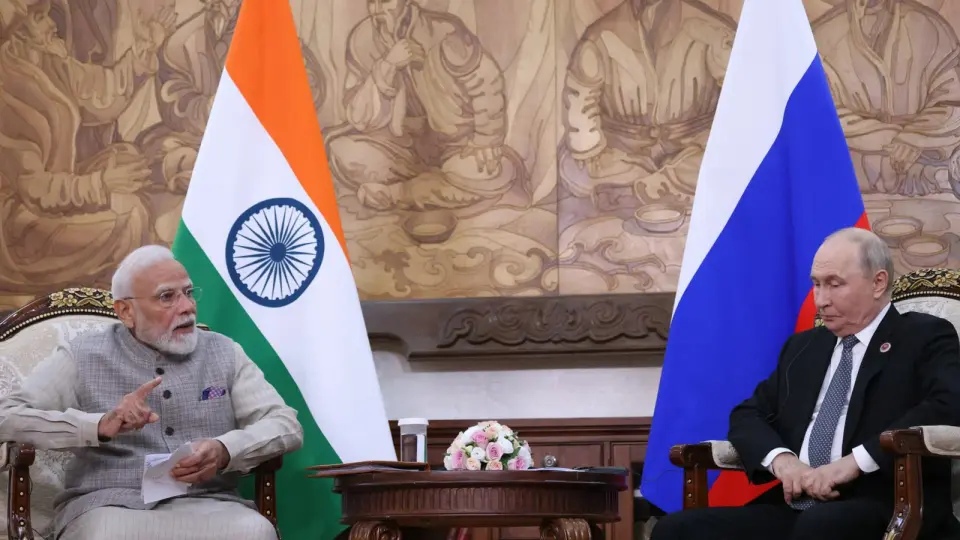
Indian Prime Minister Narendra Modi urged Russian President Vladimir Putin to end the war in Ukraine during the Shanghai Cooperation Organisation (SCO) summit in Bishkek, Kyrgyzstan. Modi emphasized the need for a cessation of hostilities, stating that the ongoing conflict harms humanity. This diplomatic push occurs as India faces potential U.S. tariffs of up to 100% for purchasing Russian crude oil. Meanwhile, China and Russia reaffirmed their strategic alliance, and the summit highlighted growing multipolar dynamics amid ongoing conflicts in Ukraine and Iran.
Key points
- Modi called for an end to the Ukraine war, stating that 'every day that the war continues, humanity takes a step backwards.'
- India’s reliance on Russian crude has surged, accounting for over 50% of its oil imports in June and July 2026, driven by a global energy shortage from the Iran war.
- The U.S. House is expected to pass the Graham bill, which imposes up to 100% tariffs on countries buying Russian oil, including India and China.
- China and Russia reaffirmed their strategic alliance, with Xi Jinping describing bilateral ties as 'more solid' despite global uncertainty.
- Russia’s Defense Ministry announced plans for 'massive strikes' on Ukraine’s energy infrastructure, following a deadly attack on an ammunition warehouse that killed 38 people.
Background
India has increasingly turned to Russian crude as global energy markets shifted due to the Iran war. Previous coverage noted that Russia, facing domestic fuel shortages from Ukrainian drone strikes on refineries, had even imported petrol from India. Additionally, Kremlin economists have warned of a potential social crisis due to the economic strain of the prolonged Ukraine war. The current SCO summit marks the 25th anniversary of the bloc, which now includes 10 members and 15 dialogue partners, representing over 40% of the world’s population.
How outlets are covering it
CNBC focuses on the diplomatic tension between India’s call for peace and the looming U.S. tariff threat, highlighting India’s heavy dependence on Russian oil. Al Jazeera emphasizes the reaffirmation of the Russia-China strategic alliance, noting that Xi and Putin discussed economic ties more than the Ukraine war, which they addressed only 'in passing.' Euronews frames the summit as a broader shift toward a multipolar world, where middle powers like India and Turkey seek new economic and political momentum away from Western-led orders. While all sources agree on the SCO’s significance, they differ in emphasis: CNBC on energy and tariffs, Al Jazeera on the Russia-China axis, and Euronews on global realignment.
Why it matters
The SCO summit underscores the growing influence of non-Western powers in shaping global energy and security policies. India’s balancing act between its energy needs and U.S. pressure highlights the complex dynamics of multipolar diplomacy. The potential passage of the Graham bill could significantly impact global oil trade, while the Russia-China alliance signals a consolidated front against Western sanctions. These developments may reshape energy markets and geopolitical alliances in the coming years.
What to watch
The U.S. House is expected to vote on the Graham bill later this month, which could impose severe tariffs on India and China for purchasing Russian oil. India may seek to increase imports of Venezuelan crude to replace Russian barrels, as the U.S. has pushed for this shift. Russia’s planned strikes on Ukraine’s energy infrastructure could escalate the conflict, potentially leading to a harsher winter for Kyiv. The SCO summit’s outcomes, including the establishment of a Development Fund, may further solidify economic ties among member states.
- Indian Prime Minister Modi asks Putin to end Ukraine war amid U.S. tariff threat on Russian oil CNBC
- Summit With Russia, India and Iran Shows Leverage Wars Have Given Xi of China The New York Times
- Putin, Xi reaffirm Russia-China ties amid ‘unpredictable’ world aljazeera.com
- Eurasian nations gather in Bishkek to forge stronger ties, new alliances Euronews.com
- India's Modi tells Russia's Putin that the war in Ukraine must end for humanity's sake Reuters
Want the full story? Read the original reporting
Read on CNBC