
Pyongyang Claims 900km Hypersonic Test, But Seoul and Tokyo Detect Shorter Flights
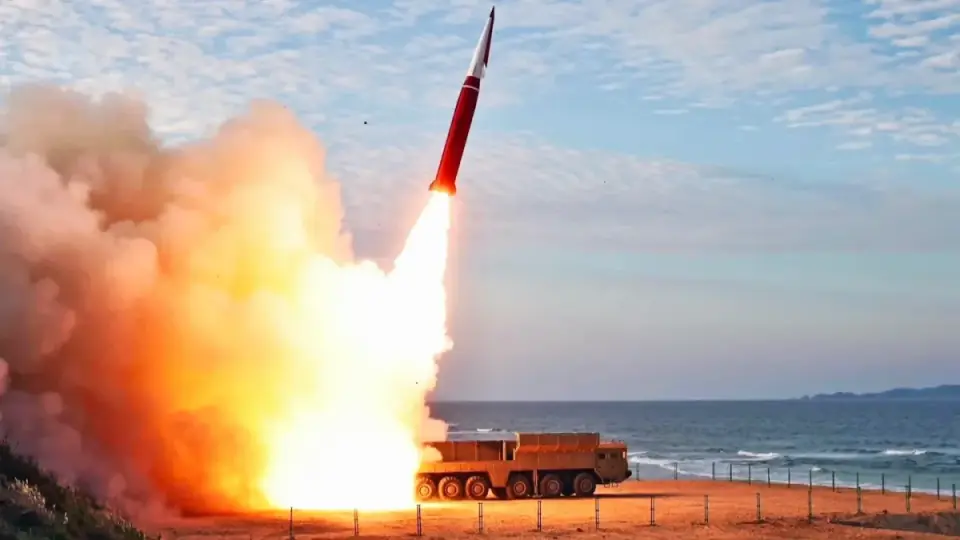
North Korea claims a successful test of the Hwasong-11Ma-1 hypersonic glide vehicle, but independent tracking by South Korea and Japan suggests the missiles traveled significantly shorter distances than Pyongyang reported.
Key points
- North Korea state media released images of a September 20 launch of the Hwasong-11Ma-1, described as an updated version of a hypersonic missile first shown in October 2025.
- Pyongyang claims the missile traveled 908.2 kilometers at a speed of 2,146 meters per second, but South Korean and Japanese authorities assessed the two launches as traveling approximately 450-600 kilometers.
- The test was observed by Kim Jong Un and his daughter, Kim Ju Ae, from a coastal site near Anbyon County, south of Wonsan.
- The new missile is mounted on a six-axle transporter-erector-launcher, an upgrade from the five-axle vehicle used when the weapon was first displayed.
- Analysts note that while the claimed speed is hypersonic, the discrepancy in range data raises questions about the accuracy of Pyongyang's reported figures.
Background
This test follows a pattern of North Korean missile launches timed around U.S.-South Korea military drills, such as the Ulchi Freedom Shield exercises in August 2026. Pyongyang has previously tested hypersonic glide vehicles on different boosters, including the Hwasong-8 and Hwasong-16B, but independent verification of their maneuverability and accuracy remains limited.
How outlets are covering it
The War Zone and NBC News highlight the political significance of the test, noting Kim Jong Un's presence and his statement that the weapon would give enemies an 'incurable headache.' However, The War Zone emphasizes the technical discrepancy between North Korea's claimed range of 908.2 km and the 450-600 km range assessed by South Korea and Japan, suggesting Pyongyang may have altered data to portray success. Space.com focuses on the broader context of North Korea's push for 'ultra-modern' defense technology, while noting that the KCNA report initially did not specify the weapon type, relying on analyst interpretation of the imagery.
Why it matters
The Hwasong-11Ma-1 represents an attempt to combine a compact short-range ballistic missile with a maneuvering hypersonic glide vehicle, potentially complicating defense systems in South Korea. The discrepancy in reported ranges highlights the ongoing challenge of verifying North Korea's military claims and the strategic importance of hypersonic weapons in regional deterrence.
What to watch
Analysts will continue to assess the technical capabilities of the Hwasong-11Ma-1, particularly its maneuverability and accuracy, while South Korea, Japan, and the U.S. monitor for further tests. The discrepancy in range data may lead to further scrutiny of North Korea's reporting practices and the actual operational readiness of its hypersonic weapons.
- North Korea Tests New Hwasong-11Ma Hypersonic Missile TWZ
- North Korea reports new missile test designed to give enemy ‘incurable headache’ NBC News
- North Korea conducted test of upgraded rocket launcher system, KCNA says Reuters
- Hypersonic weapon test? North Korea says it just launched a new 'ultra-modern' missile Space
- North Korea Tests New Hypersonic Missile USNI News
Want the full story? Read the original reporting
Read on TWZ