
Turkey, Saudi Arabia, and Pakistan Detail Operational Framework for New Collective Defense Pact
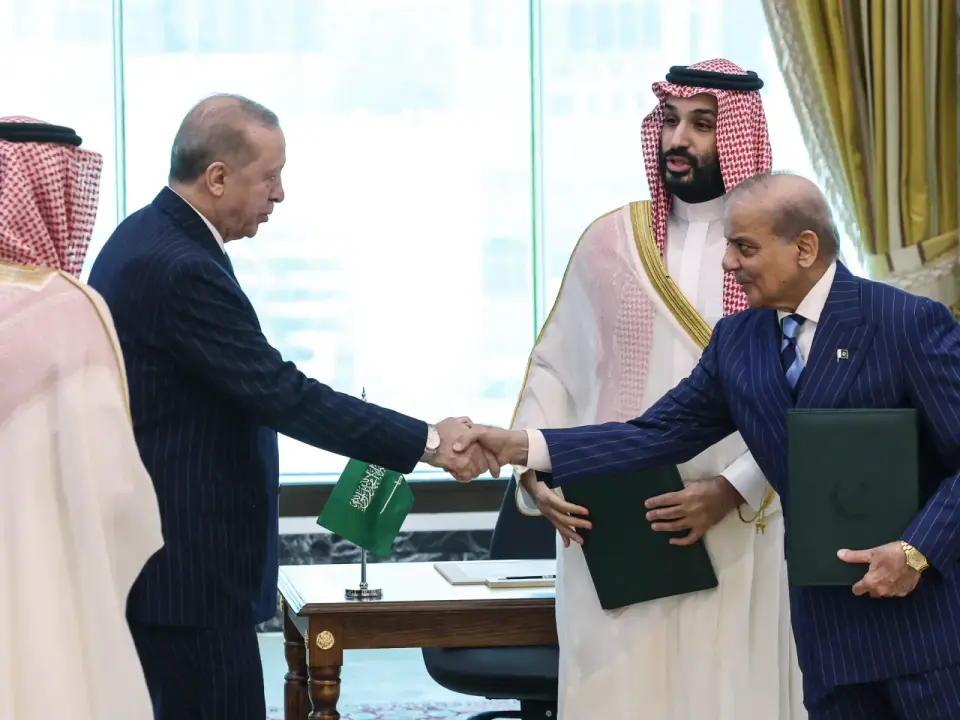
Turkiye, Saudi Arabia, and Pakistan have outlined the operational structure of their new collective defense pact, signed in Mecca on August 7, 2026. The agreement, which mirrors NATO’s Article 5 by treating an attack on one member as an attack on all, will establish joint ministerial committees, conduct combined military exercises, and deepen defense industry cooperation. While the pact aims to institutionalize security ties and enhance deterrence, analysts debate whether it represents a genuine security bloc or a supplementary measure to existing U.S. partnerships. The agreement includes provisions for a Saudi-based secretariat and prioritizes cooperation in unmanned systems and artificial intelligence, with potential expansion to other regional states like Egypt.
Key points
- The Mecca Joint Defence Agreement, signed on August 7, 2026, establishes a mutual defense clause where an armed attack against any of the three signatories is considered an attack against all.
- Turkiye’s defense ministry announced the creation of strategic political and military mechanisms involving defense ministers, foreign ministers, and chiefs of staff to coordinate at the highest level.
- Planned joint exercises will involve land, naval, and air forces, with a focus on air defense, unmanned systems, electronic warfare, and artificial intelligence capabilities.
- The pact includes provisions for joint development and production in the defense industry, moving beyond simple product supply to include technology cooperation and logistics support.
- A general secretariat for the alliance will be based in Saudi Arabia, and negotiations for the agreement took two years and eight months to finalize.
- Turkiye’s Foreign Minister Hakan Fidan stated the pact is technically similar to NATO’s Article 5 but allows for consultation on the degree and form of assistance provided.
Background
The signing of the Mecca Joint Defence Agreement followed a series of diplomatic visits and discussions in early August 2026, including a one-day working trip by Turkish President Recep Tayyip Erdogan to Riyadh. Earlier reports indicated that the pact was intended to extend a Saudi-Pakistan framework to include Turkiye, aiming to create a regional security umbrella without naming specific adversaries. The agreement was seen as a response to broader tensions in the Red Sea-Hormuz corridor and Yemen, as well as a move to diversify security partnerships in the region.
How outlets are covering it
Al Jazeera and the Turkish defense ministry emphasize the institutional and operational aspects of the pact, highlighting joint exercises, defense industry cooperation, and the establishment of high-level coordination mechanisms. They frame the agreement as a step toward more sustainable and institutionalized defense ties. Fox News, however, presents a more skeptical view, with analysts questioning whether the pact constitutes a genuine NATO-style alliance or merely a supplementary measure to existing U.S. partnerships. Some experts, such as Sinan Ciddi, argue that the pact is more focused on economic and commercial ties rather than substantive security commitments. Saudi officials, including Deputy Minister for Public Diplomacy Rayed Krimly, reject the notion that the agreement represents a new sectarian or military bloc, stating it is not connected to nuclear ambitions or an arms race. Iran, meanwhile, has downplayed the pact, stating it sees no reason to be concerned that the agreement is directed against it. India has expressed concern, stating it is examining the pact’s implications for national security and regional peace and stability.
Why it matters
The Mecca Joint Defence Agreement represents a significant shift in regional security dynamics, potentially reducing reliance on U.S. security guarantees and enhancing the strategic autonomy of Turkiye, Saudi Arabia, and Pakistan. The pact’s collective defense clause and operational framework could influence deterrence and crisis management in the Middle East, while also complicating U.S. strategy and Arab-Israeli normalization efforts. The agreement’s focus on defense industry cooperation and advanced technologies like artificial intelligence and unmanned systems could reshape regional defense capabilities and industrial partnerships. Additionally, the potential expansion of the alliance to other regional states, such as Egypt, could further alter the balance of power in the Middle East and North Africa.
What to watch
The next steps include the establishment of the general secretariat in Saudi Arabia and the formation of joint ministerial committees to coordinate defense and military ties. Joint military exercises involving land, naval, and air forces are planned, with a focus on air defense, unmanned systems, and artificial intelligence. The defense industry cooperation will move toward joint development and production, with an emphasis on technology cooperation and logistics support. Turkiye’s Foreign Minister Hakan Fidan has indicated that the alliance is open to expansion, with Egypt identified as a potential candidate. The countries will also consult on the degree and form of assistance provided in the event of an armed attack, with operational details to be determined by the new ministerial committee.
- Turkiye lays out ‘mechanisms’ of defence pact with Pakistan, Saudi Arabia Al Jazeera
- Turkey lays out plans for defence pact with Pakistan and Saudi Arabia Reuters
- Mecca defense pact isn’t meant to challenge Israel, at least not on the battlefield The Times of Israel
- China, India and Pakistan’s dangerous nuclear triangle just got more complicated South China Morning Post
- New power axis in the making? Three military heavyweights lock arms, complicating Abraham Accords strategy Fox News
Want the full story? Read the original reporting
Read on Al Jazeera