
EU-China Trade Talks Hit Deadlock Over Hybrid Cars and Market Access
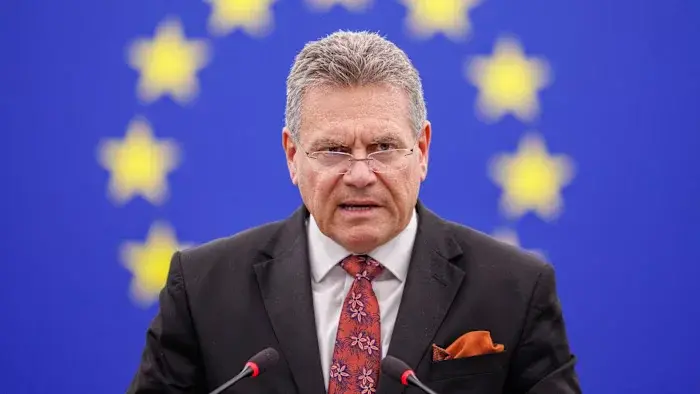
EU trade commissioner Maroš Šefčovič is in Beijing for critical two-day talks aimed at resolving a trade deficit of €1 billion per day. The negotiations face a significant hurdle as China has rejected EU requests to limit plug-in hybrid vehicle exports, a move European officials warn could cause the talks to fail. While Beijing offers expanded direct investment and potential minimum price agreements for electric vehicles, it refuses to cut tariffs that hinder EU exports. The European Parliament has simultaneously adopted a tougher stance, demanding concrete results on market access and security, while Chinese state media criticizes the EU’s approach as confrontational and self-defeating.
Key points
- Šefčovič is meeting Chinese commerce minister Wang Wentao and vice-premier He Lifeng to avert a spiraling trade conflict.
- China has refused to limit exports of plug-in hybrid electric vehicles, which surged after tariffs were imposed on battery-only EVs.
- European officials view Chinese offers of expanded direct investment and minimum price negotiations as insufficient to address the core trade imbalance.
- The European Parliament adopted a recommendation by 454 votes to 86, urging a tougher line on trade, security, and human rights.
- Germany and France have proposed a last-resort trade instrument that could cut off China’s access to the EU single market if necessary.
Background
Previous coverage indicated that China’s car exports from January to August 2026 already exceeded the total for all of 2025, driving a rapid expansion in shipments. The European Commission had previously signaled a bilateral approach to manage trade, aiming for tangible deliverables by October to address the massive trade deficit and industrial job losses in the bloc.
How outlets are covering it
The Financial Times reports that European officials are pressing Beijing to drop tariffs to allow EU exports to compete, while China seeks the lifting of restrictions on technology exports, including chipmaking equipment from ASML. The EUalive source highlights the European Parliament’s demand for a 'de-risking' strategy and concrete results on market access, citing concerns over Chinese military training for Russian troops. In contrast, China Daily Global Edition characterizes the EU’s new document as hostile and driven by internal anxieties, arguing that the EU is using China as a scapegoat for its own economic transition challenges and warning that confrontation will harm the complementary nature of the relationship.
Why it matters
The outcome of these talks determines whether the EU will escalate to unilateral restrictions or a rapid-response trade defense mechanism. A failure to resolve the hybrid car issue could lead to a rapid deterioration in trade relations, impacting global supply chains and industrial stability in both regions.
What to watch
Šefčovič is scheduled to meet vice-premier He Lifeng on Friday. A new round of the China-France Strategic Dialogue is also underway in Beijing. The EU aims to present results to leaders in Brussels by October 15, with the European Parliament’s international trade committee returning from China in late October.
- EU envoy lands in China for last-ditch talks over car exports Financial Times
- How Europe should deal with the new China shock The Economist
- Parliament tells Šefčovič: no business as usual in Beijing EUalive
- Chinese commerce minister meets with EU trade chief in Beijing CGTN
- European Parliament should be wary of dire consequences of acting on its new document: China Daily editorial China Daily Global Edition
Want the full story? Read the original reporting
Read on Financial Times