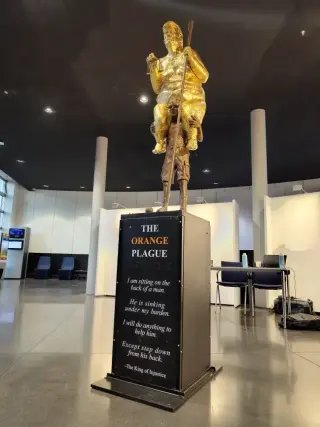
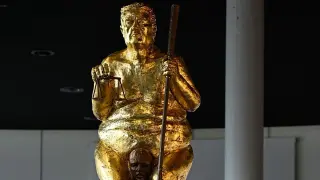
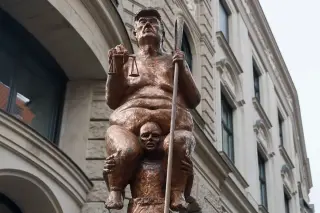
Danish artist Jens Galschiøt unveiled 'The Orange Plague,' an 8.5-foot gold-leaf statue of a nude Donald Trump, in the European Parliament in Strasbourg on October 6. The sculpture, which depicts Trump riding on the back of a frail figure, was installed by left-wing Danish MEP Per Clausen to critique US climate and foreign policies. The work, inspired by 'The Emperor's New Clothes,' was displayed until October 8 and is set to move to the COP31 climate conference in Turkey.
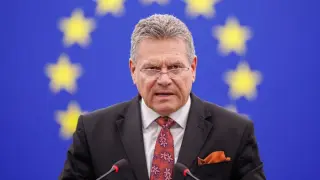
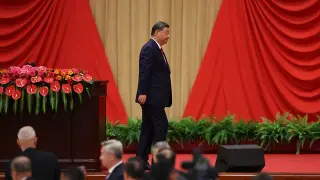
EU trade commissioner Maroš Šefčovič is in Beijing for critical two-day talks aimed at resolving a trade deficit of €1 billion per day. The negotiations face a significant hurdle as China has rejected EU requests to limit plug-in hybrid vehicle exports, a move European officials warn could cause the talks to fail. While Beijing offers expanded direct investment and potential minimum price agreements for electric vehicles, it refuses to cut tariffs that hinder EU exports. The European Parliament has simultaneously adopted a tougher stance, demanding concrete results on market access and security, while Chinese state media criticizes the EU’s approach as confrontational and self-defeating.
Danish artist Jens Galschiøt has installed a 2.6-meter gold-leaf statue of a naked Donald Trump in the European Parliament in Strasbourg. Titled 'The Orange Plague,' the sculpture depicts the US president sitting on the back of a smaller, frail figure, symbolizing the burden of American power on global climate efforts and international order. Sponsored by Danish MEP Per Clausen, the exhibit aims to spark debate on US foreign policy and environmental destruction. The installation includes the distribution of over 1,000 3D-printed miniatures to visitors and staff. The artwork, which previously toured Copenhagen and Brazil, is set to move to the COP31 climate conference in Turkey next month. No official reaction from the US administration has been reported.
European Parliament members voted overwhelmingly for a resolution demanding tougher action against China, citing economic coercion and support for Russia. Simultaneously, EU Trade Commissioner Maroš Šefčovič arrived in Beijing for high-stakes negotiations aimed at rebalancing a trade deficit that now exceeds €1 billion daily. The talks focus on Chinese export surges, particularly in hybrid vehicles, and restrictions on critical raw materials, with Brussels considering new retaliatory tools if Beijing does not offer concrete concessions.
Danish artist Jens Galschiøt unveiled 'The Orange Plague,' an eight-foot gold-leaf statue of a nude Donald Trump, at the European Parliament in Strasbourg on October 6. The sculpture depicts the president sitting on the back of a frail man, symbolizing the burden of U.S. power on global climate efforts and rule-based order. Galschiøt described the work as a satirical critique of Trump’s actions undermining green transitions and scientific data, inspired by Hans Christian Andersen’s 'The Emperor’s New Clothes.' The exhibition, hosted by Danish MEP Per Clausen, includes free miniature 3D-printed copies for attendees to use as protest symbols. The installation follows previous stops in Denmark and Germany and will next appear at the COP31 climate conference in Turkey.
Danish artist Jens Galschiøt has installed a controversial 8.5-foot gold-leaf statue of President Donald Trump at the European Parliament in Strasbourg. Titled 'The Orange Plague,' the sculpture depicts a nude Trump riding on the back of a smaller, frail figure, symbolizing the burden of US power on the world. Sponsored by Danish MEP Per Clausen, the exhibit is a satirical critique of Trump's climate and foreign policies, with over 1,000 3D-printed miniatures distributed as 'protest tokens.'
Danish artist Jens Galschiøt unveiled a 8.5-foot, gold-leaf-covered nude statue of Donald Trump at the European Parliament in Strasbourg. Titled 'The Orange Plague,' the sculpture depicts the U.S. president riding on the back of a smaller, frail figure, symbolizing the burden of American power on the world. Sponsored by Danish MEP Per Clausen, the exhibit is a satirical critique of Trump's climate and foreign policies, with over 1,000 3D-printed miniatures distributed as 'protest tokens.'
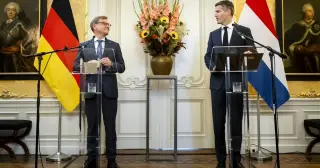
European Parliament members are urging the European Commission to activate the EU blocking statute to shield the International Criminal Court (ICC) from U.S. sanctions. Washington has already targeted nine judges and four prosecutors following the ICC’s issuance of an arrest warrant for Israeli Prime Minister Benjamin Netanyahu. Lawmakers argue that automatic compliance with U.S. financial restrictions by European banks undermines European sovereignty and the rule of law. German and Dutch foreign ministers have publicly supported the court, with the Netherlands positioning the blocking statute as a critical 'nuclear option' to prevent operational paralysis for the Hague-based institution.
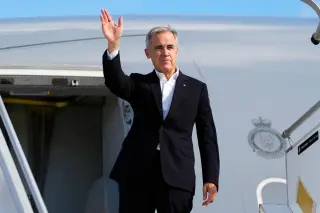
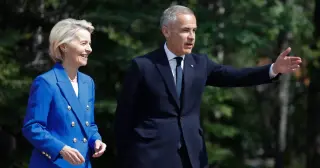
Canadian Prime Minister Mark Carney has proposed a new 'associate membership' status for Canada within the European Union, a move designed to counter US pressure and diversify trade. While the specific legal terminology remains debated, the political signal is clear: a closer strategic alliance between Ottawa and Brussels.
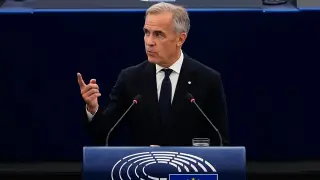
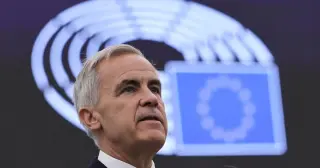
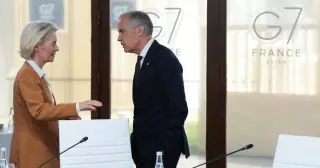
Canadian Prime Minister Mark Carney addressed the European Parliament in Strasbourg on September 17, 2026, acknowledging the European Commission’s proposal for Canada to become an 'associate member.' While Carney welcomed the ambition of the idea and cited strong public support for closer ties, he declined to formally endorse the specific status. Instead, he outlined concrete areas for cooperation, including critical minerals, defense, AI, energy security, and space, while emphasizing the need for seamless digital trade and participation in student exchange programs. Carney confirmed that the Canadian Parliament will eventually vote on the matter, noting that the House of Commons returns from summer break on Monday. The discussion follows a surprise announcement by Commission President Ursula von der Leyen, which had not been pre-coordinated with other EU capitals. U.S. President Donald Trump warned of potential tariffs if Canada moves closer to the EU, prompting Ottawa to seek additional trade guarantees and industrial policy alignment to protect against protectionist measures.
Canadian Prime Minister Mark Carney is set to address the European Parliament in Strasbourg, outlining Ottawa’s pursuit of an 'associate membership' status with the EU rather than full integration. This move follows Canada’s recent entry into the EU’s 150-billion-euro SAFE defense procurement program and reflects a strategic pivot toward Europe amid tensions with the United States. While full membership is rejected to preserve sovereignty, Canada seeks deeper cooperation in energy, AI, and digital trade, signaling a new era of transatlantic alignment that is closely monitored by Washington.
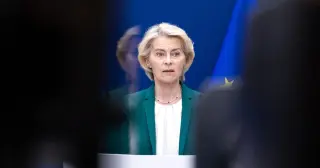
European Commission President Ursula von der Leyen faced diplomatic backlash after initially planning to skip Canadian Prime Minister Mark Carney’s address to the European Parliament in Strasbourg, though she reversed course at the last minute. The incident occurred amid broader confusion over the nature of deepening EU-Canada ties, with von der Leyen proposing a non-existent 'associate membership' status while Carney seeks a 'unique alliance' to diversify trade away from the United States.
European Commission President Ursula von der Leyen will attend Canadian Prime Minister Mark Carney's address to the European Parliament in Strasbourg on Thursday, reversing an earlier decision to skip the event. The change follows backlash from MEPs who deemed her absence unacceptable. Carney is expected to pitch a deeper economic and security alliance with the EU as Ottawa pivots away from the US amid a trade dispute.
European Commission President Ursula von der Leyen will not attend Canadian Prime Minister Mark Carney’s address to the European Parliament in Strasbourg. Carney is seeking a 'unique alliance' with the EU, not full membership, as Canada pivots away from Washington due to escalating trade tensions.
The European Commission pulled out of a democracy conference in Italy after Taiwan's vice premier was invited as a surprise guest, citing diplomatic sensitivities with Beijing. The event, co-organized by the European Parliament, focused on autocracy and featured dissidents from Ukraine, Russia, and Venezuela. Commission officials removed their branding and cancelled scheduled speeches, while Parliament leaders accused Brussels of yielding to Chinese pressure. The Commission maintained its 'One China' policy stance but denied hosting the event, highlighting ongoing tensions in EU-China relations amid trade disputes and geopolitical conflicts.