
Mladić’s Hero’s Funeral in Belgrade Deepens Serbia-EU Rift
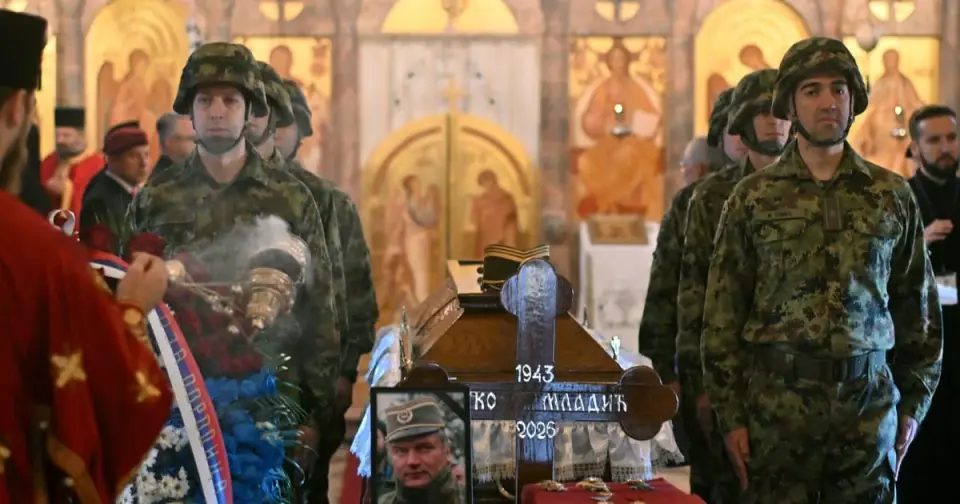
Ratko Mladić, the Bosnian Serb general convicted of genocide, was buried in Belgrade with military honors, drawing sharp condemnation from the EU. The ceremony, attended by thousands and senior officials, highlighted a stark divide between Serbia’s EU aspirations and its domestic nationalist politics, prompting Brussels to cancel a planned visit and threaten accession progress.
Key points
- Mladić died at 84 in The Hague in late August while serving a life sentence for the 1995 Srebrenica massacre, which killed over 8,000 Bosniaks.
- His funeral in Belgrade featured military escorts, a government plane for his remains, and attendance by Defense Minister Bratislav Gašić and Justice Minister Nenad Vujić.
- EU Enlargement Commissioner Marta Kos canceled a visit to Belgrade, stating the 'glorification' of Mladić contradicts fundamental European values.
- President Aleksandar Vučić, who skipped the funeral, dismissed the event as an 'emotional outpouring' unrelated to state policy, despite government involvement in logistics.
- The ceremony reignited tensions over Serbia’s stalled EU accession, with Brussels citing democratic backsliding and failure to sanction Russia as additional barriers.
Background
Serbia has been an EU candidate since 2014, but accession talks have stalled since December 2021 due to rule-of-law concerns and its refusal to sanction Russia. Mladić’s rehabilitation in Serbian public memory, including murals and public wakes, has long been a point of friction with Brussels, which views reconciliation with the past as a prerequisite for membership. The funeral follows a period of domestic unrest, including student protests and allegations of state spyware use against activists.
How outlets are covering it
While all outlets agree on the facts of the military-style funeral and EU condemnation, they emphasize different aspects. POLITICO and The Guardian focus on the contradiction between Serbia’s EU ambitions and its nationalist actions, noting that Vučić’s government claimed no official role despite state resources being used. CNN highlights the defiance of Serbian leadership, quoting Vučić’s claim that Serbs are 'persecuted' by the West, and notes the presence of Bosnian Serb leader Milorad Dodik. BBC provides a broader historical context, noting that Mladić remains a 'hero' to many Serbs despite his conviction, and includes testimony from victims’ families in Sarajevo who view the event as a 'shame.'
Why it matters
The funeral serves as a critical test for Serbia’s EU path, exposing the limits of Brussels’ leverage over Belgrade. It underscores the deep-seated nationalist sentiment in Serbia that resists reconciliation with the Bosnian war, potentially delaying accession indefinitely. The event also highlights the broader geopolitical tension, as Serbia’s alignment with Russia and its domestic authoritarian trends clash with EU norms, affecting regional stability in the Balkans.
What to watch
The EU may freeze pre-accession payments to Serbia, as demanded by 29 EU lawmakers, citing democratic backsliding and the glorification of war criminals. Serbia faces an early parliamentary election next month, where Vučić’s anti-Western rhetoric may influence the outcome. The incident could further strain relations with neighboring countries, including Bosnia and Croatia, which have condemned the funeral and filed criminal complaints against those promoting Mladić’s image.
- Ratko Mladić funeral exposes gap between Serbia’s EU ambitions and political reality politico.eu
- Thousands turn out in Serbia for funeral of 'Butcher of Bosnia' Ratko Mladić BBC
- War criminal Ratko Mladić to receive full military honors in funeral as crowds gather cnn.com
- Ratko Mladić, the ‘Butcher of Bosnia’, given hero’s funeral in Serbia The Guardian
- Funeral of convicted war criminal Mladic draws thousands, opens old wounds reuters.com
Want the full story? Read the original reporting
Read on politico.eu