
280 Ice Age Engravings Uncovered in Catalan Cave Visited by Tourists for Decades
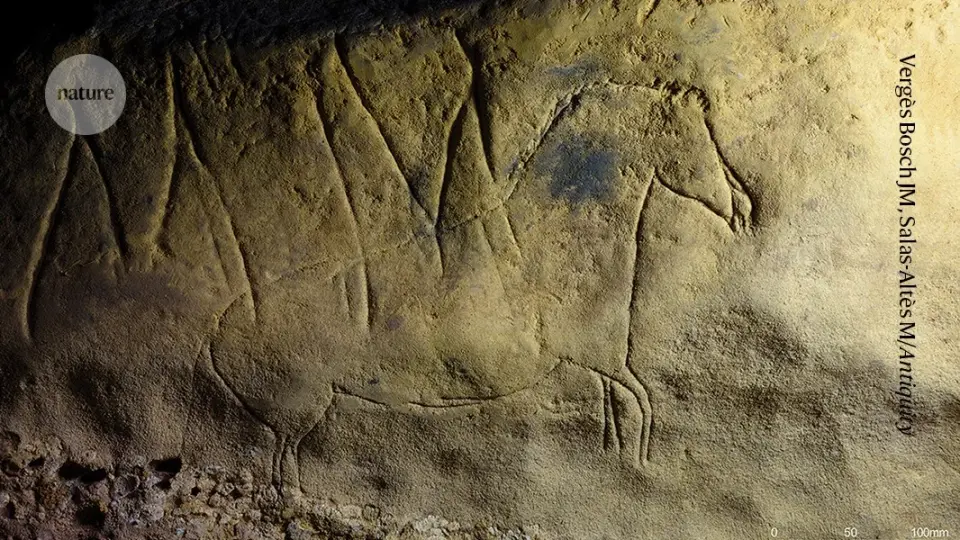
Archaeologists have identified 280 Paleolithic engravings in the Cova de la Font Major in Catalonia, Spain, a site open to tourists since the 1950s. The discovery, published in Antiquity, includes 55 animal figures and abstract shapes dating to approximately 26,000 years ago. The find challenges the assumption that northeastern Iberia lacked significant Ice Age art and suggests a distinct Mediterranean artistic tradition separate from the Franco-Cantabrian region.
Key points
- Josep Maria Vergès Bosch and Míriam Salas-Altès of the Catalan Institute of Human Paleoecology and Social Evolution (IPHES-CERCA) identified 280 motifs during a 2019 excavation.
- The engravings include 55 animal depictions, such as horses, bears, and aurochs, alongside abstract loops and lines.
- Radiocarbon dating of charcoal found in one groove places the art at roughly 26,000 years old, though some figures predate the Magdalenian period.
- The cave, which became a museum in 1993, had been visited by thousands of people since 1957 without the art being recognized.
- The discovery suggests higher population density in Catalonia during the Upper Paleolithic than previously assumed.
Background
Previous coverage in our archive noted that the Cova de la Font Major was identified as a site with significant Paleolithic art in November 2025, highlighting the challenge of distinguishing ancient art from modern graffiti. This latest report provides specific details on the dating and stylistic analysis of the engravings.
How outlets are covering it
Nature emphasizes the 'hidden in plain sight' aspect, noting that the engravings were difficult to see due to lighting and rock irregularities. Archaeology News Online highlights the statistical significance of the find, noting that 55 animal figures far exceed the regional average of five or fewer for Mediterranean sites. Smithsonian Magazine focuses on the potential for 'animation' in the art, suggesting some sequences depict movement. ARTnews notes the historical timeline of the cave's access, from Roman-era collapses to 19th-century exploration. All sources agree that the find redefines the artistic and demographic history of northeastern Iberia.
Why it matters
The discovery fills a significant gap in the record of Upper Paleolithic art in Europe, demonstrating that the Mediterranean side of the Iberian Peninsula had a rich artistic tradition. It also suggests that population estimates for the region may need to be revised upward, as the volume of art implies a more substantial human presence than previously thought.
What to watch
Researchers are calling for systematic rock art surveys across Catalonia to identify similar sites. Further analysis of the engravings may reveal more about the symbolic and ritualistic practices of the people who created them. The cave may also undergo conservation efforts to protect the newly identified art from environmental damage and visitor impact.
- The palaeo cave art that hid in plain sight for 26,000 years Nature
- Hundreds of Ice Age engravings discovered in a Catalan cave visitors walked past for decades Archaeology News Online Magazine
- For Centuries, Cave Visitors Walked Right by 280 Ice Age Engravings. The Newly Discovered Rock Art Is Rewriting Catalonia's Prehistory Smithsonian Magazine
- Archaeologists Discover Large Assemblage of Ice Age Cave Art Hiding in Plain Sight ARTnews.com
- Hundreds of stunning ice age drawings discovered inside Spanish cave Scientific American
Want the full story? Read the original reporting
Read on Nature