
Genome reveals forest ancestry hidden in Africa’s savanna elephants, guiding conservation
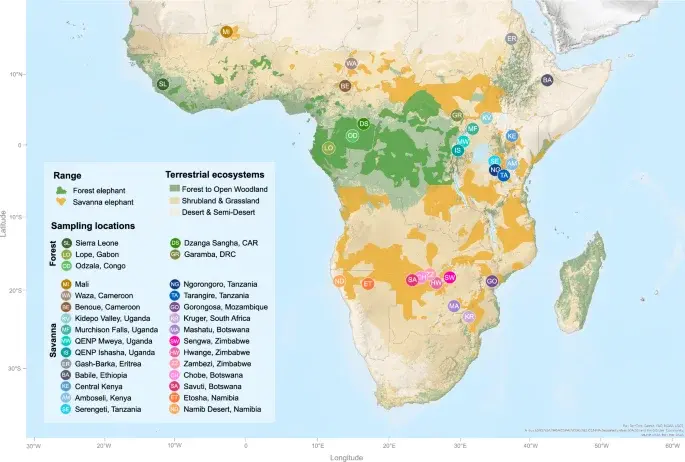
A continent-wide genomic analysis of 232 African elephants (savanna Loxodonta africana and forest L. cyclotis) shows a deep species split with forest elephants more genetically diverse and historically larger effective population sizes, while savanna elephants display more inbreeding and higher genetic load. The study also uncovers widespread forest-into-savanna introgression, including recent hybrids at the DRC–Uganda and Garamba zones, plus trace forest ancestry across savanna populations in west-central Africa. Despite high within-species connectivity, human-driven habitat fragmentation has produced isolated peripheral populations with elevated runs of homozygosity, underscoring the need to maintain habitat connectivity and protected-area networks to preserve genetic diversity and potential fitness. These findings highlight gene flow as a key evolutionary force and provide genomic guidance for conservation of Africa’s keystone elephants.
- The genomic impact of population connectivity and decline in Africa’s elephants Nature
- Genetic trouble detected in isolated African elephant populations Reuters
- African elephant genomes reveal a past of continental connectivity and a future of increasing isolation Phys.org
- Inbreeding causing African elephants to be vulnerable to disease cbs19news.com
- Africa’s Elephants Are Written in Their Genes, and the Story Is One of Vanishing Connection ScienceBlog.com
Want the full story? Read the original reporting
Read on Nature