
Marshall Islands atolls offer rare glimpse of intact ocean ecosystems
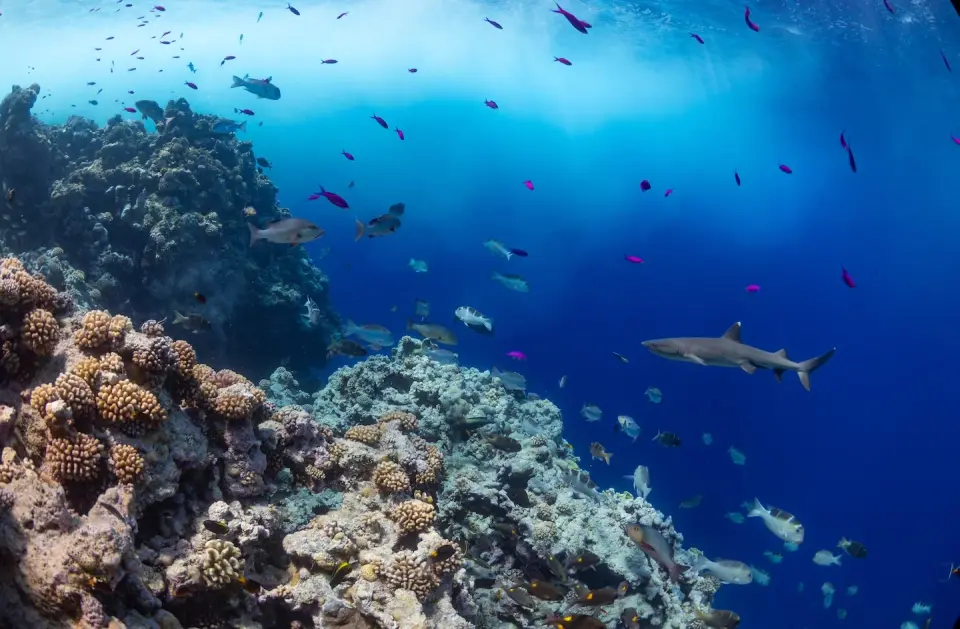
A new study identifies Bikar and Bokak atolls in the Marshall Islands as among the world's most intact marine ecosystems. The 2023 survey revealed high biodiversity, including 266 reef fish groups and 15 seabird colonies. The atolls, now a 48,000-square-kilometer national sanctuary, serve as a baseline for conservation despite facing global climate threats.
Key points
- The study, published in Frontiers in Marine Science, details the ecological richness of Bikar and Bokak, located over 100 and 385 kilometers from the nearest inhabited atoll, respectively.
- Researchers documented 266 reef fish taxa, 15 open-water predator groups, and 17 seabird species, with 15 confirmed breeding colonies.
- Sharks accounted for 26.8% of fore-reef biomass at Bikar and 33.9% at Bokak, while deep-sea cameras revealed 79 additional fish groups.
- The atolls were designated the Marshall Islands' first national marine sanctuary in January 2025, covering 48,000 square kilometers.
- Despite their remoteness, the atolls face threats from introduced Polynesian rats, ocean warming, and coral bleaching.
Background
This story follows earlier coverage of the Marshall Islands' environmental policies and the global decline of marine biodiversity. The archive contains no relevant background on these specific atolls, as previous entries focused on unrelated sports news. The current report builds on the 2023 expedition that informed the 2025 sanctuary designation.
How outlets are covering it
The Washington Post emphasizes the atolls as a 'natural baseline' for what reefs used to look like, highlighting their status as top-tier intact ecosystems. ScienceAlert and BBC Wildlife focus on the specific biodiversity metrics, such as shark biomass and deep-sea discoveries, while noting the presence of invasive rats. Euronews highlights the contrast between these protected areas and the global 73% decline in wildlife populations since 1970. All sources agree on the ecological value but differ in emphasis: The Post focuses on the 'intact' status, while ScienceAlert and BBC detail the specific species counts and the limitations of 'pristine' status due to global climate impacts.
Why it matters
These atolls provide a critical reference point for conservationists to understand what healthy marine ecosystems look like, aiding in restoration efforts elsewhere. As global marine populations decline and coral reefs face bleaching, protected areas like Bikar and Bokak serve as vital refugia and benchmarks for monitoring climate change impacts on biodiversity.
What to watch
Future studies will examine nutrient transfer and ecological connectivity between habitats to better understand how these systems function. Conservationists will continue to monitor the atolls for signs of climate-driven changes, such as coral bleaching and ocean warming, to assess the long-term viability of these protected areas.
- These are some of the most wild places left on the planet The Washington Post
- Scientists Discover Two Remarkably Untouched Worlds Hidden in The Pacific ScienceAlert
- Scientists find some of the 'very last wild and healthy ecosystems' in the world's oceans untouched by humans Phys.org
- Scientists studied extremely remote atolls in the Pacific, almost untouched by humans – and found them teeming with life BBC Wildlife Magazine
- ‘Treasures for the entire planet’: Scientists map life in one of the world’s last wild ecosystems Euronews.com
Want the full story? Read the original reporting
Read on The Washington Post