
New Fossils in Southern China Reveal Denisovans and Unidentified Hominins
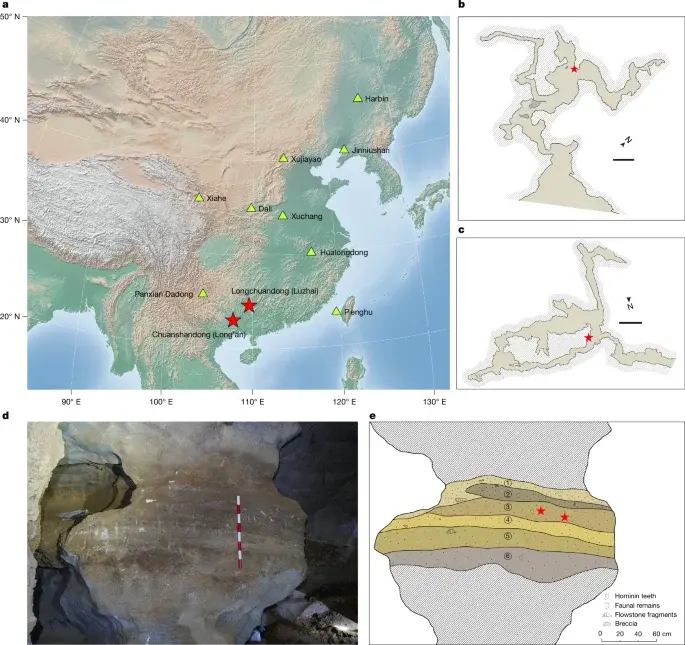
A new study published in Nature reports the discovery of four hominin teeth from two caves in Guangxi, southern China, dating to the Middle and Late Pleistocene. The findings suggest that at least two distinct archaic human lineages coexisted in the region: a Denisovan-affinity group and an unresolved archaic Homo lineage distinct from known species.
Key points
- Researchers identified four isolated teeth from Chuanshandong and Longchuandong caves in Guangxi, dated between 42,600 and 104,500 years ago.
- Teeth from Longchuandong show morphological and protein similarities to Denisovans found in Altai, Harbin, and Penghu, confirming their presence in subtropical southern China.
- Teeth from Chuanshandong exhibit a unique combination of traits, including ancestral variants shared with Homo antecessor and Homo erectus, but lack Denisovan-specific markers.
- The Chuanshandong lineage is described as an 'unresolved archaic Homo' rather than a new named species, due to limited data and the possibility of interbreeding with Homo erectus.
- The findings challenge the view that Denisovans were the only archaic humans in East Asia during this period, suggesting a more diverse population structure in southern China.
Background
Previous studies have identified Denisovans in northern and central China, but southern China’s warm, humid climate has hindered ancient DNA preservation, making protein analysis crucial. Recent findings have also shown Homo erectus surviving in Chinese rainforests until 184,000 years ago, highlighting the region’s complex hominin history.
How outlets are covering it
Live Science emphasizes the potential for a new human lineage but notes uncertainty, while Global Times highlights the coexistence of Denisovans and an unknown group. The Nature study itself is cautious, labeling the Chuanshandong group as 'unresolved' and calling for more data to determine its exact affinity.
Why it matters
The discovery expands the known geographic range of Denisovans to subtropical southern China and suggests that multiple archaic human groups may have coexisted in East Asia, complicating the narrative of human evolution in the region.
What to watch
Researchers plan to analyze additional fossils from Guangxi caves and seek more molecular data to clarify the taxonomic status of the Chuanshandong lineage and its relationship to other archaic humans.
- Middle–Late Pleistocene Denisovans and unresolved Homo in southern China Nature
- Fossil teeth challenge a long-held idea about where early humans could live Earth.com
- 100,000-year-old tooth found in Chinese cave may be from unknown human lineage Live Science
- New evidence of Denisovans and unknown ancient humans found in southern China Global Times
Want the full story? Read the original reporting
Read on Nature