
Black Robin Wins New Zealand Bird of the Year Amid Record Turnout
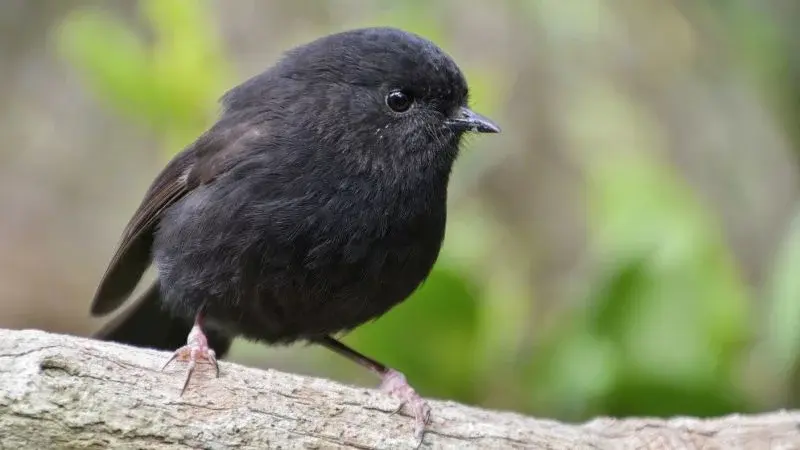
The black robin, a tiny bird once reduced to five individuals, won New Zealand's 2026 Bird of the Year with over 25,000 votes. The species, found only on the Chatham Islands, recovered to about 350 adults through a pioneering conservation program, though its habitat is now nearly full and it remains critically threatened.
Key points
- The black robin (karure) won the 2026 Bird of the Year competition with over 25,000 votes, beating the kakapo and New Zealand falcon.
- The competition attracted a record 105,000 votes, with 88% cast from within New Zealand, the highest domestic turnout in the contest's 20-year history.
- By 1980, the species had been reduced to just five birds, including only one fertile female named Old Blue. A breeding program using Old Blue and Old Yellow as the founding pair led to a recovery to about 350 adults.
- The black robin is found only on two pest-free nature reserve islands in the Chatham Islands, about 800 kilometers east of mainland New Zealand. Its habitat is nearly at capacity, and conservationists are seeking to establish a third population, potentially on Pitt Island.
- The species remains classified as Threatened-Nationally Critical by the New Zealand Department of Conservation. The Chatham Islands support 20% of New Zealand's threatened bird species.
- The 2026 competition used an election theme, grouping candidates into 'parties' such as Shy Birds and Floor Birds. Tree Birds won the party vote with around 101,000 votes.
Background
The black robin's victory follows a remarkable conservation effort that began in the 1970s-1980s, when the species was on the brink of extinction. The use of foster parenting and intensive breeding programs, pioneered with Old Blue and Old Yellow, helped rebuild the population. This success story has put New Zealand's conservation efforts on the international map. The competition itself has a history of controversy, including voter fraud and non-bird winners, but it continues to engage the public in conservation issues.
How outlets are covering it
CNN emphasizes the black robin's 'goth' appearance and its remarkable recovery from near-extinction, highlighting the record voter turnout and the species' critical status. The Guardian focuses on the bird's cultural significance and the 'goth' nickname, noting that it has been in the top five for several years but never won. It also mentions the bird's distinct species status and the need for a third pest-free island. Qazinform provides a more factual overview, noting the record turnout and the election-themed format, including the 'Tree Birds' party winning the party vote. It also mentions the potential for a third population on Pitt Island and the removal of feral cats. All sources agree on the key facts of the win, the recovery, and the ongoing threats, but differ in emphasis: CNN on the cultural and visual aspects, The Guardian on the cultural and historical context, and Qazinform on the logistical and political aspects of the competition.
Why it matters
The black robin's victory highlights the success of conservation efforts in New Zealand, but also underscores the ongoing challenges faced by endangered species. The record voter turnout indicates growing public interest in conservation, but the species' critical status and habitat limitations show that more work is needed. The competition's evolution, including its election-themed format and past controversies, reflects the complex dynamics of public engagement in conservation. The black robin's story serves as a model for other conservation efforts, but also a reminder that recovery is fragile and requires continued support.
What to watch
Conservationists are working to establish a third population of black robins, potentially on Pitt Island, to address the habitat limitations on the current two reserve islands. A project to remove feral cats from Pitt Island is being prepared, which could also benefit other rare birds. The Chatham Islands Landscape Restoration Trust continues to campaign for the species, emphasizing that while the black robin is a conservation success, it is not 'saved yet.' The competition's organizers, Forest & Bird, will likely continue to use the event to raise awareness of New Zealand's native wildlife and the threats facing its most endangered species.
- This tiny ‘goth’ bird was nearly extinct. Now it’s New Zealand’s Bird of the Year CNN
- The black robin, once down to just a single breeding pair, wins NZ bird of the year theguardian.com
- New Zealanders pick endangered black robin as Bird of the Year Phys.org
- Black robin bucks shy tag to take Bird of the Year 2026 RNZ
- Bird saved from extinction named New Zealand’s Bird of the Year qazinform.com
Want the full story? Read the original reporting
Read on CNN