
Saudi Arabia Discovery Suggests 125,000-Year-Old Poisoned Stone Weapons
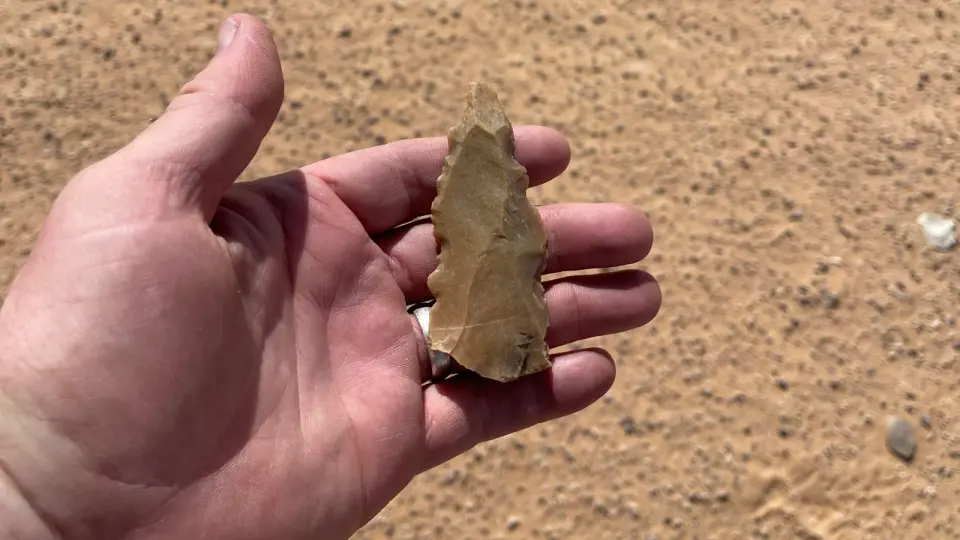
Researchers identified over 5,500 stone artifacts at the 125,000-year-old site of 'Uruq Aljelibah in southern Saudi Arabia. Chemical analysis reveals residues from a poisonous tree on some stone points, suggesting early humans used toxic hunting weapons. This discovery predates similar findings in South Africa by 65,000 years and indicates sophisticated toolmaking in an ancient lakeshore environment.
Key points
- Archaeologists found more than 5,500 stone tools and preserved organic materials at 'Uruq Aljelibah, a 125,000-year-old site in the Empty Quarter of Saudi Arabia.
- Microscopic analysis detected residues from the arrow poison tree (Acokanthera schimperi) on stone points, suggesting the use of poisoned hunting weapons.
- The site was once a 130-square-mile freshwater lake supporting megafauna like hippos and buffalo, now a hyper-arid desert.
- The findings predate similar poisoned weapon evidence in South Africa by approximately 65,000 years.
- Researchers note that while the lake is dated to 125,000 years, the tools were surface finds, making the 125,000-year mark a maximum age for the artifacts.
Background
Recent studies have highlighted how climate shifts in Arabia created 'Green Arabia' periods, allowing human migration through the desert. However, earlier coverage noted that the lack of suitable stone for toolmaking in the Rub' al Khali desert often prevented sustained human settlement, despite the presence of water. This new discovery adds to the understanding of how early humans exploited specific pockets of resources in the region.
How outlets are covering it
Live Science emphasizes the technological sophistication of the tools, highlighting the combination of stone, wood, and poison. ScienceAlert contrasts this with a separate study showing that the broader desert lacked the stone necessary for widespread settlement, suggesting humans were 'tethered' to specific resource-rich zones. Popular Mechanics provides context on human migration patterns, noting that earlier populations in Arabia may have died out during dry spells, potentially including the makers of similar 120,000-year-old footprints found elsewhere in the region.
Why it matters
This discovery pushes back the timeline for complex hunting technologies, suggesting early humans in Arabia were more technologically advanced than previously thought. It also underscores the importance of organic material preservation in understanding prehistoric lifeways, as stone tools alone often obscure the full complexity of ancient technology.
What to watch
Researchers plan to return to the site to excavate deeper layers for stratified artifacts and human fossils. They aim to further analyze the chemical residues to determine exactly how the poison was prepared and applied, as well as to investigate whether the site was occupied by Homo sapiens or other hominin species.
- 125,000-year-old stone points discovered in Saudi Arabia may be world’s oldest poisoned weapons Live Science
- Oldest Use of Poison Detected at Homo Sapiens Site in Saudi Arabia Haaretz
- The World's Biggest Sea of Sand Shows No Trace of Ancient Humans. Here's Why. ScienceAlert
- Archaeologists Found 120,000-Year-Old Human Footprints Where They Shouldn’t Be Popular Mechanics
- Discoveries from a 125,000-year-old lakeshore reveal life in a greener Arabia The Conversation
Want the full story? Read the original reporting
Read on Live Science