
Study finds 90% of 1.5°C warming already realized in all regions
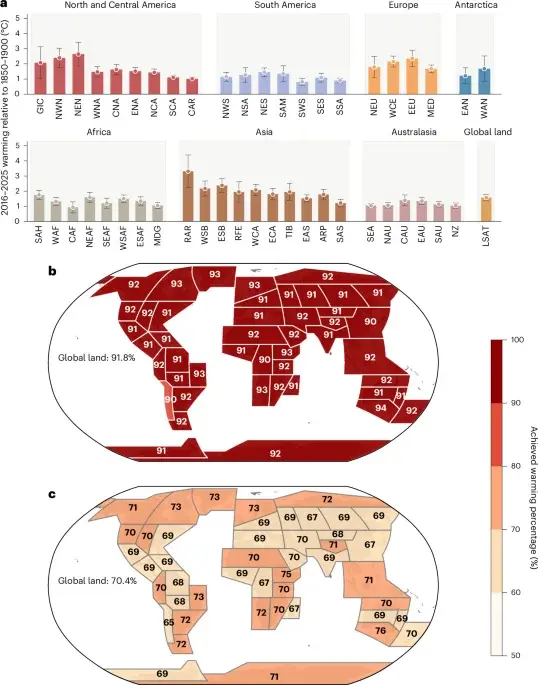
A new study in Nature finds that by 2025, all 46 IPCC regions have reached 90–94% of the warming expected at 1.5°C global average, with high-latitude areas exceeding 2.5°C. Researchers attribute this primarily to greenhouse gases, noting that current warming is statistically indistinguishable from a 1.5°C world, urging immediate adaptation.
Key points
- By 2025, attributed regional warming reached 90–94% of levels expected at 1.5°C global warming and 65–76% of those at 2°C.
- The Russian Arctic experienced 3.3°C warming, while Northwestern North America reached 2.4°C, driven by polar amplification.
- Greenhouse gases are the dominant driver, partially offset by aerosol cooling in industrial regions like Europe and North America.
- Tropical regions, including much of Africa, show high attribution confidence due to low natural variability, despite sparse historical data.
- The 1.5°C global threshold is projected to be reached around 2029 under high-emission scenarios.
Background
The Paris Agreement, adopted in 2015, set targets to limit global warming to well below 2°C and pursue efforts to limit it to 1.5°C. Previous assessments, such as the IPCC AR6, noted uncertainties in regional warming due to insufficient historical observations, particularly in data-sparse areas like Africa and the Arctic. This study addresses those gaps using a Bayesian framework to provide robust estimates for all regions.
How outlets are covering it
The primary source, published in Nature, emphasizes the statistical robustness of the findings, noting that current warming is indistinguishable from a 1.5°C world across all regions. The Times Colonist highlights the implications for Canada, noting that high-latitude regions like British Columbia are warming faster than the global average due to Arctic amplification. DongA Science frames the findings within the context of COP31 in Antalya, Türkiye, where delegates stressed the need for concrete climate finance and loss-and-damage support, citing the study to underscore the urgency of action. All sources agree on the rapid pace of warming but differ in emphasis: Nature focuses on methodological confidence, while the secondary sources highlight policy and regional impacts.
Why it matters
The findings underscore that the 1.5°C threshold is imminent, with most of the expected warming already realized. This highlights the urgent need for adaptation strategies and climate finance, particularly in vulnerable regions with limited data. The study provides a scientific basis for policy decisions, emphasizing that current warming is driven by human activities and that further action is critical to mitigate catastrophic outcomes.
What to watch
The 1.5°C global threshold is projected to be reached around 2029 under high-emission scenarios, while the 2°C threshold could be reached by 2042. COP31 delegates are expected to focus on implementing greenhouse gas reduction pledges and providing climate finance to vulnerable regions. The WMO has warned that El Niño may further raise temperatures and increase extreme weather risks in 2026.
- All IPCC AR6 regions are close to their 1.5 °C- and 2 °C-equivalent warming limits Nature
- 1.5 Degrees of Warming Is Already Here for Most Regions Gizmodo
- Some regions may already be living in a 1.5°C warmer world Phys.org
- Global warming near levels forecast for 2040: UVic study Times Colonist
- COP31 in Türkiye warns 90% of 1.5°C global warming already realized DongA Science
Want the full story? Read the original reporting
Read on Nature