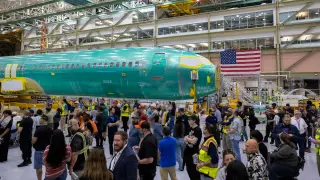
Boeing will reduce its commercial airplane workforce by 5% (about 2,500 employees) starting in December, citing slower-than-expected production ramp-ups for the 737 Max that have left the division overstaffed.
Boeing announced Monday it will reduce its commercial airplane workforce by approximately 5%, or about 2,500 employees, due to slower-than-expected production ramp-ups for the 737 Max. The cuts, to be executed through attrition and involuntary layoffs starting in December, are necessary because the company cannot sustain the staffing levels required for its previous production goals. While the firm aims to stabilize output at 47 planes per month, it now expects to reach that rate only in early 2027, with a target of 52 per month delayed until the second half of 2027. This decision follows a third quarter where the commercial division posted a $697 million operating loss despite $10.7 billion in revenue.
Boeing is cutting 5% of its commercial airplane workforce through attrition and layoffs because production rates for the 737 MAX are lagging behind targets. The company now expects to reach a monthly output of 47 jets in early 2027, a delay from previous forecasts, forcing a reduction in staffing to align with lower output.
Boeing shares fell 11% after third-quarter results missed expectations and the company delayed its production ramp. CEO Kelly Ortberg admitted that stabilizing 737 MAX output at 47 units per month will take longer than anticipated, pushing the target for 52 units per month to the second half of 2027. While revenue grew 4% to $24.2 billion, the adjusted loss of $0.34 per share exceeded forecasts. The company now expects to reach $10 billion in annual free cash flow by 2029, a year later than previously guided. Despite the setback, Wall Street maintains a Strong Buy consensus, with analysts citing a record $745 billion order backlog and recent defense contract wins as long-term stabilizers.
Boeing shares fell 10% to an 18-month low after the company lowered its 2026 delivery targets and delayed its production ramp-up. CEO Kelly Ortberg admitted that reaching a monthly output of 47 737 jets is taking longer than expected, with the next increase to 52 jets now pushed to the second half of 2027. Despite a narrower net loss of $116 million and strong defense sales, the commercial aircraft division remains unprofitable, causing investors to sell off the stock despite a record backlog.
Boeing reported a narrower third-quarter loss driven by rising defense sales, but the commercial aircraft division remains unprofitable. The company delivered 161 jets, yet production rates for the 737 MAX remain below targets as supply chain costs persist.
The Federal Aviation Administration (FAA) has certified the Boeing 737 Max 10, the largest aircraft in the 737 Max family, ending years of delays. The certification follows extensive safety reviews and thousands of test flights. Boeing expects to begin deliveries in 2027. The Max 10 can seat up to 230 passengers and is designed to offer lower per-seat costs and better fuel efficiency than competitors. This milestone is seen as a key step in Boeing's recovery from previous safety crises and production challenges. Major airlines, including United, Delta, American, and Ryanair, have ordered the aircraft. The certification completes the 737 Max lineup, which now includes the Max 7, 8, 9, and 10.
Boeing engineers and technical workers have approved a new four-year contract, averting a potential strike. The agreement includes an immediate 10% wage increase, annual raises of 4%, and merit-based bumps up to 6%. This resolution comes as Boeing seeks to stabilize production and secure federal approval for delayed aircraft models.
Boeing has acknowledged a software defect in certain 737 MAX aircraft that may disable automated flight guidance during specific landing scenarios. The issue, first reported by The Wall Street Journal, has prompted the Federal Aviation Administration to review the matter while several airlines have halted deliveries of affected planes. Boeing is developing a permanent software update, though the glitch has already triggered a decline in the company's stock price.
Boeing is developing a permanent software fix for a 737 MAX glitch that can disable automated flight guidance during specific landing scenarios. The issue, disclosed to operators in August, has triggered an FAA review and caused airlines to reject new deliveries.
A software defect in Boeing 737 MAX aircraft may disable automated landing navigation during missed approaches, prompting an FAA investigation and a 3% drop in Boeing stock. While Boeing claims the planes remain safe, airlines like Southwest and United have rejected new deliveries with the faulty code.
Boeing is developing a software update to fix a flaw in the 737 MAX's automated flight guidance system that can disable vertical navigation during missed approaches. The issue, disclosed to operators in August, has prompted Southwest and United Airlines to pause deliveries of affected aircraft. While Boeing asserts the glitch poses no safety risk, it remains under FAA oversight as the company prepares to deliver the newly certified 737-7 and seek approval for the 737-10.
Boeing has identified a software defect in the 737 MAX that may disable automated landing navigation after a missed approach. The FAA is reviewing the issue, while Southwest and United have halted deliveries of affected aircraft.
Boeing CEO Kelly Ortberg stated that stabilizing 737 Max production is taking longer than anticipated, with wing manufacturing in Renton, Washington, currently acting as a bottleneck. The company is producing approximately 47 aircraft per month and expects to increase output next year. Ortberg also indicated that certification for the 737 Max 10 is imminent, though he declined to predict when Chinese airlines might place new orders ahead of the September 24 summit between Presidents Trump and Xi. Following these remarks, Boeing shares dropped more than 5% during afternoon trading.
The FAA certified the Boeing 737 MAX 7 on August 3, 2026, ending a nine-year review. However, two days later, the agency issued an airworthiness directive requiring crack inspections on approximately 1,429 MAX 8, 9, and 8200 aircraft due to manufacturing defects found in a structural component.