Arrestin-targeted breakthrough: first small molecules lock β-arrestin in an inactive state
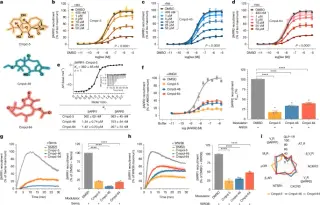
Nature reports the discovery of the first small-molecule inhibitors that directly bind and inhibit β-arrestins, blocking their engagement with agonist-activated GPCRs and downstream signaling while sparing G protein coupling. Using differential scanning fluorimetry, three modulators (Cmpd-5/oridonin, Cmpd-46, Cmpd-64) were characterized across biophysical and cellular assays, showing dose-dependent inhibition of β-arrestin recruitment and receptor desensitization/internalization. Cryo-EM reveals Cmpd-5 binding to a central crest (the MCL site) on β-arrestin1, stabilizing an inactive-like conformation incompatible with receptor engagement. Complementary ITC, MD simulations, docking, and mutagenesis validate this allosteric pocket as a drug-design target. Across GPCR panels, T cell migration, and cardiomyocyte assays, these modulators alter β-arrestin signaling and effector interactions without suppressing Gi or Gs activity, suggesting a path toward pathway-specific GPCR therapeutics. Data include PDB/EMDB structures for βarr1–Cmpd-5 and related states, and the work outlines a mechanistic framework for transducer-targeted GPCR drugs.