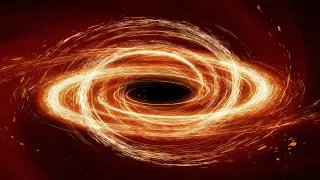
Lab-made black hole made of light reveals Hawking radiation in a lab
Physicists created a tabletop black hole analogue by sending a strong pump pulse and a weaker probe through a photonic-crystal fiber, producing a moving horizon where Hawking radiation appears as ultraviolet photons and, for the first time, a measurable back-reaction on the source light. The observed glow matches Hawking’s thermal spectrum even in regimes where standard physics breaks down, providing a direct look at the Hawking mechanism and addressing the trans-Planckian issue. The team plans to push into the quantum regime to explore features like entanglement between Hawking partners and their missing counterparts.