Tag

Hawking Radiation

All articles tagged with #hawking radiation

Dynamic Horizons Extend Black Hole Thermodynamics
science1 month ago

Dynamic Horizons Extend Black Hole Thermodynamics

Penn State researchers propose using dynamical horizons instead of event horizons to define black hole entropy in real time, extending the first and second laws of black hole thermodynamics to non-equilibrium processes such as formation, merging, and evaporation, thus addressing teleological issues and offering a practical framework for evolving black holes and gravitational-wave observations.

Dynamic horizons rewrite black hole thermodynamics
space1 month ago

Dynamic horizons rewrite black hole thermodynamics

A Penn State team led by Abhay Ashtekar proposes replacing Hawking's equilibrium-based event horizon with a 'dynamical horizon' and generalizing black hole thermodynamics to non-equilibrium situations, allowing the first and second laws to apply during growth, mergers, and evaporation. This framework complements Hawking radiation by focusing on entropy changes in dynamical processes, improving our understanding of evolving black holes; the work is published in Physical Review Letters.

Lab-made black hole made of light reveals Hawking radiation in a lab
science1 month ago

Lab-made black hole made of light reveals Hawking radiation in a lab

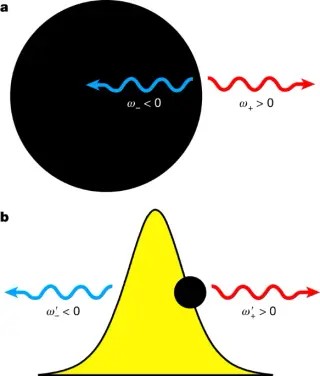
Physicists created a tabletop black hole analogue by sending a strong pump pulse and a weaker probe through a photonic-crystal fiber, producing a moving horizon where Hawking radiation appears as ultraviolet photons and, for the first time, a measurable back-reaction on the source light. The observed glow matches Hawking’s thermal spectrum even in regimes where standard physics breaks down, providing a direct look at the Hawking mechanism and addressing the trans-Planckian issue. The team plans to push into the quantum regime to explore features like entanglement between Hawking partners and their missing counterparts.

Lab-made black hole from light tests Hawking radiation and its recoil
science1 month ago

Lab-made black hole from light tests Hawking radiation and its recoil

Physicists built a laboratory black hole analogue by launching a strong pump pulse through a photonic-crystal fiber, creating a moving optical front that forms an event horizon for a probe pulse. They detected Hawking-like ultraviolet radiation and, for the first time, observed the backreaction—a spectral shift indicating the analogue black hole paid a small energetic price for emitting the glow. The results align with Hawking’s predictions and suggest a direct one-step mechanism for Hawking radiation in this setup, with future work planned to explore quantum features such as entanglement.

Knee relief breakthrough, room-temperature superconductivity, and cosmic enigmas this week
science1 month ago

Knee relief breakthrough, room-temperature superconductivity, and cosmic enigmas this week

This This Week in Science roundup covers six stories: a minimally invasive knee treatment using dissolvable gel beads that block new nerve growth to OA pain, potentially halving knee pain over a year; a new world record for superconductivity at ambient pressure and higher temperatures; two patients with severe autoimmune disease achieving remission after alloHCT (donor stem cell reboot of the immune system); JWST-detected a mysterious chemical signature on Pluto and Titan; a lab analog simulating Hawking radiation backreaction in a black-hole-like system; and evidence that a fast-mimicking diet may reduce gum disease-related inflammation, highlighting links between diet, inflammation, and oral health. Watch the TWIS video recap for highlights.

Lab Light Reveals Direct Hawking Backreaction in Black-Hole Analog
science1 month ago

Lab Light Reveals Direct Hawking Backreaction in Black-Hole Analog

Physicists used ultrafast laser pulses in a patterned optical fiber to create a black-hole analog that emits Hawking radiation and, for the first time, observed backreaction: a tiny energy shift in the initiating pulse caused by the radiation. The study suggests a direct, biquadratic interaction mechanism, helping explain how Hawking radiation could arise in gravity, though real black holes remain unobservable. If the same mechanism appears in other analogs, it could inform the black hole information paradox.

Direct Backreaction of Hawking-like Radiation in a Photonic Horizon
science1 month ago

Direct Backreaction of Hawking-like Radiation in a Photonic Horizon

A fibre-optic analogue of a black-hole horizon demonstrates a direct, simple mechanism for generating stimulated Hawking radiation and shows its backreaction on the propagating field. By combining experiment and theory, the work provides evidence that Hawking-like quanta can arise in lab systems and that the emitted radiation can influence the original optical field, offering insights relevant to both analogue gravity experiments and real black-hole physics.

Seven hidden dimensions could trap black holes in tiny remnants, reshaping Hawking’s paradox
science4 months ago

Seven hidden dimensions could trap black holes in tiny remnants, reshaping Hawking’s paradox

A new theoretical study proposes that if the universe has seven space-time dimensions with three hidden compact dimensions (folded in a G2 geometry), a torsion field could halt Hawking evaporation at the end of a black hole’s life, leaving stable microscopic remnants that store information and may connect gravity to the Higgs mechanism—though testing this idea would require physics beyond current capabilities and must contend with the limits of semiclassical descriptions near the Planck scale.

Hawking’s Tiny 1974 Paper: Black Holes That Could Explode
science5 months ago

Hawking’s Tiny 1974 Paper: Black Holes That Could Explode

In 1974 Stephen Hawking published a short Nature paper proposing that tiny primordial black holes, formed in the early universe, could evaporate and explode via Hawking radiation, flipping the view that black holes only grow. The idea, which connects quantum mechanics to gravity, later sparked the black hole information paradox as it suggested information might be lost; Hawking and collaborators’ later work proposed mechanisms for information escape, including wormholes, though direct evidence remains elusive. Ongoing research, including gravitational waves and James Webb observations, continues to investigate primordial black holes and their potential cosmological signatures.

Ghost-state neutrino from a black hole explosion could rewrite physics and dark matter
space6 months ago

Ghost-state neutrino from a black hole explosion could rewrite physics and dark matter

A 2023 ultra-energetic neutrino detected by KM3NeT may have originated from an exploding primordial black hole with a dark charge (a quasi-extremal PBH). If confirmed, such events could provide a complete catalog of subatomic particles and illuminate dark matter, but the idea is unproven and lacks corroborating detections. Researchers predict a first quasi-extremal PBH explosion could occur by 2035, highlighting a potential new window into particle physics and cosmology.

Cosmic Countdown: Universe May Fade Away in 10^78 Years, Study Finds
science6 months ago

Cosmic Countdown: Universe May Fade Away in 10^78 Years, Study Finds

A new theoretical study argues that not only black holes but other ultradense objects will evaporate via Hawking radiation, shortening the universe’s remaining lifetime to about 10^78 years—far sooner than the previously estimated 10^1100 years. White dwarfs and neutron stars, along with black holes, will gradually fade through gravitational pair production, with white dwarfs and massive black holes persisting around 10^78 years and neutron stars around 10^67 years. Earth would survive roughly 5 billion more years until the Sun consumes it, after which all matter and life would ultimately vanish in the cosmic void.

Dark-Charge Black Holes May Explain Ultra-High-Energy Neutrino Burst
space6 months ago

Dark-Charge Black Holes May Explain Ultra-High-Energy Neutrino Burst

KM3NeT detected a 100 PeV neutrino (KM3-230213A) with no known source. A Physical Review Letters study proposes exploding quasi-extremal primordial black holes with a dark charge as a possible origin, invoking Hawking radiation that heavier, lighter PBHs would emit high-energy particles in a final burst. IceCube has not observed a comparable event, possibly due to its different energy window. If correct, such PBH evaporations could occur roughly every decade, linking ultra-high-energy neutrinos to PBH physics.

Ultra‑Energy Neutrino Sparks Dark-Electron Black Hole Theory
science6 months ago

Ultra‑Energy Neutrino Sparks Dark-Electron Black Hole Theory

A rare, ultrahigh-energy neutrino detected by KM3NeT in 2023 prompts a bold hypothesis: a quasi-extremal primordial black hole dumping dark electrons, triggering a rapid explosion that emits a narrow band of neutrinos; the idea, outlined in a Physical Review Letters preprint and set for formal publication, could explain why KM3NeT saw the event while IceCube did not, but it remains speculative pending more data and analysis.