Berkshire Hathaway’s $330 billion portfolio has 37.4% allocated to three AI-related holdings—Alphabet (GOOG/GOOGL), Coca-Cola, and Apple—with Apple the largest at 20.7%, highlighting a steady, long-term investing approach under new leadership as AI initiatives bolster these core businesses.
Warren Buffett’s so‑called “forever” holdings are Apple, Coca‑Cola, and American Express. The article explains these picks’ staying power: Apple’s durable ecosystem and high‑margin services; Coca‑Cola’s pricing power and 64‑year dividend streak; and AmEx’s closed‑loop model and recurring membership revenue. Berkshire’s new CEO, Greg Abel, is portrayed as continuing the strategy of holding these high‑quality franchises for the long term.
Greg Abel, Buffett's successor at Berkshire Hathaway, kicked off his tenure by buying $235 million of Buffett's favorite stock—though the exact ticker isn’t disclosed and the purchase isn’t in Berkshire’s portfolio. The move follows Buffett’s heavy use of buybacks (about $77.8 billion from 2018–2024) and suggests Abel will continue returning capital to shareholders as Berkshire maintains a sizable cash pile.
Costco quietly expanded its iconic $1.50 hot dog combo to include a Hot Dog & Water option alongside the Hot Dog & Soda; the price remains $1.50 and unchanged since the 1980s, with CFO comments backing its stability. The change is reflected in some stores with Coca‑Cola beverage signage replacing Pepsi, and social media posts show the water option has been rolling out for months. The piece also notes related context: tighter access rules for outside food courts and Costco’s prior membership- and pricing-directions.
Spotify shares fell about 13% after a guidance miss, while Coca-Cola rose roughly 4.6% on earnings updates; the broader market moved mixedly with other stocks showing gains and declines.
Coca-Cola posted strong Q1 2026 results with net revenues up 12% (organic revenue growth of 10%), EPS up 18% to $0.91, and operating margin of 35.0%; the company updated its full-year guidance to 4-5% organic revenue growth and 6-7% comparable currency-neutral EPS growth, and expects about $12.2 billion in free cash flow for 2026.
Coca-Cola beat Q1 2026 expectations with adjusted EPS of 86 cents on revenue of $12.47 billion, and raised its full-year outlook to 8-9% in comparable EPS growth (from 7-8%), with organic revenue growth seen at 4-5%. Organic revenue rose about 10% in the quarter, while unit case volume grew 3%, aided by strong premium brands amid mixed demand. Shares rose about 2% in premarket trading.
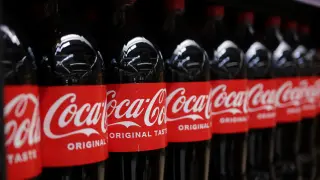
Coca-Cola releases yellow-capped bottles each spring containing cane-sugar Coca-Cola for Passover to signal the drink is kosher for the holiday and free of high-fructose corn syrup. The practice began in 1935 after a rabbi urged Coke to create a Passover-friendly version. While these yellow-cap bottles appear annually, cane-sugar Coke can be purchased year-round as Mexican Coke (usually in glass and pricier). Social media users are buzzing as people stock up during the two-week window.
Top executives including Coca‑Cola’s James Quincey and Walmart’s Douglas McMillon are stepping down to hand leadership to successors better aligned with AI-driven disruption; Quincey has overseen AI-related layoffs and argued the next wave requires different leadership. The moves, echoed by other tech-adjacent exits like Adobe’s Narayen, signal boards pushing for faster AI adoption amid concerns about labor costs and the broader impact of AI on capitalism.
The Motley Fool highlights Coca-Cola, Realty Income, and Walmart as durable, long-term dividend stocks. Coca-Cola boasts a 63-year dividend-raise streak, Realty Income offers a monthly dividend with a high occupancy rate, and Walmart benefits from steady sales and 53 years of dividend growth, making them solid anchors for a forever income portfolio.
The Schwab U.S. Dividend Equity ETF (SCHD) tracks the Dow Jones U.S. Dividend 100 Index and focuses on dividend quality and growth, a combination that has produced 12.9% annualized returns since its 2011 inception. Its holdings yield about 3.8% and grow dividends at roughly 8.4% annually, topping the S&P 500's ~1.2% yield and ~5% dividend growth. With Coca-Cola and PepsiCo among its top holdings (each ~4%), the fund benefits from steady income and rising earnings, supporting price appreciation and making SCHD a compelling long-term option for dividend investors.
With markets pulling back, the article outlines three dividend-focused strategies: anchor your portfolio with Dividend Kings Coca-Cola and PepsiCo for decades of rising payouts; add a quality dividend-growth stock like Microsoft for potential total returns; or diversify via a dividend ETF such as SCHD to balance yield with broad exposure and low fees, helping protect against downside while generating passive income.
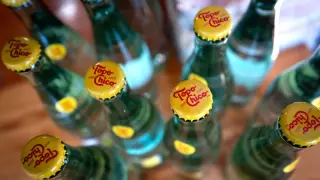
Coca-Cola says Topo Chico Mineral Water in glass bottles is temporarily unavailable in the United States due to upgrades at the water source and production facilities in Mexico, with supply slowed by problems at wells in Monterrey. Production is expected to resume later this year—likely in the third quarter—while other Topo Chico products remain available.
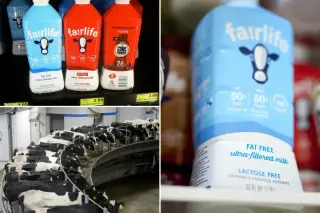
Coca-Cola reported Q4 2025 net revenues of $11.8B (up 2% y/y) and full-year net revenues of $47.9B (up 2%), with organic revenues up 5% in both periods. Q4 operating margin was 15.6% (comparable 24.4%); full-year margin was 28.7% (comparable 31.2%). Q4 EPS rose 4% to $0.53 (comparable $0.58); full-year EPS rose 23% to $3.04 (comparable $3.00). Cash flow from operations for 2025 was $7.4B, with free cash flow of $5.3B (or $11.4B excluding the fairlife contingent payment). For 2026, the company guides organic revenue growth of 4–5% with about a 1% currency tailwind and roughly a 4% headwind from acquisitions/divestitures, aiming for about $12.2B in free cash flow, while continuing strategic investments and maintaining its dividend and share repurchase program.
Coca-Cola posted a mixed Q4 2025, reporting adjusted EPS of 58 cents on $11.82 billion in revenue and net income of $2.27 billion. Unit-case volume rose 1%, with North America up 1% and Latin America up 2%, while premium drinks like Smartwater and Fairlife helped offset flat overall sparkling volumes. For 2026, the company guided 4%-5% organic revenue growth and 7%-8% comparable EPS growth, supported by strength in its water/tea/coffee portfolio. Shares have risen about 22% over the past year but fell roughly 3% in premarket trading after the report.