Tag

Cognitive Assessment

All articles tagged with #cognitive assessment

Medicare Annual Wellness Visit Unpacked: What to Expect, From an Expert
health2 days ago

Medicare Annual Wellness Visit Unpacked: What to Expect, From an Expert

A Medicare Annual Wellness Visit (AWV) is a nonphysical check-up that focuses on your medical history, current medications, and family history to tailor a personalized prevention plan. A cognitive assessment may be included to detect early impairment. To qualify, you must be enrolled in Medicare Part B for at least 12 months. If you visit an in‑network doctor, the AWV itself is typically no-cost, though additional diagnoses or tests outside the scope can incur out-of-pocket costs. Prepare by bringing a list of medications and dosages; the cognitive portion usually involves simple memory tasks. After the visit, prioritize preventive screenings such as blood pressure and cholesterol checks, diabetes screening for those with high BMI, lung cancer screening for long-time smokers, and age-appropriate mammograms, cervical cancer screenings (up to 65), colorectal cancer screenings (50–75), and prostate exams as advised by your doctor.

5-Minute Test Enhances Dementia Care in Primary Settings
health1 year ago

5-Minute Test Enhances Dementia Care in Primary Settings

A new five-minute cognitive assessment tool, 5-Cog, embedded in electronic medical records, significantly improved dementia diagnosis and care in a clinical trial involving 1,200 predominantly Black and Hispanic older adults. The tool tripled the odds of receiving dementia-related care within 90 days compared to standard care, highlighting its potential to reduce barriers and improve follow-up care in primary care settings. The study was funded by the NIH and published in Nature Medicine.

"Experts Urge Biden to Take Gold-Standard Dementia Tests as Scientists Stress Careful Diagnosis for Memory Loss"
health2 years ago

"Experts Urge Biden to Take Gold-Standard Dementia Tests as Scientists Stress Careful Diagnosis for Memory Loss"

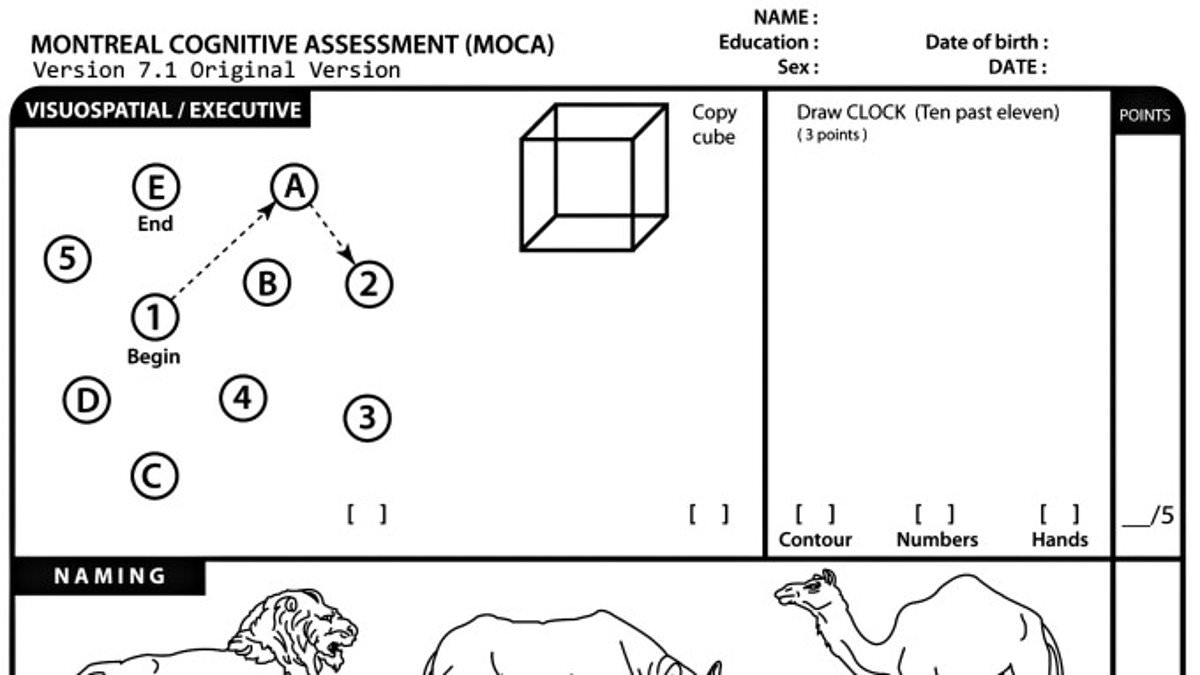
Doctors have requested that President Joe Biden takes the Montreal Cognitive Assessment (MoCA) to prove his mental acuity after a DOJ report described him as an "elderly man with a poor memory." The test assesses concentration, attention, memory, language, calculations, orientation, executive functions, and visual skills, with a score above 26 considered normal. Former President Donald Trump received a perfect score on the test and has urged Biden to take it. Concerns about Biden's mental and physical health have been raised, with 62 percent of voters expressing major concerns. The article includes details on the test and scoring criteria.

Rapid Detection of Mild Cognitive Impairment in Primary Care
healthcare2 years ago

Rapid Detection of Mild Cognitive Impairment in Primary Care

Primary care is an ideal setting for screening and detecting mild cognitive impairment (MCI) using brief cognitive assessment tools. Alberto Freire, MD, presented a stepwise algorithm for diagnosing and treating MCI, emphasizing the importance of functional assessment and deprescribing medications that contribute to cognitive disorders. Freire recommended picture-based tests and caregiver-oriented tests for cognitive assessment, as well as the use of the Mongil test for assessing activities of daily living. He also highlighted the need for comprehensive laboratory testing and neuroimaging. Nondrug therapies, such as cognitive training and rehabilitation, were emphasized, as there is currently no drug that is an improvement over nondrug therapies for MCI.

Advancements in AI Revolutionize Dementia Detection and Diagnosis
health2 years ago

Advancements in AI Revolutionize Dementia Detection and Diagnosis

Researchers at the University of Sheffield have developed CognoSpeak, an AI tool that utilizes virtual agents to engage patients in cognitive tests and analyze their language and speech patterns to assess the early signs of dementia and Alzheimer's. Accessible via a web browser, CognoSpeak aims to streamline the diagnosis process, with early trials showing a 90% accuracy rate in distinguishing Alzheimer's patients from cognitively healthy individuals. The tool is being tested more extensively across UK memory clinics with a target of 700 participants, and it has the potential to reduce waiting times and provide earlier access to treatments for patients.