
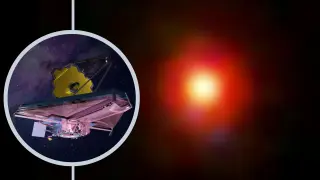
Little Red Dots Hint at Dense, Metal-Poor Hosts in the Early Universe
A new JWST analysis of 217 Little Red Dots (LRDs) in the early universe finds faint light from surrounding host galaxies, which are unusually compact (~1,400 light-years across) and metal-poor. The results suggest LRDs may be connected to bursts of star formation in their hosts (not just a central engine), offering a host-galaxy perspective on their origin and evolution. The study, led by Jorge Zavala (UMass Amherst), calls for spectroscopy and searches for local analogs, and was published in Nature Astronomy.