Tag

Dna Computing

All articles tagged with #dna computing

Maynooth University Unveils DNA Computer That Solves Math in a Drop of Saline
science2 months ago

Maynooth University Unveils DNA Computer That Solves Math in a Drop of Saline

Researchers at Maynooth University in Ireland have developed a new DNA-based computer, termed the Scaffolded DNA Computer (SDC), capable of performing complex calculations without continuous electrical power. Published in Nature on September 16, the system uses billions of DNA strands in a saline droplet to self-assemble into answers via thermodynamic favorability. It successfully executed 100-bit additions in 14 hours and simple sums in 30 seconds, marking a significant leap in molecular computing speed and efficiency.
Ireland’s Maynooth University Demonstrates Thermodynamically Driven DNA Computer in Nature
science2 months ago

Ireland’s Maynooth University Demonstrates Thermodynamically Driven DNA Computer in Nature

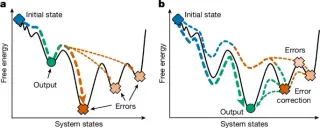
Researchers at Maynooth University have developed the Scaffolded DNA Computer (SDC), a molecular system that performs calculations by drifting toward thermodynamic equilibrium rather than consuming continuous energy. Published in Nature, the SDC executed ten distinct programs, including addition, multiplication, and division, with some tasks completing in under a minute. The system achieved up to 95% accuracy in standard tests and demonstrated reusability by running 25 consecutive calculations in a single droplet without performance loss. This approach eliminates the need for error-correction mechanisms typical of digital electronics, offering a potential pathway for ultra-low-energy computing and dense data storage.

Penn State Team Creates Ultra-Low-Power Memory Using Synthetic DNA and Perovskite
technology3 months ago

Penn State Team Creates Ultra-Low-Power Memory Using Synthetic DNA and Perovskite

Penn State researchers have developed a bio-hybrid memory device that combines synthetic DNA with crystalline perovskite semiconductors. This 'memristor' stores data by remembering previous electrical current directions, similar to neural function. The device operates at less than 0.1 volts and consumes 100 times less power than traditional storage while offering higher capacity. The technology aims to support energy-efficient AI and neuromorphic computing systems.