
Tag

Gtex

All articles tagged with #gtex

PathStAR maps organ-specific aging timelines and coordinated tissue decline
science1 month ago

PathStAR maps organ-specific aging timelines and coordinated tissue decline

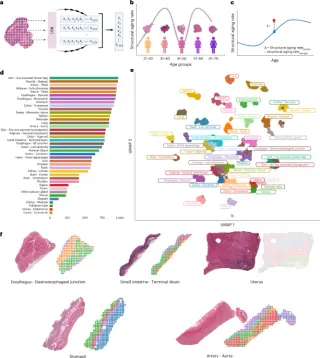
PathStAR (Pathology-based Structural Aging Rate) quantifies tissue structural aging from routine H&E slides without training on chronological age, analyzing ~25,000 GTEx postmortem biopsies from 970 donors (21–70 years) across 40 tissues. It reveals distinct, nonlinear aging trajectories: vascular tissues accelerate early, uterus and vagina accelerate around menopause, and several digestive and male reproductive organs show biphasic aging. Accelerations accompany increased inflammation and reduced energy production, repair, and quality control; cross-tissue analysis shows coordinated aging within individuals, including sex-specific patterns like uterus–vagina coupling, and germline variant burden associating with faster aging in certain tissues. PathStAR provides a new, quantitative dimension of aging that complements molecular clocks and is available as open-source software with GTEx data.
Histology-based tissue clocks reveal organ-specific aging patterns and disease signals
science1 month ago

Histology-based tissue clocks reveal organ-specific aging patterns and disease signals

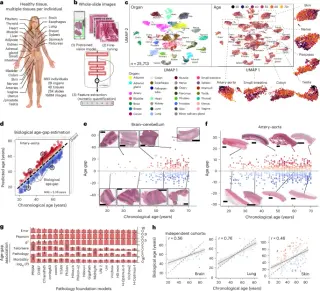
A large-scale study analyzes 25,713 whole-slide pathology images from 983 GTEx donors across 40 tissues to build tissue-specific “tissue clocks” that predict biological age from tissue morphology. The clocks achieve a mean absolute error of about 4.9 years and an r2 of ~0.69, with age gaps correlating to telomere shortening and subclinical pathologies. Higher age gaps accompany tissue-specific disease features and comorbidities, and tissue clocks generalize to independent brain, lung and skin cohorts. Comparisons with DNA methylation clocks show modality-specific strengths, while integrating RNA-seq data reveals tissue-specific gene expression changes linked to aging. Vision-language models help interpret aging-related histological features, and the authors demonstrate potential to predict tissue age gaps from blood expression, enabling non-invasive aging assessment and disease risk signals for conditions such as Alzheimer’s disease, stroke and Crohn’s disease.