
PathStAR maps organ-specific aging timelines and coordinated tissue decline
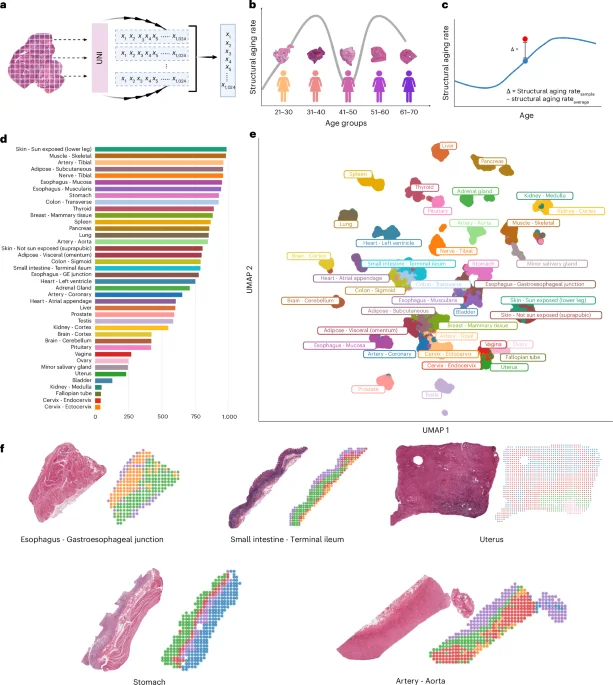
PathStAR (Pathology-based Structural Aging Rate) quantifies tissue structural aging from routine H&E slides without training on chronological age, analyzing ~25,000 GTEx postmortem biopsies from 970 donors (21–70 years) across 40 tissues. It reveals distinct, nonlinear aging trajectories: vascular tissues accelerate early, uterus and vagina accelerate around menopause, and several digestive and male reproductive organs show biphasic aging. Accelerations accompany increased inflammation and reduced energy production, repair, and quality control; cross-tissue analysis shows coordinated aging within individuals, including sex-specific patterns like uterus–vagina coupling, and germline variant burden associating with faster aging in certain tissues. PathStAR provides a new, quantitative dimension of aging that complements molecular clocks and is available as open-source software with GTEx data.
- Mapping structural aging across human tissues reveals tissue-specific trajectories and coordinated deterioration Nature
- Computer vision 'sees' our organs age at different rates Medical Xpress
- AI tissue clocks reveal how human organs are seen to age at different rates Labmate Online
- Every organ ages on its own schedule—and the schedules are in sync | Newswise Newswise
- Can Proteins Reveal How Fast Someone Is Aging? Technology Networks
Reading Insights
1
17
52 min
vs 53 min read
99%
10,442 → 114 words
Want the full story? Read the original article
Read on Nature