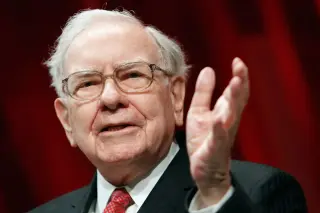
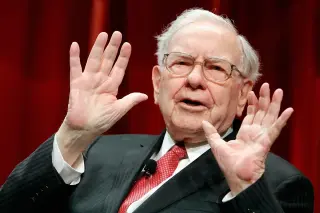
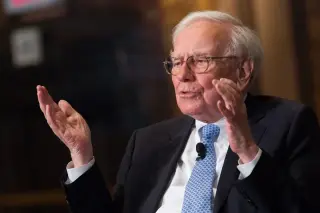
As the Nasdaq enters correction territory, investors are revisiting Warren Buffett’s 1999 warning that technological novelty does not guarantee financial returns. The advice emphasizes focusing on a company’s competitive durability rather than its societal impact.
Nvidia shares fell over 5% after co-founder Jensen Huang resigned amid allegations of ties to a suspected Chinese spy, leaving the stock 31% below its October high. While some investors view the drop as a rare opportunity to buy a high-growth asset at a discount, experts warn that founder-led companies often struggle to maintain growth after leadership transitions. Investors are advised to reassess their long-term thesis rather than blindly buying the dip.
With major U.S. stock indices down 3% to 8% from recent highs and the Fear and Greed Index at 23, The Motley Fool highlights Warren Buffett's 2008 advice that 'bad news is an investor's best friend.' The article argues that historical data shows the S&P 500 has delivered over 1,000% total returns since that advice was published, rewarding investors who bought during periods of panic rather than those who sold out of fear.
Warren Buffett advises investors to use market downturns to buy high-quality companies at discounted prices, emphasizing long-term value over short-term timing.
Despite fears of an AI-driven bubble, Warren Buffett’s philosophy advocates staying invested through volatility rather than attempting to time market crashes. Recent data shows that even a 99% decline in Berkshire Hathaway would not erase its outperformance of the S&P 500 since 1965, highlighting the power of long-term compounding. While the S&P 500 has risen 118% since the 2022 bear market bottom, driven by AI enthusiasm, experts emphasize that diversified portfolios and patience are more reliable predictors of success than predicting short-term downturns.
With US midterm elections approaching in November 2026, financial strategists are analyzing three primary outcomes for the S&P 500. JPMorgan identifies gridlock, a Democratic 'Blue Wave,' and a Republican 'Red Wall' as key scenarios, noting that divided government historically benefits markets by limiting fiscal expansion. Prediction markets currently favor a Democratic takeover of the House, with some odds suggesting a full sweep, though analysts caution that executive actions may persist regardless of congressional control.
Warren Buffett advises investors to hold cash and wait for a market crash rather than panic-selling, emphasizing that long-term value is created during periods of extreme volatility. This strategy aligns with historical data showing that bear markets, defined by a 20% drop, typically last nine months and are followed by strong recoveries. Recent market conditions, including rising bond yields and narrow tech-led rallies, have heightened concerns about a potential downturn, making Buffett's cautious approach relevant for investors seeking to preserve capital and identify undervalued opportunities.
A Yahoo Finance article argues that while some predict an imminent stock market crash, historical data over 155 years suggests investors who maintain a long-term strategy can still achieve positive returns. The piece emphasizes that market downturns are not inevitable and that disciplined investing approaches have historically outperformed panic-driven selling. It references broader market conditions, including elevated valuations and interest rate pressures, but concludes that historical patterns favor patience over fear. The article does not provide specific new data points but relies on long-term market behavior to counter crash predictions.
Warren Buffett’s foundational investment advice, 'Rule No. 1: Never lose money,' emphasizes avoiding permanent capital loss over chasing short-term gains. This philosophy, rooted in the concept of a 'margin of safety,' prioritizes downside protection to ensure long-term survival. While the primary source from Yahoo Finance failed to load, secondary sources confirm that this principle remains central to Buffett’s legacy, even as Berkshire Hathaway transitions to new leadership under Greg Abel.
Financial analysts suggest that the optimal strategy during a bear market is to maintain investment contributions rather than selling assets. Historical data indicates that U.S. bear markets occur approximately every 3.5 years and last an average of 289 days. By continuing to buy high-quality assets at lower prices, investors can lower their average cost per share through dollar-cost averaging. This approach positions portfolios to benefit from the subsequent recovery, as a significant portion of the S&P 500's best performance days often occur in the early stages of a new bull market.
The Motley Fool highlights Warren Buffett's 2008 advice to 'be greedy when others are fearful' as U.S. markets experience a sentiment shift. The Fear and Greed Index dropped from 71 in May to 37, entering 'fear' territory, while the Nasdaq Composite fell 9.7% since June. Although the S&P 500 is on track for a second consecutive monthly decline, the VIX volatility index fell 6.44% to 15.99, suggesting reduced short-term panic. The article argues that current volatility offers opportunities to buy quality stocks at discounts, citing historical data showing that long-term investors in S&P 500 ETFs during the 2008 crisis earned 126% returns over ten years.
SpaceX stock has fallen roughly 30% from its June IPO debut and over 50% from its all-time high of $225.64, following a brief surge that briefly made it the fifth-largest publicly traded company by market value. Financial advisors are urging investors to implement structured strategies, such as stop-loss orders or options, to manage volatility rather than reacting to panic. The decline follows a pattern seen in many large IPOs, where median returns drop 10% six months after lockup expirations. While some investors may hold for long-term growth, others are advised to rebalance portfolios to prevent SpaceX from overwhelming their overall holdings. The stock’s trajectory remains uncertain, with potential dilution from new share issuances and ongoing questions about the company's ability to sustain high launch rates and manage significant losses.
The article argues that a dividend-growth approach (starting with about 3.5% yield and payouts growing around 7% annually) can surpass a fixed 10% high-yield strategy over time because compounding and inflation protection boost long-term income. It presents three yield paths—Conservative (3–4%), Moderate (5–7%), and Aggressive (8–14%)—to reach a target of $80,000 annual retirement income, showing how growth-oriented dividend stocks (e.g., Johnson & Johnson, Procter & Gamble, Coca‑Cola, Microsoft, Lowe’s, Texas Instruments) can compound to roughly $310,000 in 20 years versus a flat 10% yield that would still be $80,000 in 20 years if payouts don’t grow. The piece cautions that high-yield vehicles like BDCs and mortgage REITs should be treated as spendable capital with principal risk managed accordingly, and emphasizes matching income needs to growth potential rather than chasing the highest starting yield.
Berkshire Hathaway’s Greg Abel is committing another $10 billion to Alphabet via a private placement, following an estimated $11 billion investment last quarter. The deal leverages Berkshire’s hefty cash pile (about $380 billion) and could make Alphabet Berkshire’s third-largest marketable equity position, echoing Buffett-like dealmaking by securing favorable terms. Abel’s move comes as Alphabet advances AI initiatives (Google Cloud and Gemini) and maintains solid growth, though the stock trades at a rich multiple relative to earnings; still, the investment signals Berkshire’s willingness to deploy cash into tech with long-term strategic value.
Berkshire Hathaway disclosed a roughly $2.6 billion stake in Delta Air Lines, marking its return to the airline sector after exiting in 2020 and placing Delta as Berkshire’s 14th-largest holding as of March. The report also notes broader portfolio moves, including trimming Chevron, boosting Alphabet, initiating a small Macy’s position, and unwinding Todd Combs–driven bets amid a cash-rich environment.