Contrasting Hues on Uranus’ Rings Suggest Distinct Origins
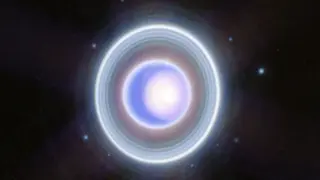
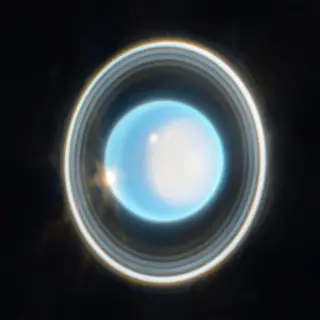
Using Hubble, JWST, and Keck, scientists show Uranus’ faint μ and ν rings have distinct colors and compositions: μ appears blue and icy, likely sourced from the moon Mab; ν appears red and dust-rich with 10–15% carbon-bearing organics, probably from micrometeorite impacts on rocky parent bodies. These differences raise questions about their origins and materials, and the rings—likely young and continually refreshed—will be monitored to track brightness changes and refine the system’s dynamics.