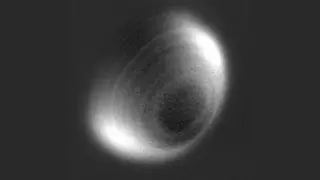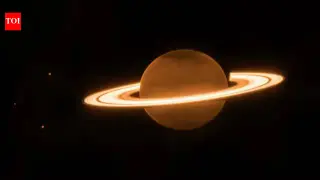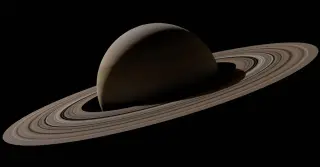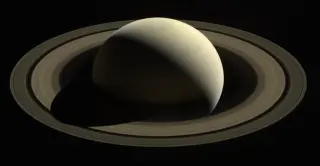
NASA’s joint observations from the Hubble and James Webb Space Telescopes deliver the most detailed, multi-wavelength portrait of Saturn to date, revealing a layered atmosphere and intricate ring structures by combining visible and infrared data to visualize atmospheric layers, jet streams, and seasonal changes as Saturn approaches its 2025 equinox.
NASA's James Webb Space Telescope (JWST) and the Hubble Space Telescope released complementary views of Saturn in infrared and visible light, revealing a dynamic atmosphere, bright rings, and several moons. The multi-wavelength approach lets scientists probe different atmospheric depths, effectively slicing Saturn's atmosphere by altitude. Webb highlights features like the long-lived northern ribbon wave and remnants of the Great Springtime Storm (2010–12), while Hubble shows color variations and ring shadows. Captured about 14 weeks apart in late 2024 as part of ongoing monitoring (including Cassini-era data and the OPAL program), the observations extend Saturn’s atmospheric record and demonstrate Webb’s infrared capabilities alongside Hubble’s view, in an international NASA/ESA/CSA collaboration.
Space.com reports Matija Ćuk and colleagues propose Saturn’s Titan may have formed from a collision/merger with a now-missing moon called Chrysalis about 100–200 million years ago. This upheaval could have widened Titan’s orbit, triggered further moon collisions, redistributed Saturn’s mass to alter its precession, and helped form Saturn’s rings. Hyperion might be a debris remnant from the event. Cassini data revised Saturn’s internal mass distribution, moving it slightly out of Neptune’s orbital resonance. There’s no direct evidence yet, but the scenario is being explored in Planetary Science Journal with an arXiv preprint, and future Dragonfly observations could test it.
A new Planetary Science Journal preprint argues Saturn’s young rings and Titan’s odd orbit could come from a past collision between two proto-moons, which produced Hyperion and destabilized inner moons; the Dragonfly mission to Titan (2034) may help test this scenario with fresh data.
Astronomers have observed for the first time rings forming around the centaur 2060 Chiron, revealing a rapidly evolving ring system that provides insights into the dynamics of small celestial bodies and their ring formation processes.
Instagram is launching 'Rings,' an awards program to honor top creators with physical and digital rings, judged by notable figures including Spike Lee and Marc Jacobs, aiming to celebrate creative risk-taking and influence on the platform.
The Philadelphia Eagles received their Super Bowl LIX rings after a delay due to production issues, featuring an intricate design with wings resembling their helmet logo, just in time for training camp as they aim for sustained success and possibly another championship.
A new hypothesis suggests that the collision of Comet Shoemaker-Levy 9 with Jupiter in 1994 may have left the planet with a new, thin ring. The comet's fragments, which were the first observed hitting another Solar System body, could have generated dust particles that settled into a ring around Jupiter. This proposal, presented by Professor Mihaly Horanyi, awaits confirmation from NASA's Europa Clipper mission, which will study Jupiter and its moons in 2030.
A new study suggests that a massive asteroid impact may have once given Mars a set of rings, which eventually coalesced into its current moons, Phobos and Deimos. This theory provides a potential explanation for the unusual orbits and characteristics of these Martian moons, indicating a dynamic history of celestial events around the planet.
Millie Bobby Brown and Jake Bongiovi were spotted in the Hamptons flaunting their wedding rings, confirming their secret marriage. The couple, who started dating in 2021 and got engaged last year, are planning a larger ceremony later this year. Their recent public appearance, filled with celebratory gestures, suggests they are indeed newlyweds, although official confirmation from Millie's representatives is still pending.
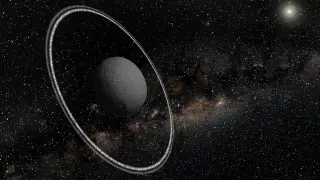
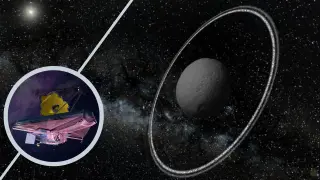
Scientists have discovered that the asteroid-like minor planet Chariklo, located in the space between Jupiter and Neptune, is circled by a pair of gossamer rings likely shepherded by a tiny, unseen moonlet. The rings are being maintained and shaped by the moonlet, keeping them tidy and preventing them from dispersing. This discovery sheds light on the complex lives of minor planets and adds to our understanding of ring formation around small celestial bodies.
Computer simulations suggest that a small, unseen moonlet may be responsible for shaping the thin rings around the distant minor planet Chariklo, a Centaur located between Jupiter and Neptune. These rings, which are not like the rings of giant planets, are thought to be sculpted by the influence of a small satellite, keeping them narrow and preventing them from dispersing. The rings are primarily made of water ice, and their formation and stability are still under investigation.
Astronomers have suggested that a previously unknown satellite may be responsible for shaping the rings of Chariklo, a small body located between Saturn and Uranus. Recent simulations indicate that the rings are being confined by a satellite, potentially preventing them from dispersing. The team's N-body simulations suggest that a satellite with a diameter of about 3.73 miles could maintain Chariklo's thin rings. Further observations are needed to confirm the presence of this satellite, as current imaging technology is not capable of directly spotting it.
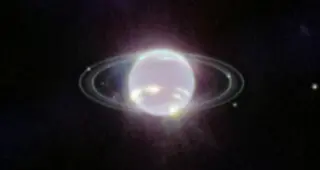
The James Webb Space Telescope has captured detailed images of Uranus, revealing its dynamic atmosphere, including rings, moons, and storms. These observations provide insights into the study of exoplanets and help astronomers understand the formation and meteorology of similarly sized planets. Uranus' unique tilt and extreme seasons make it a valuable proxy for studying exoplanets. The images show a more active Uranus with a prominent seasonal north polar cloud cap and several storms, and astronomers are eager to monitor changes as the planet approaches its next solstice in 2028.
NASA's James Webb Space Telescope has captured a high-resolution image of the rings of Uranus, revealing its inner and outer rings as well as its 27 known moons. The image, which shows the planet's cloudy north pole and storms within its atmosphere, provides valuable information for future missions to Uranus and helps scientists understand the meteorological systems of similar-sized planets in the universe. NASA scientists are now calling for an exploratory probe to further study Uranus and its moons based on the insights gained from the James Webb's observations.