
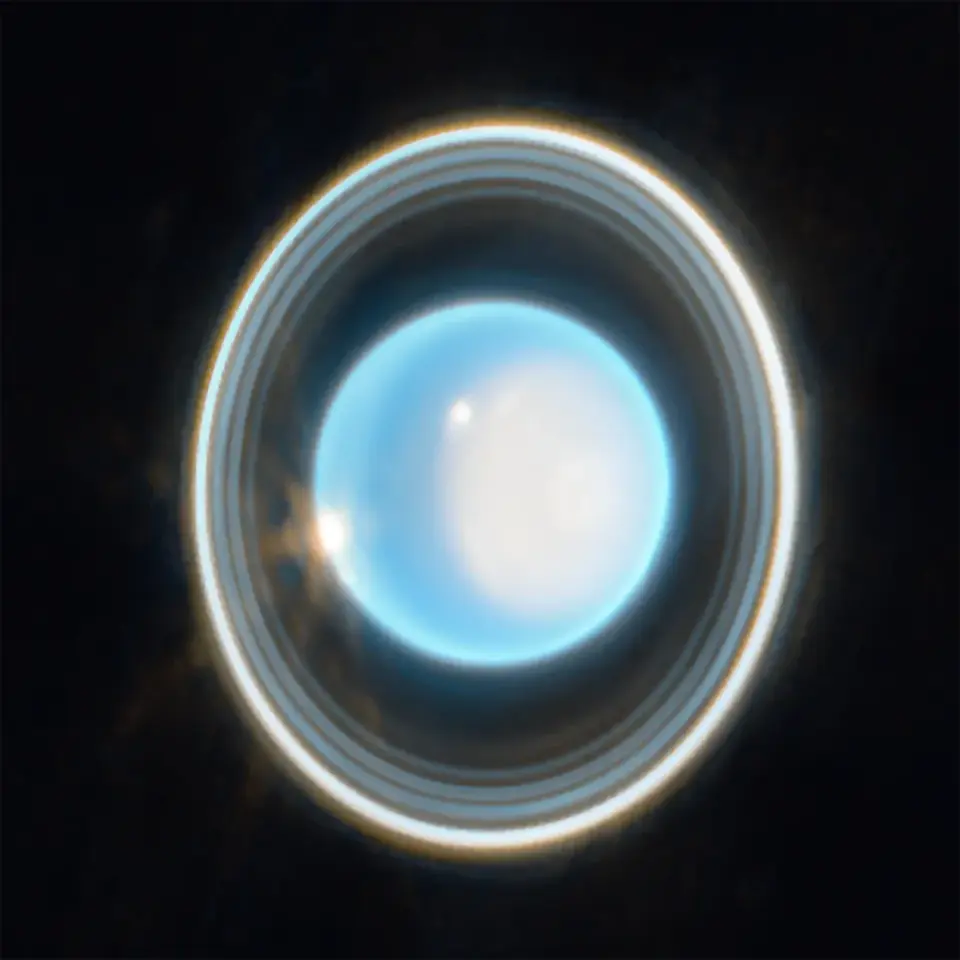
Contrasting Hues on Uranus’ Rings Suggest Distinct Origins
TL;DR
Using Hubble, JWST, and Keck, scientists show Uranus’ faint μ and ν rings have distinct colors and compositions: μ appears blue and icy, likely sourced from the moon Mab; ν appears red and dust-rich with 10–15% carbon-bearing organics, probably from micrometeorite impacts on rocky parent bodies. These differences raise questions about their origins and materials, and the rings—likely young and continually refreshed—will be monitored to track brightness changes and refine the system’s dynamics.
- Scientists Find Peculiar Differences in Two Uranian Rings Universe Today
- Uranus’s Outermost Rings Are Made of Two Different Things Sky & Telescope
- Mysterious rings around Uranus point to hidden moons orbiting the ice giant Space
- The Origins of Uranus’ Distant Rings Hint at a Hidden Moon Nautilus | Science
- Distinct origins of two outermost rings of Uranus uncovered by new study Maui Now
Want the full story? Read the original reporting
Read on Universe Today