Jason Kelce argues on New Heights that Sunday is the heart of NFL tradition, but the league’s growing use of standalone games on other days risks diluting that Sunday‑feeling, even as broadcast rights and new media partnerships push football onto more days and platforms.
An opinion piece argues LIV Golf’s plan to raise up to $250 million to reach profitability in about 20 months rests on shaky ground: four years of cash burn with little growth, US TV ratings rarely above 500,000 per round, a nominal Fox Sports deal, and limited sponsorship. Even if funding hits $250 million (or $170 million), profitability would depend on a meaningful media-rights deal after Fox expires and rising team values, which the author says is unlikely, casting doubt on LIV's survival beyond the near term.
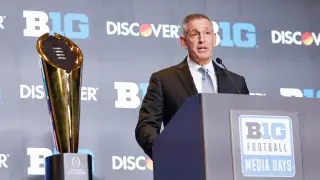
The Athletic reports that major conferences back expanding the College Football Playoff to 24 teams even though revenue models aren’t settled. ESPN prefers keeping the field at 12–16, while Fox supports wider access to attract more networks; Big Ten Commissioner Tony Petitti says there’s a deep commitment to 24, not 16. Replacing roughly $200–$250 million in annual conference-championship revenue and offsetting it with on-campus games is a central hurdle, and critics warn increased field size could dilute competition. Bidders beyond ESPN and Fox—potentially TNT/CBS—enter the mix, with comparisons to the March Madness expansion history suggesting the financial and scheduling complexities could temper any push to 24, possibly capping expansion or delaying final decisions.
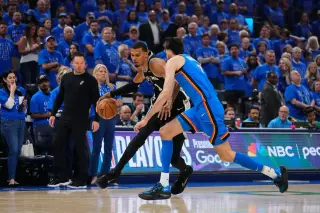
Sports Media Watch analyzes the NBA's decision to air a second‑round Game 7 on Amazon Prime Video, framing it as a litmus test for streaming’s ability to attract marquee viewership and comparing Prime’s performance with traditional broadcast windows on ABC/NBC. The piece notes NBC’s strong Sunday‑night numbers and situates Prime within the broader shift of league rights toward streaming, suggesting a typical Game 7 could land in the 6–7 million viewer range (with occasional higher peaks), illustrating the ongoing tension between revenue‑driven streaming deals and broad audience reach.
The NFL will add four new national broadcast windows by reallocating two ex-ESPN MNF games to FOX and NBC, with CBS also adding a primetime Saturday slot. The arrangement shifts ESPN/ABC’s MNF inventory to broadcast TV and ties into broader streaming-rights dynamics involving Netflix and YouTube, including a Munich Week 10 game and a Week 15 Saturday window, plus NBC’s Week 17 Peacock slot.
The Cardinals-Padres four-game series in San Diego is broadcast on ESPN, Apple TV, a Fox regional network, and each team’s local RSNs, with four different start times, illustrating MLB’s fragmented rights and prompting fan frustration over needing multiple subscriptions to follow a marquee series.
Netflix is reportedly close to a five-game NFL package for next season, including the two Christmas games already under contract plus a Week 1 Australia game and a Thanksgiving Eve game; a Week 18 Saturday game is also in play. YouTube’s planned five-game package remains uncertain, with reports that the two games it was set to receive are being shopped to traditional broadcasters, raising the possibility that YouTube winds up with nothing as the NFL shifts sales to CBS, NBC, ESPN and Fox. The situation remains fluid ahead of the 2026 schedule release.
The NFL plans a modest increase in its broadcast footprint for next season as it faces a DOJ antitrust probe and an FCC inquiry into media-rights practices, with streaming partners like YouTube and Netflix expected to receive additional games while most games still air on free over-the-air networks (87% last season).
The Big Ten distributed a record $1.37 billion to its 18 member schools in FY2024-25, about $76.1 million per school on average, with Washington and Oregon receiving smaller shares after joining in 2024. The payout reflects the full implementation of the conference’s seven-year media-rights deal with Fox, CBS and NBC and the first year of the expanded College Football Playoff, as Ohio State won the national title and Indiana, Penn State and Oregon advanced to the CFP field. The SEC had previously announced about $1.03 billion in shares for its universities that year.
With LIV's funding in flux, Bryson DeChambeau's potential PGA Tour return may hinge on media‑rights rules: the Tour currently bars content that substitutes for official broadcasts, potentially limiting his YouTube output unless policy changes; insiders differ on the likelihood of adjustments—some expect changes, others say he won’t return if he must relinquish YouTube profits. DeChambeau has hinted at stepping back from full‑time play to focus on YouTube, possibly competing only in majors, and the Tour under Brian Rolapp is moving toward modernization that could make keeping the channel more feasible given his star power.
The Big Ten posted a record $1.47 billion in revenue for the 2024-25 fiscal year and distributed $1.37 billion to its 18 member schools, up $540 million from the prior year thanks to an 18-member season, more than $1 billion in media-rights income, and the 12-team College Football Playoff; Ohio State led payouts at about $91.6 million, with other members earning roughly $76–89 million, while the conference also faced costs like legal fees and officiating technology.
Prime Video will exclusively stream three Duke men's basketball neutral-site nonconference games per season, marking its first foray into college sports. The inaugural schedule features Duke vs. UConn in Las Vegas (Nov. 25), Duke vs. Michigan at Madison Square Garden (Dec. 21), and Duke vs. Gonzaga in Detroit (Feb. 20), with Prime Video producing all games. Duke will also participate in ESPN-owned neutral-site events in 2027‑28 and 2028‑29 as part of the deal, expanding Prime Video's live-sports portfolio.
High prices for NFL and NBA teams, driven by massive media-rights deals, are pushing investors to cheaper, smaller leagues like the NWSL. Expansion fees for new NWSL teams have surged (Columbus at $205M, up from earlier multi‑million marks), while overall league valuations climb to record levels. Private‑equity groups and consortium buyers are chasing these “second‑tier” sports as a way to gain exposure, causing bidding wars even as some bankers warn the underlying economics may not support such prices. The trend is underscored by record MLB sales and the broader value surge across professional sports, with little payoff in some women's leagues like the WNBA/NWSL aligned with new player deals, raising questions about long‑term profitability.)
The NBA’s new media rights deal is lifting playoff ratings, with the first round averaging 3.84 million viewers across NBCUniversal, ESPN/ABC and Prime Video through Sunday—up 20% from last year and the highest at this stage since 1993. NBC’s exclusive broadcast windows helped drive gains, yielding weekend peaks like Celtics–Sixers (about 6.3M), Lakers–Rockets (about 6.2M) and Knicks–Hawks (about 5.3M). ESPN/ABC were down in several windows, while Prime Video posted double‑digit increases. Nielsen’s evolving methodology and NBC’s combined Nielsen + Adobe figures complicate year‑over‑year comparisons, but the trend suggests stronger overall ratings driven by more broadcast exposure and streaming presence rather than cable exclusivity.
The NCAA is close to officially expanding the men’s and women’s tournaments to 76 teams for the 2026-27 season, adding more pre-tournament play-in games (eight more teams must win a play-in to reach the traditional 64-team bracket). TV rights talks are ongoing, with ESPN not expected to pay more for the women’s tournament while CBS/TNT are likely to pay modest increases for the men’s. The change is framed as boosting access rather than revenue and has drawn fan skepticism.