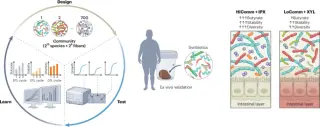
A machine-learning framework is used to identify optimal gut microbial communities and nutrient inputs to maximize predefined health benefits, enabling AI-driven design of gut microbiomes as a tool in synthetic biology.
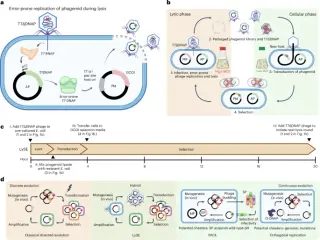
LySE is a T7 phage–based system that merges discrete, checkpointed mutagenesis with continuous-like selection to accelerate evolution of large gene clusters (up to ~39 kb) while preventing off-target host mutations. It uses a biocontained phagemid, an accessory plasmid expressing a hypermutagenic T7 DNA polymerase, and cycles of lysis and transduction to rapidly mutate and select GOIs. Variants v8 and v9 achieve mutation rates up to 3.82×10⁻⁵ substitutions per base, with balanced transition mutations aided by TadA-8e and TadDE deaminases. Demonstrations include evolving tetA for tigecycline resistance and a five-gene ethylene glycol assimilation pathway, outperforming ALE in on-target evolution and enabling rapid optimization of complex metabolic pathways with potential applications in plastics recycling and beyond.
Researchers engineered E. coli to produce tagatose by introducing a slime mold Gal1P enzyme, achieving up to 95% yield; tagatose is a rare, naturally occurring sugar about 92% as sweet as sucrose with roughly a third of the calories and no insulin spike, offering a scalable alternative to sugar and artificial sweeteners; the study lays a framework for rare-sugar production, with the market expected to reach around $250 million by 2032.
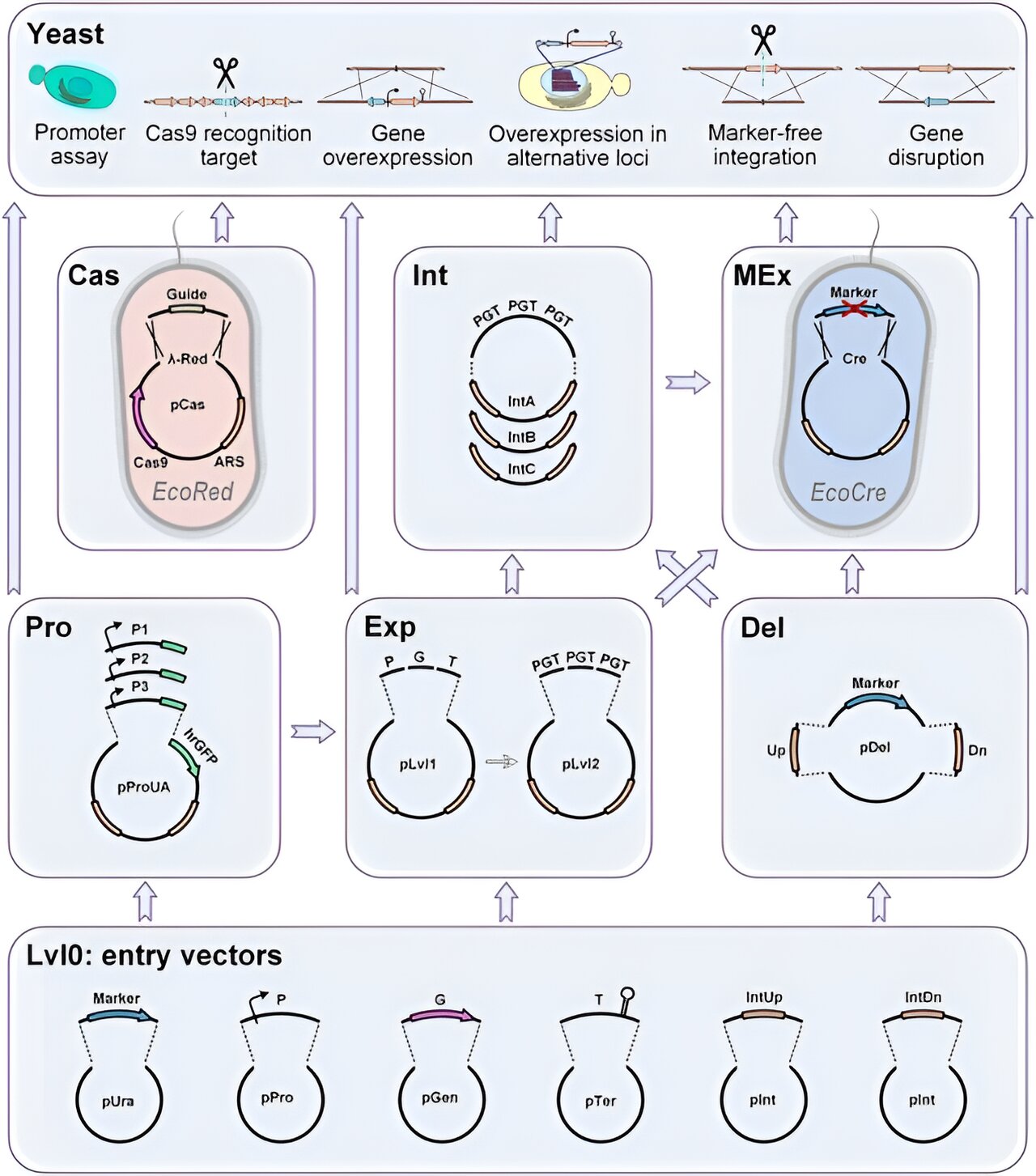
Researchers have developed a comprehensive DNA assembly toolkit to unlock the potential of CRISPR-Cas9 for metabolic engineering. The toolkit consists of seven modules that enable quick and easy assembly of integrative constructs and Cas9-helper plasmids. It includes methods for marker-free integration, donor DNA re-direction, and cloning of guide RNAs. The researchers demonstrated the functionality of the toolkit by engineering yeast to produce homogentisic acid, a precursor for pyomelanin, a constituent of natural sunscreens and cosmetics. The toolkit has broad applications in strain engineering and is expected to facilitate advancements in metabolic engineering and other fields of biological engineering.