Tag

Molecular Machines

All articles tagged with #molecular machines

science1 month ago

Helicene Molecule Achieves 100% Directional Rotation via Electric Current

A multinational research team has demonstrated a current-driven molecular machine using a helicene molecule suspended between gold electrodes. The device exhibits 100% directional rotation preference, which can be reversed by changing voltage polarity. Above a specific voltage threshold, the rotating molecule’s conductance increases significantly, a phenomenon absent in previous helical junctions. Theoretical calculations confirm that current-induced forces drive this cyclic motion, enabling a transition from stepwise to continuous rotation that accesses highly conducting configurations. This prototype represents a new class of torque-driven molecular machines with perfect rotor unidirectionality and substantial current modulation capabilities.

"Study Unveils Revolutionary Kinetic Asymmetry in Molecular Interactions"
science-and-technology2 years ago

"Study Unveils Revolutionary Kinetic Asymmetry in Molecular Interactions"

Researchers have discovered a new type of non-reciprocal molecular interaction, termed kinetic asymmetry, which does not require external forces such as hydrodynamics. This phenomenon could redefine our understanding of molecular interactions and has implications for the evolution of life and the design of molecular machines. The study, conducted by scientists from the University of Maine and Penn State, suggests that local gradients of reactants and products around catalysts, like enzymes, can lead to one molecule being repelled by yet attracting another molecule. This insight into kinetic asymmetry could also inform the development of synthetic molecular motors and pumps, offering a deeper understanding of the origins of life and the complex behavior of matter.

"Light-activated molecular machines revolutionize cell communication and drug delivery"
science-and-technology3 years ago

"Light-activated molecular machines revolutionize cell communication and drug delivery"

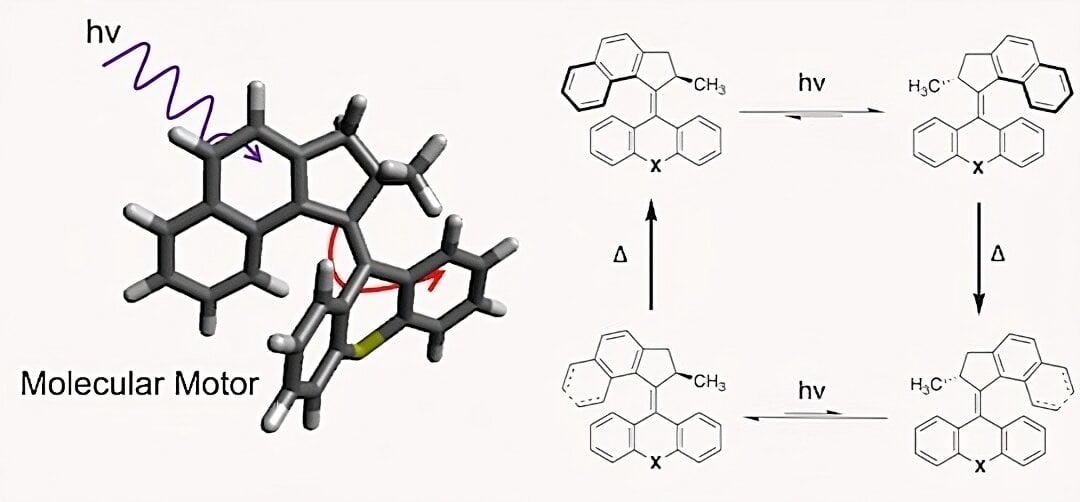
Scientists at Rice University have used light-activated molecular machines to trigger intercellular calcium wave signals, offering a new approach to controlling cellular activity. By rotating small-molecule-based actuators with visible light, they induced a calcium-signaling response in smooth muscle cells. This breakthrough could lead to improved treatments for heart problems, digestive issues, and other diseases characterized by calcium-signaling dysfunction. The ability to control cell-to-cell communication in muscle tissue at the molecular level has the potential to revolutionize medical interventions.