Tag

Mom Bh 1

All articles tagged with #mom bh 1

JWST spots solar-system-sized 'black hole star' in the early universe
space1 month ago

JWST spots solar-system-sized 'black hole star' in the early universe

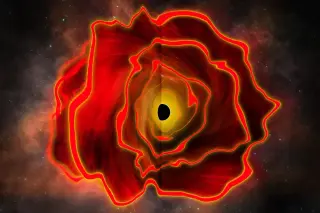
Astronomers using the James Webb Space Telescope have spotted MoM-BH*-1, a solar-system-sized, red, gas-enshrouded object about 660 million years after the Big Bang. Interpreted as a black hole star—a massive black hole wrapped in a cocoon of dense gas—the object could be the best evidence yet for this hypothetical class and may explain the mysterious 'little red dots' seen by JWST. The central black hole could weigh up to about 100,000 solar masses, and while previous candidates existed, MoM-BH*-1 is farther away and thus more informative; further observations are needed to confirm the model and understand how such objects form.
Webb spots solar-system-sized dot likely a black hole star from the dawn of the universe
space-and-astronomy1 month ago

Webb spots solar-system-sized dot likely a black hole star from the dawn of the universe

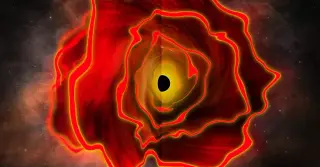
The James Webb Space Telescope identified MoM-BH*-1, a solar-system-sized, ruby-red dot seen about 660 million years after the Big Bang, proposed as a new object class: a black hole star—a dense shell of gas around a massive black hole. If confirmed, it would be the strongest evidence yet for this type of object and could help explain the enigmatic “little red dots” JWST has found. The object may host up to ~100,000 solar masses, with its Balmer-break spectrum indicating a dust-free, hydrogen/helium gas cocoon rather than ordinary starlight; further observations and modeling are needed to verify this interpretation.

JWST Spots a Black Hole Star Lighting Up the Early Universe
science1 month ago

JWST Spots a Black Hole Star Lighting Up the Early Universe

Using the James Webb Space Telescope, scientists describe MoM-BH*-1—a black hole embedded in a massive, luminous gas envelope that glows bright red about 660 million years after the Big Bang. The object emits energy far exceeding normal stars, while dense surrounding gas absorbs light in a way that makes the source appear star-like. This provides evidence for the existence of black hole stars and may explain mysterious red spots seen in the early universe.

Cosmic Oddity: JWST Identifies a One-in-a-Billion Black-Hole Star
science1 month ago

Cosmic Oddity: JWST Identifies a One-in-a-Billion Black-Hole Star

Astronomers using the James Webb Space Telescope have identified MoM-BH*-1, a rare hybrid object that blends a star-like gas cloud with a black hole about 100,000 solar masses. It emits energy far exceeding typical stellar formations and is about 100 billion times brighter than the average star, even outshining its host galaxy. This “black-hole star” could explain the little red dots seen in JWST images from the dawn of the universe and may shed light on how the first cosmic structures formed; researchers will continue studying its size and atmospheric composition with JWST starting in December.