
space-and-astronomy53.375 min read
US Air Force Antarctic flight rerouted after space debris warning
1 month ago•Source: yahoo.com

The latest space and astronomy stories, each synthesized from multiple sources with added background and context.
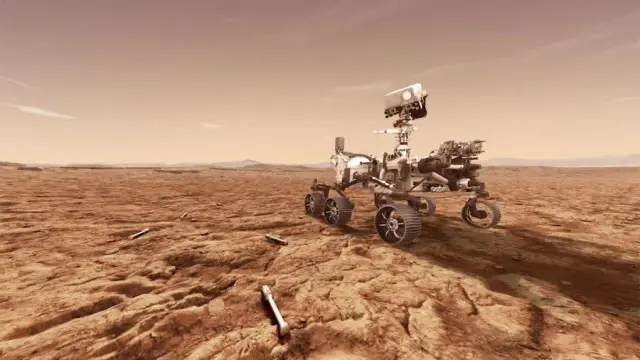
China announced a timeline to retrieve Mars surface samples with the Tianwen-3 mission (planning a 2028 launch) that would collect about 500 grams and return them to Earth by 2031, with analysis in a biosphere‑guarded lab in Anhui. If funded and realized, it would surpass NASA/ESA efforts for Mars sample return, whose program has faced funding cuts, and could offer biosignature insights about whether Mars hosted life, though such plans remain contingent on diplomacy, funding and technical success.
Yahoo•1 month ago
Yahoo•1 month ago

A Space.com study on Reflect Orbital’s plan to deploy space mirrors finds that a single 60-by-60-foot mirror would cast a beam roughly 3.4 miles wide that appears 40 times brighter than the full Moon to observers in its path, turning the night sky into a twilight zone and washing out stars within the beam. The glow would extend up to about 50 miles from the beam, and could brighten the sky above the horizon for many miles in the beam’s direction, depending on conditions. If 40,000 mirrors were launched, the combined light could be 10,000 times brighter than the full Moon, creating daytime-like brightness that could hinder astronomy, even as proponents tout potential uses for nighttime solar power and disaster illumination. The FCC licensed a demonstration satellite (EARENDIL-1) for this concept, prompting objections from astronomers and environmental groups; Reflect Orbital argues that only a fraction would be active and that coordination with NSF and independent researchers is planned. The debate highlights a tension between space-led lighting/testing and preserving dark skies for astronomy.
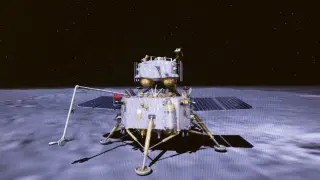
China’s China Manned Space Agency said the Chang’e-7 lunar mission will be postponed as launch conditions were not met, highlighting prudence and the goal of absolute mission success. Weather factors (including Typhoon Narra) and potential technical issues are cited, reflecting a broader, safety-focused sprint in the Moon race against NASA’s Artemis program that is likely to extend beyond this year in pursuit of a permanent lunar presence.

China announced the postponement of the Chang’e-7 lunar mission, saying it did not meet launch conditions for this year’s window. The mission, planned to launch from the Wenchang Space Launch Site on Hainan, aimed to explore permanently shadowed lunar craters, search for water ice, and conduct environmental and resource surveys as part of China’s lunar program. The decision emphasizes prudence to ensure absolute success, with no new launch date disclosed yet.
Astronomers have identified GJ 523b, a dense 'mega-Earth' about 2.5 times Earth in size and around 23 times as massive, with a surprisingly thin atmosphere. Discovered by NASA’s TESS and examined with the WIYN telescope and the James Webb Space Telescope, the planet’s high density and lack of a thick gaseous envelope defy simple formation models, leading researchers to speculate that extreme heat or a past planetary collision stripped away much of its atmosphere and to push for a clearer definition of the Mega-Earth category.
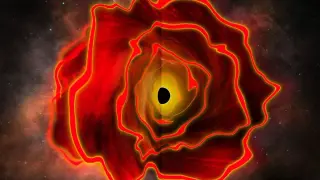
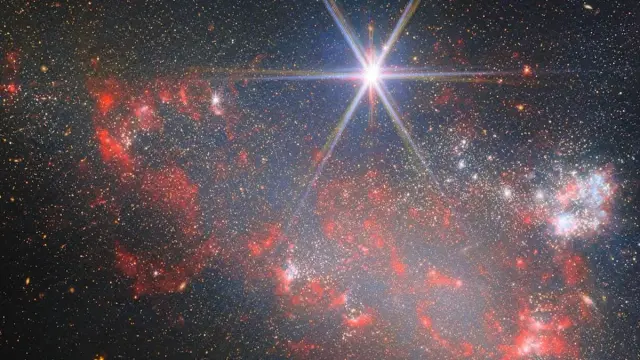
The James Webb Space Telescope identified MoM-BH*-1, a solar-system-sized, ruby-red dot seen about 660 million years after the Big Bang, proposed as a new object class: a black hole star—a dense shell of gas around a massive black hole. If confirmed, it would be the strongest evidence yet for this type of object and could help explain the enigmatic “little red dots” JWST has found. The object may host up to ~100,000 solar masses, with its Balmer-break spectrum indicating a dust-free, hydrogen/helium gas cocoon rather than ordinary starlight; further observations and modeling are needed to verify this interpretation.
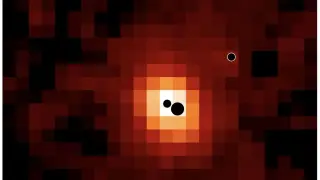
Astronomers using the JWST have identified three active black holes in the distant galaxy J0148-4214, about 12.5 billion light-years away. Two lie at the core (80 million and 600,000 solar masses) and are 620 light-years apart, while a third, ~2 million solar masses, sits ~5,500 light-years away and may merge with the pair or escape. The system supports rapid black-hole growth in the early universe via mergers and foreshadows future low-frequency gravitational-wave detections by space-based observatories like LISA.
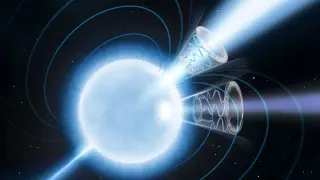
Observations of a highly magnetic magnetar (1E 1547-5408) with NASA’s IXPE show X-ray polarization nearly three times higher than typical neutron-star emission and aligned with the star’s magnetic field, providing the strongest evidence yet that vacuum birefringence occurs—empty space acting like a prism under extreme magnetic fields. This long-predicted quantum effect, rooted in Heisenberg and Euler’s work from 1936, tests quantum electrodynamics in nature’s most extreme laboratories and motivates future missions (e.g., GoSOX) to confirm the finding.
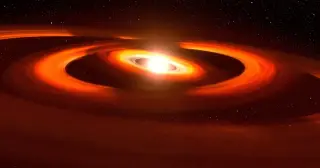
Using the James Webb Space Telescope, scientists have identified MoM-BH*-1—a black hole star about 100,000 solar masses formed less than 700 million years after the Big Bang. Its center is a black hole that relentlessly accretes matter, emitting about 100 billion times more energy than a typical star, while a dense gas shell makes it appear star-sized. The finding suggests other so-called 'Little Red Dots' could be black hole stars, potentially reshaping our understanding of early galaxies and black hole growth.
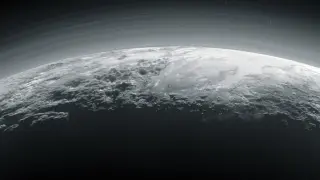
Astronomers report Pluto’s nitrogen-rich atmosphere is starting to freeze out as it moves away from the Sun, with atmospheric pressure dropping about 16% between mid-2021 and 2023. Pluto’s surface runs at roughly -382°F while the upper atmosphere sits around -333°F, conditions that favor frost formation as the air cools. Observations of ten stellar occultations from 2017–2023 show haze in the lower atmosphere settling toward lower latitudes as pressure falls. The findings, led by Amanda Sickafoose, suggest the atmosphere will not be fully frozen by aphelion (2114) but should rebuild somewhat as Pluto travels back toward the Sun. The study was published July 31 in the Planetary Science Journal.
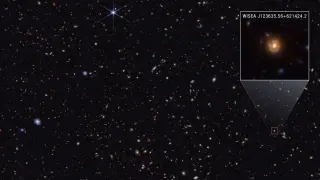
New JWST imagery suggests the enigmatic 'little red dots' seen in deep-field images are likely ordinary distant galaxies whose bright centers outshine the rest, rather than a new class of object. Researchers used the nearby spiral galaxy Saguaro (about 3.3 billion years after the Big Bang) to model how such galaxies would look at earlier epochs, showing that LRDs could be early-universe galaxies with active nuclei and offering clues about how galaxies and their central black holes grew over cosmic time.