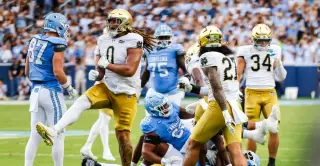
Notre Dame opens the 2026 college football season ranked No. 4 in the AP preseason poll, earning several first-place votes; its top opponents in the poll are Miami (No. 7), BYU (No. 14), and SMU (No. 19), while Ohio State, Oregon, and Georgia occupy the top three spots.
CBS Sports' preseason 2026 CFP projection envisions a 12-team field led by Notre Dame and Georgia as the top seeds, with byes for Notre Dame, Ohio State, Georgia, and Miami. The bracket advances through first-round and quarterfinal upsets to set up semifinals Texas vs. Ole Miss and Ohio State vs. Georgia, with Ohio State then defeating Texas in the national championship to claim the title.
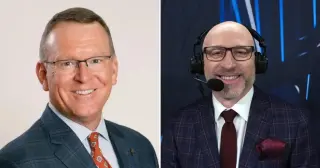
Joel Klatt unveils a 2026 preseason Top 25 led by Oregon at No. 1, with Notre Dame second and Ohio State, Miami, and Indiana rounding out the top five. The piece lauds Oregon’s elite, returning roster and Dante Moore at quarterback, notes Notre Dame’s 15 returning starters and strong front, and surveys other contenders (OSU, Miami, Indiana, LSU, Texas, USC) with emphasis on roster depth, coaching stability, and schedule challenges driving the predictions.
The Athletic explores how the Protect College Sports Act, which would cap Power 4 conferences at 19 teams and require a five-year independent period before joining another Power 4 league, could reshape realignment. It lays out a plausible 19-team lineup for each league: Big Ten adds Notre Dame (with other discussed options like UNC, Virginia, Georgia Tech, FSU, Clemson, Miami); SEC adds UNC, Virginia, and Miami; ACC adds Tulane, USF, UConn, Army and Navy; Big 12 adds Boise State, Memphis, and San Diego State. Washington State/Oregon State are noted as less likely. The piece emphasizes this is speculative and contingent on the bill passing, guided by academic and geographic considerations as much as football pedigree.
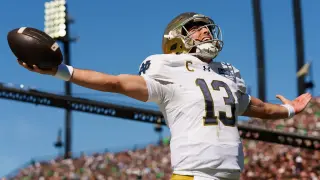
Notre Dame's first August practice featured early offensive misfires and a patient coach's plan, but quarterback CJ Carr demonstrated trust and capability behind a deep defense, with freshmen and transfers flashing potential as the program begins a long-build toward the opener.
On Day 1 of Notre Dame fall camp, CJ Carr looked like the likely starter, with two young quarterbacks also turning heads with encouraging early impressions.
Notre Dame updated its 2026 roster on Wednesday night, with Blue & Gold Football highlighting the biggest weight changes since early June, including defensive tackle Tionne Gray.
After a controversial CFP exclusion and a bowl-less season, Notre Dame is determined to control its playoff destiny in 2026, riding a strong returning defense, an experienced quarterback in CJ Carr, and a stable coaching staff. The Irish must start fast after last year’s early stumbles, opening the season at Lambeau Field against Wisconsin, with a relatively light Top 25 slate looming, and no room for another slow start.
Notre Dame and USC will revive their historic football rivalry after a four-year pause, with 2030-31 games starting as a Week 1 home-and-home and subsequent matchups slated for early-season dates before USC’s Big Ten schedule; the piece argues Lincoln Riley engineered the hiatus to gain playoff leverage, making the return bittersweet and highlighting how college football’s governance has sometimes prioritized revenue and optics over tradition.
Notre Dame and USC will revive their historic football rivalry in 2030 for at least four seasons in a home-and-home series, with the 2030 game at the Los Angeles Coliseum and the 2031 game at Notre Dame, and the 2032–2033 editions scheduled between Weeks 1 and 3; continuation beyond 2033 will require mutual agreement.
A federal injunction requires the NCAA to restore a year of eligibility for 2022 recruits who have exhausted four seasons, though players must have entered the Transfer Portal during the January window to be eligible to transfer. Notre Dame could benefit from adding veteran edge rusher Junior Tuihalamaka, but questions of conditioning, health, and how it would affect the development of younger linemen complicate the decision as fall camp approaches, even as the program boasts a strong roster.
Notre Dame and USC will renew their long-running football series for four years starting in 2030, with games set for Aug. 31, 2030 in Los Angeles and Aug. 30, 2031 in South Bend, after a multi-year hiatus and public scheduling battles tied to conference realignment. The deal was aided by Indiana backing out of its 2030–31 home-and-home with Notre Dame, and ND will also face Alabama early in the 2030 slate as part of a tightened schedule.
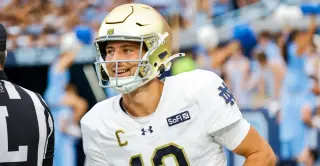
Notre Dame reportedly inked a jersey-patch deal with SoFi worth about $18–$20 million per year, surpassing Ohio State's patch deal and illustrating how college programs are monetizing uniforms; the trend could push the NFL toward jersey ads as well, with revenue potentially shared with players via the NFLPA.
With NCAA rules allowing up to two extra commercial logos on uniforms this season, major jersey-patch deals are becoming a central NIL/revenue strategy. Notre Dame and Ohio State have already inked patches worth about $18-20M per year and $15-17M per year respectively (Notre Dame with SoFi for six years; Ohio State with JPMorgan Chase across all 36 varsity sports). The trend is accelerating: a Big 12 conference-wide Monster Energy deal at about $20M, and Michigan State’s reported $40M over 10 years with MSU Federal Credit Union illustrate patch value far outpacing many pro deals. Kentucky’s rights partner JMI is actively seeking a sponsor, with Kroger among potential candidates. Patch size is capped at four square inches, but these deals signal a seismic shift in how NIL revenue is monetized across college sports.
Notre Dame announced a six-year jersey sponsorship with SoFi, reportedly averaging $18–$20 million per year and becoming the most valuable jersey deal in college athletics; SoFi will be the official financial services partner with patches on all Fighting Irish uniforms and will launch the SoFi Champions Scholarship for walk-ons, as the program eyes the 2026 season after a 10–2 finish in 2025.