A high-severity vulnerability in the pgjdbc PostgreSQL JDBC driver allows attackers to inject NUL characters into connection parameters, potentially enabling unauthorized access to database roles. The flaw affects all versions prior to 42.7.15, which has been released to fix the issue.
A medium-severity vulnerability in the pgjdbc PostgreSQL JDBC driver allows attackers to alter stored numeric values and exhaust system resources. The flaw, CVE-2026-134847, affects versions 42.3.0 through 42.7.14 and is fixed in version 42.7.15. It stems from improper handling of BigDecimal values during binary transmission, leading to data integrity issues and potential denial of service.
A medium-severity vulnerability in the pgjdbc driver allows attackers to replay network packets to bypass GSS encryption and send subsequent SQL queries in cleartext. Versions 42.2.15 through 42.7.14 are affected, with a fix available in version 42.7.15.
A high-severity vulnerability in the pgjdbc driver allows attackers to intercept and modify database traffic if TLS is not strictly enforced. The flaw affects versions 9.4.1208 through 42.7.14, where certain SSL settings fail to trigger secure connections. PostgreSQL has released version 42.7.15 to fix the issue, which now rejects ambiguous SSL values. Users can mitigate the risk by explicitly setting sslmode to verify-full and passing service names via URL.
A high-severity vulnerability in the pgjdbc PostgreSQL JDBC driver allows attackers to execute arbitrary code with elevated privileges by manipulating catalog queries. The flaw, identified as CVE-2026-134844, affects all versions prior to 42.7.15 and stems from the use of unqualified operators and functions in metadata queries. By creating a custom operator or domain in a schema within the application's search path, an attacker can force the database server to execute malicious code using the application's role privileges. The issue carries a CVSS score of 7.5 and has been patched in version 42.7.15.
A high-severity vulnerability in the pgjdbc PostgreSQL driver allows attackers to execute arbitrary SQL commands by exploiting improper exception handling. The flaw, rated 7.5 on the CVSS scale, affects versions prior to 42.7.15 and is resolved by upgrading to the patched release.
A high-severity vulnerability in the pgjdbc driver allows attackers to execute arbitrary SQL commands by exploiting incorrect parameter quoting when the 'standard_conforming_strings' setting is disabled. The flaw, rated 8.1 on the CVSS scale, affects all versions prior to 42.7.15 and can be triggered through simple query mode or specific client encodings like EUC_JP. PostgreSQL has released a patch in version 42.7.15, while users are advised to use extended query mode or ensure the setting remains enabled as a temporary workaround.
A high-severity vulnerability in the pgjdbc PostgreSQL JDBC driver allows attackers to execute arbitrary SQL commands by exploiting flaws in how the driver parses quoted text, JDBC escapes, and dollar quotes. The flaw affects all versions prior to 42.7.15, which has been released to fix the issue. With a CVSS score of 8.1, the vulnerability poses significant risks to data confidentiality, integrity, and availability, though it requires high attack complexity.
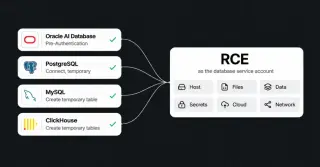
A researcher has demonstrated that low-privilege database accounts can exploit memory-corruption bugs to run code on servers for PostgreSQL, MySQL, ClickHouse, and Oracle, even without access to application data. While four flaws have received vendor fixes, the Oracle chain requires no login, and no real-world attacks have been observed yet.
The PostgreSQL Global Development Group released updates for versions 14 through 18, addressing 52 security flaws. The most critical issue, CVE-2026-6460, is a type confusion vulnerability with a CVSS score of 8.8 that allows authenticated users to execute code on the server. This flaw stems from a 2004 feature allowing column type changes, which can cause the server to misinterpret old data values. While no active exploitation has been reported, security researchers have demonstrated working exploits. Administrators must update their servers and rebuild C-language extensions to fully mitigate the risk, as older extensions may remain vulnerable even after a server update.
Drupal released highly critical security updates for Drupal Core to fix CVE-2026-9082, a flaw in the database abstraction API that allows anonymous attackers to perform arbitrary SQL injections on PostgreSQL sites, potentially leading to information disclosure, privilege escalation, or remote code execution (CVSS 6.5). Affected versions include 11.3.10, 11.2.12, 11.1.10, 10.6.9, 10.5.10, and 10.4.10; Drupal 7 is not affected. End-of-life releases are patched on a best-effort basis, and the updates include upstream fixes for Symfony and Twig.
OpenAI reportedly scales PostgreSQL to serve hundreds of millions of users by using a single write master with many read replicas, while offloading some write-heavy workloads to Azure Cosmos DB to relieve the primary. The approach favors a simpler, single-primary architecture but carries trade-offs such as potential single-point-of-failure risk, MVCC write amplification, and challenges around schema changes and cross‑shard operations. Commenters debate replication lag, WAL shipping, cost of large cloud instances, and when to shard or migrate workloads to non‑Postgres systems. Overall, the piece argues that with the right hardware and careful design, PostgreSQL can scale far beyond what many assume, though it isn’t a universal recipe and comes with notable complexity.
PostgreSQL, an open-source relational database system, has evolved from a niche solution to a widely used platform for various applications and workloads. With the recent release of PostgreSQL 16, which includes logical replication from standby servers, developers can achieve better scalability. The meticulousness and collaborative efforts of the Postgres community contribute to the stability and reliability of the features. The implementation of Direct I/O, a long-term feature, is expected to improve performance in writing data to disk, although it will take years to fully implement. Amazon RDS for PostgreSQL offers managed operational tasks, making it easier for developers to focus on application development rather than deployment and monitoring.
Google Cloud has introduced the Cloud SQL Enterprise Plus edition for MySQL and PostgreSQL, offering performance optimizations for read and write operations, improved machine types and configurations, and an integrated SSD-backed data cache option. The new edition provides higher read throughput and improved write latency compared to the existing Cloud SQL, reduces downtime for maintenance operations, and offers 35 days of log retention for compliance requirements. The data cache is available only for the MySQL engine. Cloud SQL Enterprise Plus offers a 99.99% availability SLA inclusive of maintenance, with pricing varying according to the region.