

Tag

Probabilistic Computing

All articles tagged with #probabilistic computing

Thermodynamic Brainpower: Tiny-Energy Image Generation with Noise-Driven Computing
technology1 month ago

Thermodynamic Brainpower: Tiny-Energy Image Generation with Noise-Driven Computing

Scientists report a generative thermodynamic computer that uses thermal noise to produce images from random data, mimicking AI neural networks but with energy use orders of magnitude lower. By leveraging probabilistic computing and diffusion-like dynamics (via Langevin-based calculations) and tuning coupling strengths in a network, the system retrieves or creates images from noise, offering a physics-based path to energy-efficient AI-like tasks and new insights into learning.

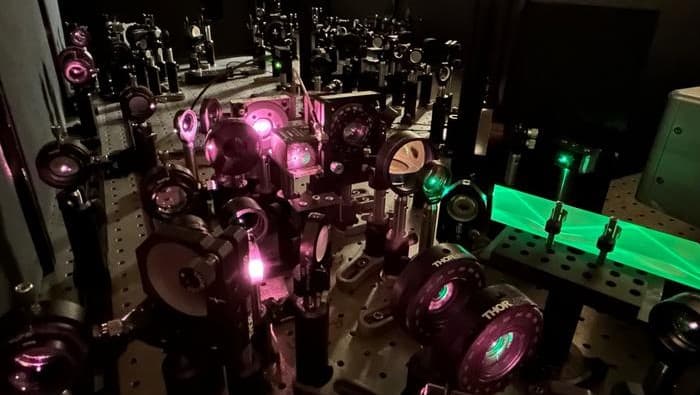
MIT Achieves Groundbreaking Control of Quantum Randomness
quantum-computing2 years ago

MIT Achieves Groundbreaking Control of Quantum Randomness

MIT researchers have achieved a breakthrough in quantum technologies by controlling quantum randomness using "vacuum fluctuations." This milestone opens up possibilities for probabilistic computing and ultra-precise field sensing. By injecting a weak laser "bias" into an optical parametric oscillator, the researchers were able to create controllable quantum randomness, allowing for the manipulation of probability distributions. This development has implications for simulating complex dynamics and optimizing systems that involve uncertainty and randomness.

Breakthrough: Controlling Quantum Fluctuations and Unveiling Quantum Superchemistry
science-and-technology2 years ago

Breakthrough: Controlling Quantum Fluctuations and Unveiling Quantum Superchemistry

Researchers at MIT have demonstrated a technique for controlling and biasing the random energy fluctuations present in empty space, known as quantum fluctuations. By applying an external signal to interfere with these fluctuations, the researchers were able to bias the probability of the system settling into a specific state. This technique has potential applications in sensing, random number generation, and probabilistic optical computing. The researchers are also exploring the possibility of using the system's responsiveness to small electric fields for sensor applications.