Tag

Sanford Underground Research Facility

All articles tagged with #sanford underground research facility

LZ Experiment's Single Underground Hit Sparks Caution Amid Dark Matter Hype
science1 month ago

LZ Experiment's Single Underground Hit Sparks Caution Amid Dark Matter Hype

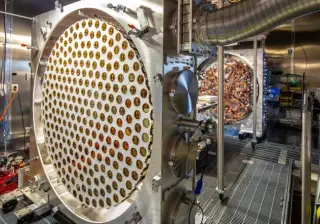
The LUX-ZEPLIN (LZ) collaboration reported a single anomalous particle interaction in its underground xenon detector, which some scientists believe could be the first direct detection of dark matter. While the event fits the profile of a weakly interacting massive particle (WIMP), it falls short of the statistical threshold required for a confirmed discovery. Researchers are now analyzing additional data to verify the signal, while other experiments worldwide prepare to test the findings.

LZ Experiment’s Single Event Sparks Debate Over First Dark Matter Detection
science1 month ago

LZ Experiment’s Single Event Sparks Debate Over First Dark Matter Detection

The LUX-ZEPLIN (LZ) collaboration reports a single particle interaction in June 2023 that may be the first direct evidence of dark matter. While the signal is statistically significant at 2.6-sigma, it falls short of the 5-sigma threshold required for a definitive discovery. Scientists are now analyzing a larger dataset to confirm if the event was a genuine weakly interacting massive particle (WIMP) or a background anomaly.

LZ Detector’s Unexplained 2023 Signal Sparks Dark Matter Debate
science1 month ago

LZ Detector’s Unexplained 2023 Signal Sparks Dark Matter Debate

Physicists at the LUX-ZEPLIN (LZ) experiment in South Dakota have identified a single, anomalous particle interaction from 2023 that defies standard background explanations. While the event could represent the first direct detection of a Weakly Interacting Massive Particle (WIMP), it falls short of the statistical threshold required for a definitive discovery. The finding has ignited intense scrutiny within the physics community, with rival experiments preparing to validate the result.

LUX-ZEPLIN Reports a Single Unexplained Event in the Hunt for Dark Matter
science1 month ago

LUX-ZEPLIN Reports a Single Unexplained Event in the Hunt for Dark Matter

Physicists at the LUX-ZEPLIN (LZ) experiment in South Dakota have reported a single, unexplained particle interaction that may be the first direct evidence of dark matter. The event, recorded on June 16, 2023, occurred in a tank of liquid xenon buried nearly a mile underground. While the signal is intriguing, researchers emphasize it is not a confirmed discovery and requires further data to rule out mundane explanations.

LUX-ZEPLIN Reports Single Unexplained Event in Dark Matter Search
science1 month ago

LUX-ZEPLIN Reports Single Unexplained Event in Dark Matter Search

The LUX-ZEPLIN experiment has reported a single, unexplained particle interaction in its liquid xenon detector, which researchers describe as the most compelling hint of dark matter to date. While the event does not meet the statistical threshold for discovery, it aligns with theoretical predictions for Weakly Interacting Massive Particles (WIMPs) and has prompted a broader scientific review.

LUX-ZEPLIN Detects Unexplained High-Energy Signal in South Dakota
science1 month ago

LUX-ZEPLIN Detects Unexplained High-Energy Signal in South Dakota

Physicists at the LUX-ZEPLIN experiment in South Dakota have identified a single, unexplained signal that may indicate the first detection of dark matter. The event, recorded in June 2023, involves a high-energy collision that does not match known background noise or standard weakly interacting massive particle (WIMP) predictions. While the result is statistically significant, it falls short of the threshold required for a confirmed discovery, prompting cautious optimism among researchers.

LZ Experiment Reports Single Event Hinting at Dark Matter, but Falls Short of Discovery Threshold
science1 month ago

LZ Experiment Reports Single Event Hinting at Dark Matter, but Falls Short of Discovery Threshold

Researchers at the Sanford Underground Research Facility in South Dakota reported a single event consistent with a weakly interacting massive particle (WIMP) colliding with a xenon atom. While the interaction produced a faint ultraviolet flash and nuclear recoil, scientists emphasize this is not a confirmed detection of dark matter. The observation lacks the statistical significance required for a discovery, and further validation is needed to rule out background noise.

science1 month ago

LUX-ZEPLIN Detects Anomalous Signal Hinting at Heavy Dark Matter

Researchers at the 2026 TeV Particle Astrophysics conference in Japan reported a single anomalous interaction, designated LZ230616, detected by the LUX-ZEPLIN experiment. The event reached a 2.6-sigma significance level, suggesting a particle mass exceeding 200 proton masses. While lead author Dr. Sam Eriksen called it the most compelling hint to date, the team emphasized that this single event falls short of the five-sigma threshold required for an official discovery. The signal could validate the Weakly Interacting Massive Particle theory if confirmed by other detectors.

Underground detector flags potential dark matter particle in South Dakota
science1 month ago

Underground detector flags potential dark matter particle in South Dakota

Researchers at the Sanford Underground Research Facility in South Dakota have reported a potential detection of a dark matter particle. The signal, observed in the LUX-ZEPLIN detector, suggests the existence of a weakly interacting massive particle (WIMP) with a mass over 200 times that of a proton. While the result is statistically significant, it has not yet reached the threshold required for a definitive discovery.

LZ Experiment Reports Unexplained Signal in Dark Matter Search
science1 month ago

LZ Experiment Reports Unexplained Signal in Dark Matter Search

Physicists at the LUX-ZEPLIN (LZ) experiment in South Dakota reported a single, unexplained signal that may indicate the first direct detection of dark matter. The event, recorded in June 2023, does not match known background noise but falls short of the statistical threshold for a confirmed discovery. While the signal aligns with some predictions for weakly interacting massive particles (WIMPs), it is too energetic for standard models, leaving its origin uncertain. The scientific community awaits more data to verify if this is a genuine dark matter interaction or an anomaly.