
LUX-ZEPLIN Detects Unexplained High-Energy Signal in South Dakota
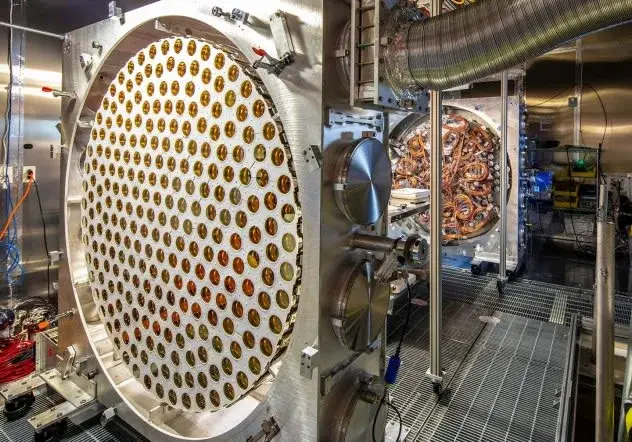
Physicists at the LUX-ZEPLIN experiment in South Dakota have identified a single, unexplained signal that may indicate the first detection of dark matter. The event, recorded in June 2023, involves a high-energy collision that does not match known background noise or standard weakly interacting massive particle (WIMP) predictions. While the result is statistically significant, it falls short of the threshold required for a confirmed discovery, prompting cautious optimism among researchers.
Key points
- A single event was detected by the LUX-ZEPLIN (LZ) detector at the Sanford Underground Research Facility in Lead, South Dakota, on June 16, 2023.
- The signal occurred approximately one mile underground in a seven-tonne tank of liquid xenon, producing a flash of light and electric charge.
- The event’s energy level is approximately 248 keV, significantly higher than the typical 30 keV range expected for standard WIMP interactions.
- The signal does not resemble known background radiation or mundane sources, but it is too energetic to fit standard WIMP models without implying a much heavier particle mass.
- The statistical significance of the event is 2.6 sigma, meaning there is a 1-in-200 chance it is a fluke, far below the 5 sigma threshold required for a confirmed discovery.
- The LZ collaboration has over 700 days of blinded data to analyze, which could confirm or refute the finding in the near future.
Background
Dark matter, which constitutes about 85 percent of matter in the universe, has eluded direct detection for decades. Previous experiments have failed to find weakly interacting massive particles (WIMPs), leading some physicists to doubt their existence. The LUX-ZEPLIN experiment is one of the largest and most sensitive detectors designed to capture these elusive particles by monitoring for rare collisions with xenon atoms deep underground to shield against cosmic background noise.
How outlets are covering it
The New York Times emphasizes the mystery of the signal, noting that it does not fit the profile of any known particles and that physicists are 'finally' finding something after years of silence. Scientific American highlights the excitement among theorists, such as Katherine Freese, who have waited 40 years for a positive result, while also stressing the caution required due to the low statistical significance. New Scientist focuses on the technical anomaly, pointing out that the high energy of the event suggests a more complex interaction with the entire xenon nucleus rather than a simple bounce off a nucleon, implying a WIMP mass more than 200 times that of a proton. All sources agree that the finding is intriguing but not yet conclusive, with the LZ collaboration itself advising against premature claims.
Why it matters
If confirmed, this detection could revolutionize our understanding of the universe by identifying the nature of dark matter and validating the WIMP hypothesis. It could also provide insights into the early universe and shake up the standard model of particle physics. However, the result is currently insufficient for a discovery claim, and the field faces a deadline as neutrino backgrounds may soon overwhelm WIMP detectors, making this potentially the last window to observe such particles.
What to watch
The LZ collaboration will analyze its remaining blinded data, which covers over 700 days, to determine if the single event is an anomaly or part of a pattern. Competing experiments, such as PandaX-4T and XENONnT, will also examine their data for similar signals. If more events are found in the same energy range, the statistical significance could rise to the 5 sigma threshold, confirming the discovery of dark matter.
- Scientists detect mysterious signal nearly 1 mile underground in South Dakota yahoo.com
- Scientists Hunting Dark Matter Found Something Strange The New York Times
- Have we finally found dark matter? Scientific American
- The first signs of dark matter particles may finally have been spotted New Scientist
- Scientists make potential breakthrough in search for dark matter Reuters
Want the full story? Read the original reporting
Read on yahoo.com