
LZ Experiment Reports Single Event Hinting at Dark Matter, but Falls Short of Discovery Threshold
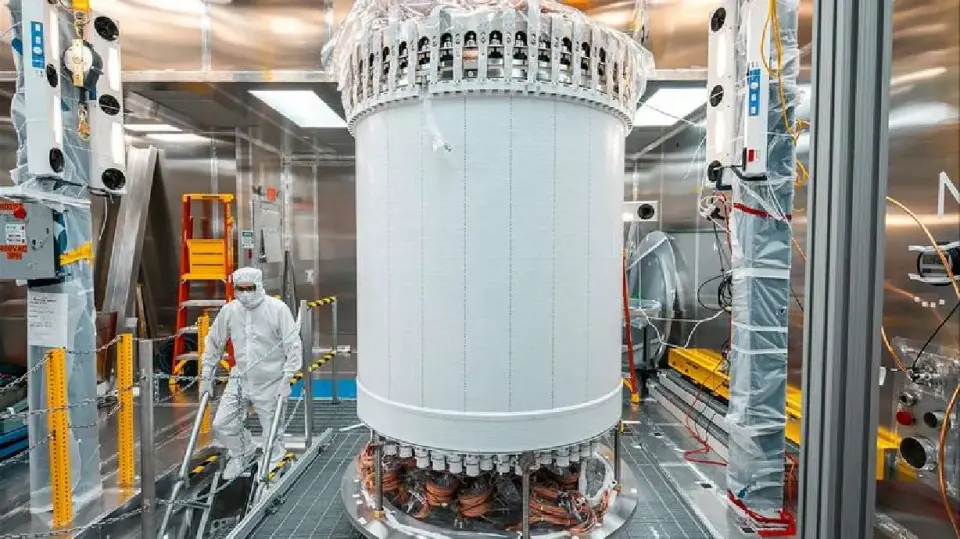
Researchers at the Sanford Underground Research Facility in South Dakota reported a single event consistent with a weakly interacting massive particle (WIMP) colliding with a xenon atom. While the interaction produced a faint ultraviolet flash and nuclear recoil, scientists emphasize this is not a confirmed detection of dark matter. The observation lacks the statistical significance required for a discovery, and further validation is needed to rule out background noise.
Key points
- The LUX-ZEPLIN experiment, located one mile underground in South Dakota, recorded a potential dark matter interaction.
- The event involved a particle colliding with a xenon atom, causing a faint ultraviolet flash and nuclear recoil.
- Lead author Sam Eriksen described the event as a possible first hint of dark matter but noted it is a single occurrence.
- The observation does not meet the statistical threshold required to claim a discovery of dark matter.
- Researchers are working to rule out other explanations and require further validation before drawing conclusions.
Background
Previous coverage in August and September 2026 highlighted similar findings from the LUX-ZEPLIN experiment, noting a 2.6-sigma significance for a single anomalous interaction. Those reports emphasized that while the signal was intriguing, it fell well below the 5-sigma discovery threshold. The current report reiterates the need for rigorous validation and cross-checking with other detectors to confirm whether WIMPs constitute dark matter.
Why it matters
Dark matter is believed to make up the majority of matter in the universe, influencing the formation of galaxies and large-scale structures. Detecting it directly would confirm its existence and nature, resolving a major mystery in physics. While ordinary matter accounts for only about 15% of all matter, dark matter's gravitational effects are observable, making its direct detection a critical goal for understanding the universe's composition and evolution.
What to watch
Researchers will continue data collection and analysis to rule out alternative explanations for the observed event. They will also cross-check findings with other experiments, such as XENON and PandaX, to verify if the signal is consistent across different detectors. Further validation is required to determine if the event is a genuine dark matter interaction or a background fluctuation.
Want the full story? Read the original reporting
Read on KSL News