Tag

Self Interacting Dark Matter

All articles tagged with #self interacting dark matter

Dense Dark Matter Clumps Might Unify Three Cosmic Puzzles
science10 days ago

Dense Dark Matter Clumps Might Unify Three Cosmic Puzzles

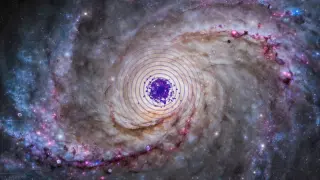
A UC Riverside study proposes that dense clumps of self-interacting dark matter (SIDM) can undergo gravothermal collapse to form compact cores that explain three different observations—an ultra-dense object in the gravitational lens JVAS B1938+666, perturbations in the GD-1 stellar stream, and the unusually young, metal-rich Fornax 6 globular cluster in the Fornax dwarf galaxy—linking distant lensing, our Galaxy, and a satellite galaxy under one mechanism, unlike collisionless CDM. The work, published in Physical Review Letters, is supported by the John Templeton Foundation and the DoE.
New self-interacting dark matter could solve three cosmic mysteries
space20 days ago

New self-interacting dark matter could solve three cosmic mysteries

A new self-interacting dark matter theory proposes that dark matter particles collide with one another to form dense cores, potentially explaining three puzzling observations: an ultradense dark matter clump in the gravitationally lensed system JVAS B1938+666, a visible “scar” in the GD-1 stellar stream, and the unusual formation of the Fornax 6 star cluster in the Milky Way’s Fornax dwarf galaxy. The mechanism, related to gravothermal collapse, could unify these disparate clues across cosmic scales in a way standard collisionless dark matter cannot.

"Study Reveals Dark Matter's Potential Collisional Properties"
science2 years ago

"Study Reveals Dark Matter's Potential Collisional Properties"

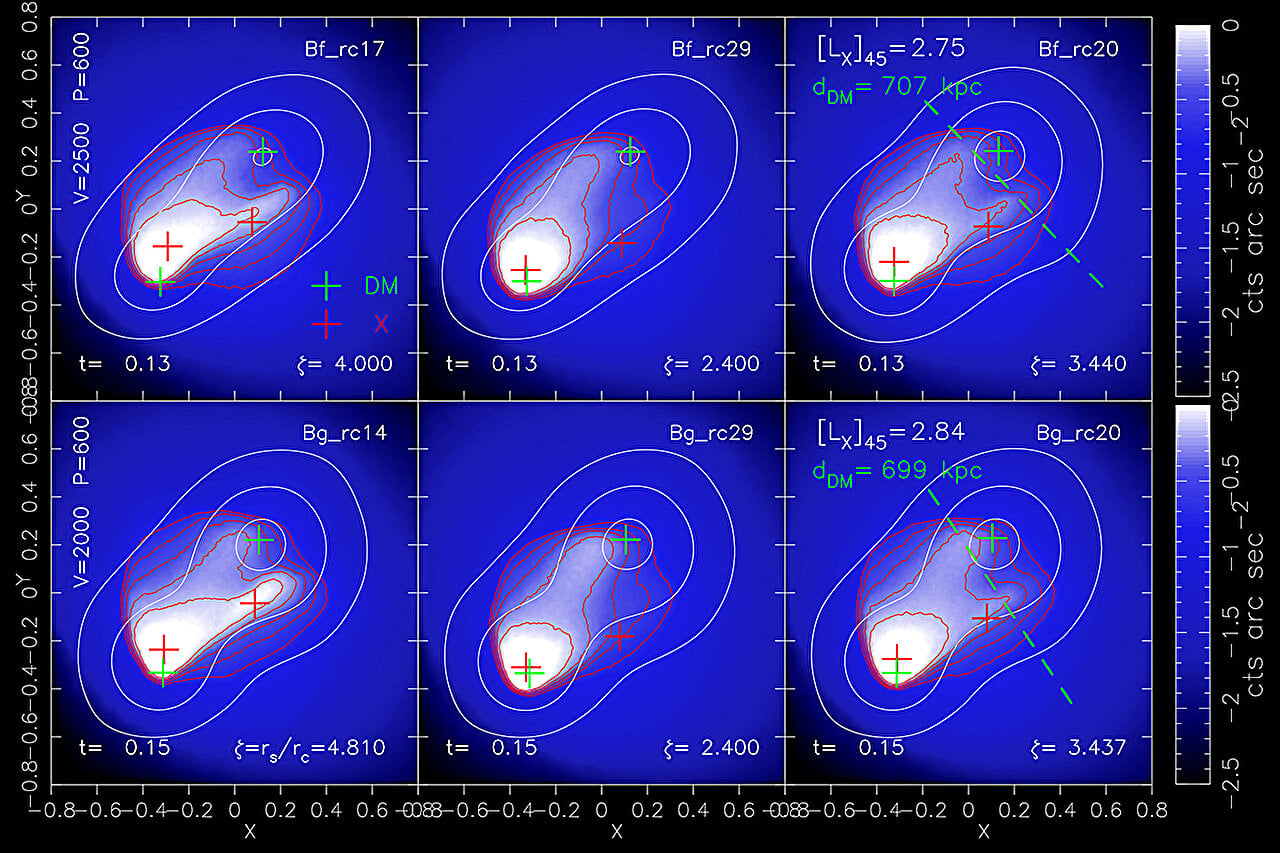
A new study published in Astronomy & Astrophysics suggests that dark matter may have collisional properties, challenging the standard model. Using numerical simulations of the galaxy cluster "El Gordo," researchers found that the observed separation between dark matter and other mass components can be explained by the Self-Interacting Dark Matter (SIDM) model, indicating that dark matter particles might exchange energy through collisions.

Unveiling the Secrets of Dark Matter: From Enigmas to Identity
science2 years ago

Unveiling the Secrets of Dark Matter: From Enigmas to Identity

Researchers from the University of California Riverside propose an alternative theory to the prevailing cold dark matter theory (CDM) called Self-Interacting Dark Matter (SIDM). They suggest that dark matter particles may interact with each other, explaining the extreme density and diffusion of dark matter halos observed in galaxies. SIDM allows for the collision and transfer of heat between particles, resulting in the expansion of dark matter and the formation of diffuse halos. Additionally, SIDM supports the formation of dense dark matter halos that can affect gravitational lensing. The study highlights the need for further research and direct detection methods to unravel the mysteries of dark matter.

Unveiling the Dark Force: Solving Cosmic Mysteries and Astrophysical Puzzles
science2 years ago

Unveiling the Dark Force: Solving Cosmic Mysteries and Astrophysical Puzzles

A new theory proposes that dark matter is composed of self-interacting particles that interact strongly with each other through a "dark force." This theory could potentially explain the extreme densities observed in dark matter haloes surrounding galaxies, which current cold dark matter models struggle to explain. By simulating cosmic structures with strong dark matter self-interactions, researchers found that self-interacting dark matter (SIDM) interacting through a "dark force" could reconcile the high-density haloes in massive elliptical galaxies and the low-density haloes in ultra-diffuse galaxies. This research highlights the potential of combining real observations with artificial intelligence to gain insights into the nature of dark matter.

"Revolutionary Dark Matter Theory Solves Astrophysics Puzzles and Unveils Cosmic Secrets"
science2 years ago

"Revolutionary Dark Matter Theory Solves Astrophysics Puzzles and Unveils Cosmic Secrets"

A new theory called "self-interacting dark matter" (SIDM) proposes that dark matter particles can collide with each other through a dark force. Researchers led by Hai-Bo Yu from the University of California, Riverside, conducted simulations and found that SIDM can explain two astrophysics puzzles: the high-density dark matter halo in a massive elliptical galaxy and the extremely low densities of dark matter halos in ultra-diffuse galaxies. These findings challenge the prevailing cold dark matter theory and suggest that dark matter may be more complex than previously thought. The study highlights the importance of astrophysical observations and computer simulations in understanding dark matter.