Tag

Solid State Physics

All articles tagged with #solid state physics

Light-Induced Non-Reciprocal Magnetism Challenges Traditional Physics
science5 months ago

Light-Induced Non-Reciprocal Magnetism Challenges Traditional Physics

Researchers from Japan have theoretically demonstrated that shining specific light on magnetic metals can induce non-reciprocal magnetic interactions that effectively violate Newton's third law, leading to a novel chiral phase with persistent rotation, opening new avenues in non-equilibrium materials science and potential technological applications.
"Breakthrough Discovery: Unveiling a Novel Form of Magnetism with Unique Magnetic Alignment"
science-and-technology2 years ago

"Breakthrough Discovery: Unveiling a Novel Form of Magnetism with Unique Magnetic Alignment"

Scientists at ETH Zurich have discovered a new type of magnetism in a custom-engineered moiré material. Unlike traditional ferromagnetism, this magnetism arises from the alignment of electron spins to minimize kinetic energy rather than the exchange interaction. The researchers filled the material with electrons and observed that it exhibited ferromagnetic behavior when there was more than one electron per lattice site. This phenomenon, known as kinetic magnetism, had previously only been observed in model systems and not in extended solid-state systems. Further research will explore the preservation of ferromagnetism at higher temperatures.

Fractons: The Future of Information Storage
science-and-technology2 years ago

Fractons: The Future of Information Storage

Fractons, fractions of spin excitations, are immobile and could be used for secure information storage. Theoretical physicists have modeled octahedral crystal structures with antiferromagnetically interacting corner atoms to reveal special patterns with characteristic pinch points in the spin correlations, which can be detected experimentally in a real material with neutron experiments. Quantum fluctuations do not enhance the visibility of fractons, but on the contrary, completely blur them, even at absolute zero temperature. The next step is to develop a model in which quantum fluctuations can be regulated up or down to study the extended quantum electrodynamic theory with its fractons in more detail.

Advancing Materials Science with Quantum Computing and 2D Materials
technology2 years ago

Advancing Materials Science with Quantum Computing and 2D Materials

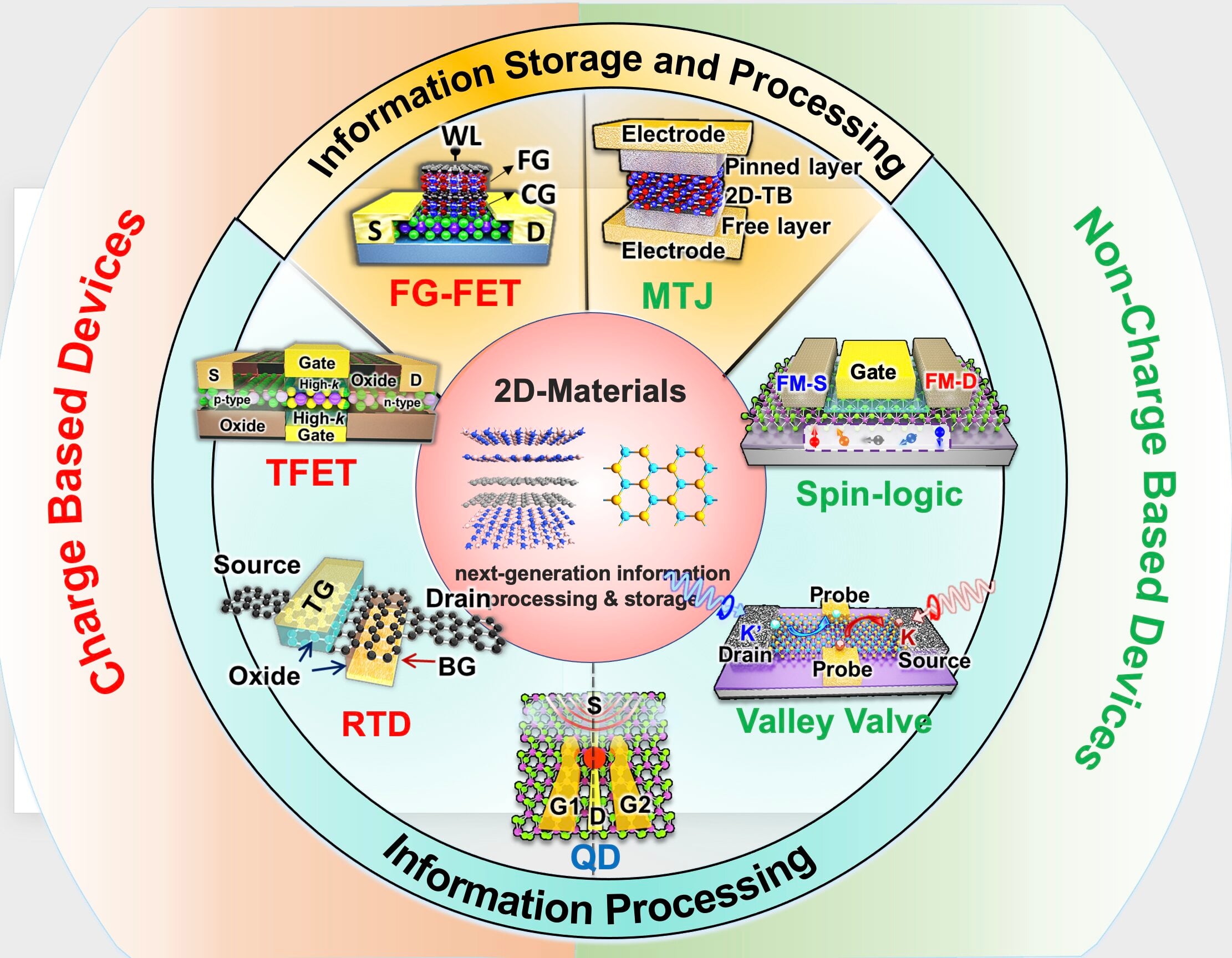
Researchers at UC Santa Barbara have developed new devices based on 2D materials that could enhance information processing and data storage while consuming less power and generating less heat. The devices include a spin-based field-effect transistor, a charge-based field-effect transistor, a charge-based floating-gate field-effect-transistor, and magnetic tunnel junctions. The unique properties of 2D materials also make it possible to efficiently design newer types of qubits for quantum computing, including spin-, valley-, and spin-valley qubits. These emerging devices offer the promise of energy-efficient high-performance computing and storage, enabling beyond-Moore integration and sparking new explorations in solid-state physics and their applications.