Tag

Excitons

All articles tagged with #excitons

Light-Driven Polarons Reveal a Wigner Crystal in a 2D WSe2 Monolayer
science14 days ago

Light-Driven Polarons Reveal a Wigner Crystal in a 2D WSe2 Monolayer

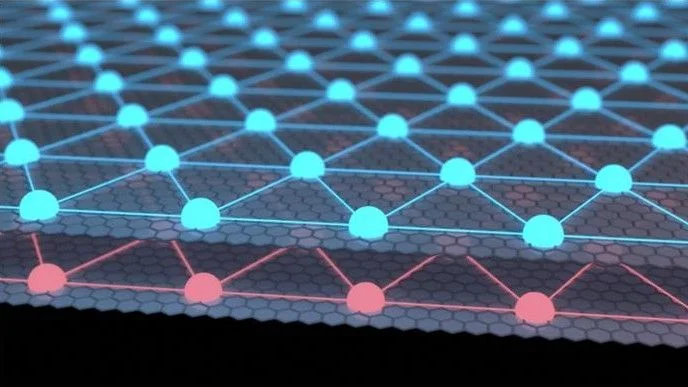
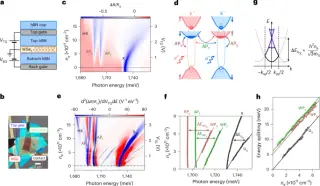
A cryogenic, gate-tunable WSe2 monolayer hosts a robust Wigner crystal whose collective excitations dress excitons into light–matter polarons. The researchers observe two WP resonances that blueshift with electron density due to hybridization with WC excitations and Bragg-umklapp scattering, alongside exciton-umklapp features. WP intensities depend on the WC spin state and can be controlled magnetically or optically with circular polarization, enabling an optical interface to the electron crystal’s spin. A simple hybridization model captures the density-dependent AP–WP splitting, linking WC dynamics to observable optical spectra. This work demonstrates a versatile platform for studying strongly correlated order via hybrid light–matter excitations in 2D materials and suggests ways to probe WC gaps and spin phenomena optically.

Light as a Nanoscale Brake: Quantum Friction Slows Nanotubes in Water
science1 month ago

Light as a Nanoscale Brake: Quantum Friction Slows Nanotubes in Water

Scientists report that shining light on fluorescent carbon-mesh nanotubes suspended in water slows their diffusion due to light-induced quantum friction: excited electrons (excitons) couple with nearby water and transfer momentum, effectively acting as a nanoscale brake. The slowdown grows with light intensity and vanishes when exciton mobility is hindered by defects, a finding confirmed by terahertz spectroscopy. This reveals a blurred boundary between solid and liquid behavior at the nanoscale and could enable light-controlled nanorobots and reaction tuning.

Terahertz cavities engineer attractive interactions in bilayer graphene
science3 months ago

Terahertz cavities engineer attractive interactions in bilayer graphene

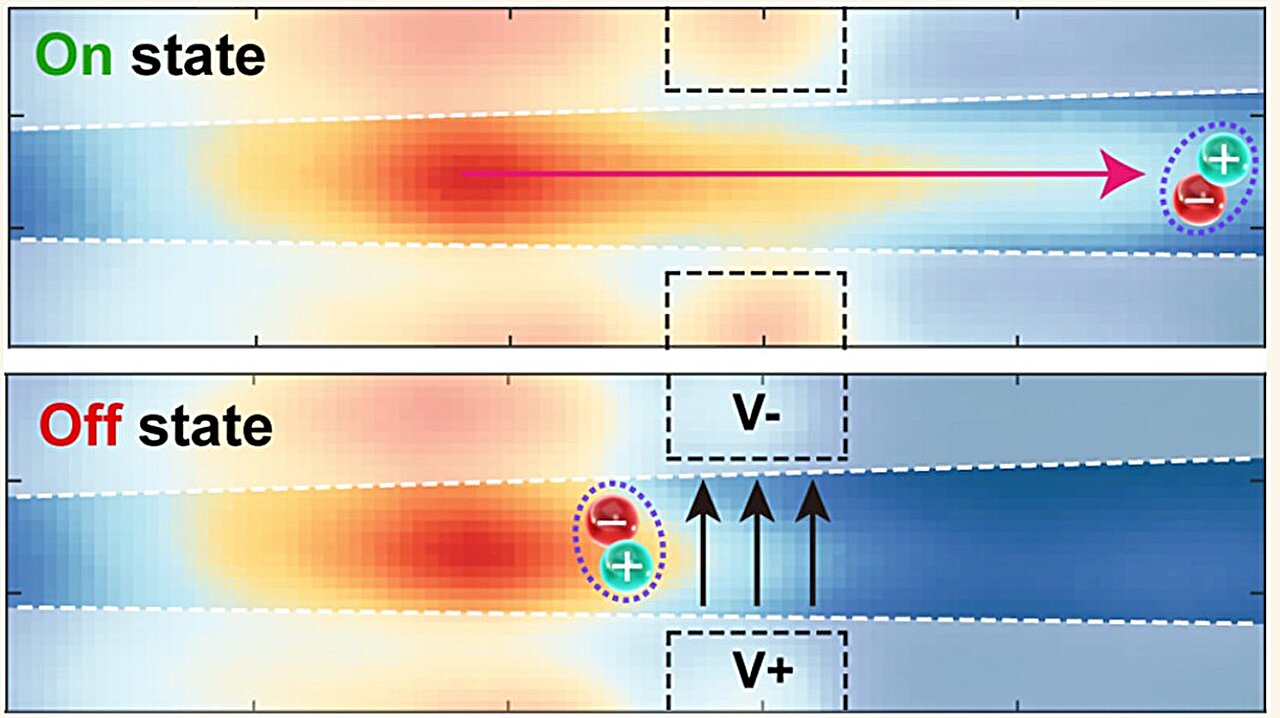
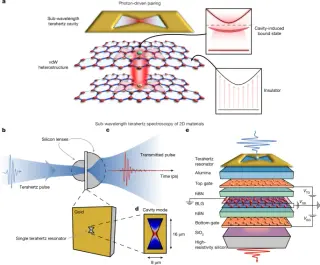
Terahertz cavity photons mediate tunable attractive interactions in bilayer graphene, reorganizing interband transitions into an exciton-like bound state. Using a broadband terahertz microscope integrated with dual-gated 2D materials in a THz cavity, researchers observe tunable bandgaps and ultrastrong coupling (g/ωc ≈ 0.4) with a cavity-induced resonance that persists across a wide temperature range, pointing to a platform for exploring hybrid light–matter phases in 2D quantum materials.

Graphene Excitons Stop Flow, Hinting at a New Quantum Phase
science6 months ago

Graphene Excitons Stop Flow, Hinting at a New Quantum Phase

Scientists using graphene bilayers under a strong magnetic field observed excitons behaving as a superfluid at high density, but as density decreases the excitons halt and the material becomes insulating; heating restores the superfluid, a result that could point to a supersolid-like excitonic state or another unusual quantum phase, though measurements are not yet definitive.

Graphene bilayers reveal a reversible superfluid-to-supersolid transition in excitons
physics6 months ago

Graphene bilayers reveal a reversible superfluid-to-supersolid transition in excitons

Physicists using two closely spaced graphene layers, a strong magnetic field, and ultracold temperatures observed bilayer excitons transition from a superfluid to an insulating, lattice-like state (interpreted as a supersolid) and then revert back to a superfluid, marking the first reported reversible superfluid-to-supersolid transition in this system in a Nature study led by Cory Dean and colleagues.

"Caltech Physics Unveils Potential for Revolutionary Technologies with Hubbard Excitons"
science-and-technology2 years ago

"Caltech Physics Unveils Potential for Revolutionary Technologies with Hubbard Excitons"

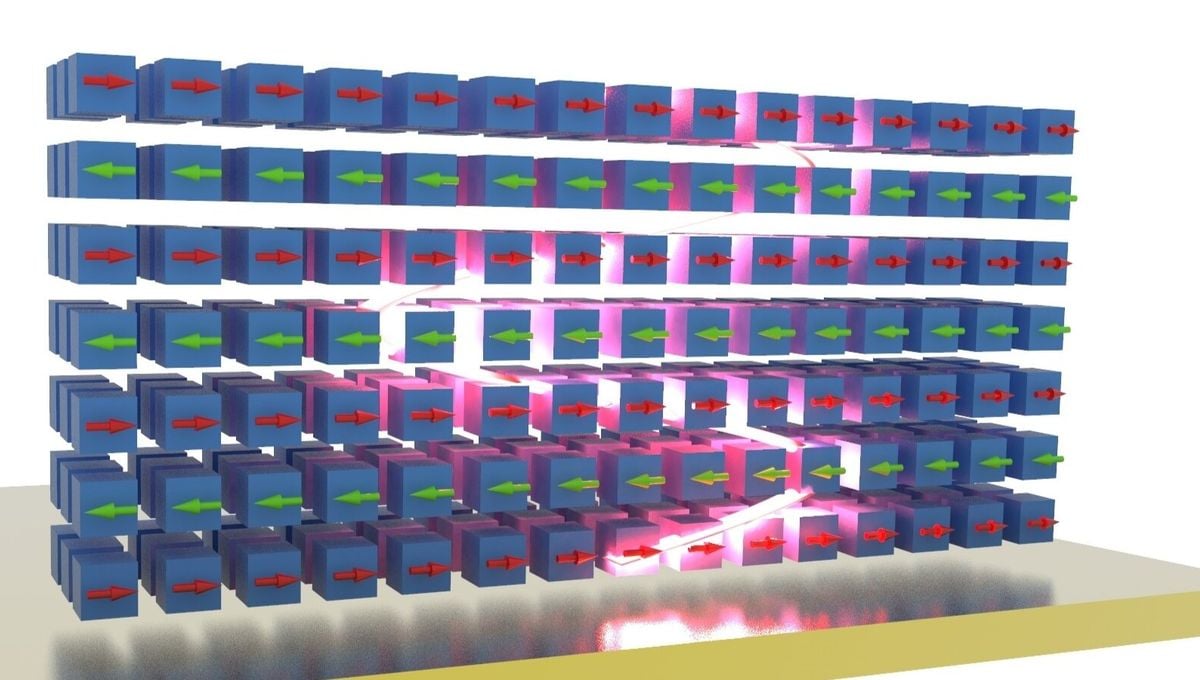
Researchers at Caltech have discovered Hubbard excitons, which are excitons bound magnetically rather than by electrical forces. This groundbreaking discovery opens up new possibilities for exciton-based technologies. By manipulating the magnetic properties of these excitons, researchers could develop novel technologies that harness both excitons and magnetism. The study used ultrafast time-domain terahertz spectroscopy to observe the generation and decay of these magnetically bound excitons in real-time. The findings have potential implications for the development of solar panels, photodetectors, light-emitting diodes, and other exciton-based devices.

"Unlocking the Magnetic Power: Scientists Harness Light Inside a Magnet"
science-and-technology3 years ago

"Unlocking the Magnetic Power: Scientists Harness Light Inside a Magnet"

Researchers have discovered a way to trap light inside a magnetic van der Waals material, a type of two-dimensional metamaterial. By shining light on the material, it interacts with excitons, creating a strong magneto-optic response and making the material 10 times more magnetic. This breakthrough could lead to the development of magnetic lasers and optically controlled magnetic memory.

"Controlling Exciton Qubits: Manipulating Quantum Oscillations in a Bose-Einstein Condensate"
quantum-computing3 years ago

"Controlling Exciton Qubits: Manipulating Quantum Oscillations in a Bose-Einstein Condensate"

Researchers propose a top-down approach to building a large quantum register using a Bose-Einstein condensate (BEC) of excitons. By generating and controlling macroscopic quantum states of BEC consisting of millions of identical excitons, they aim to overcome the challenges of short-lived phenomena and ultra-low temperatures typically associated with quantum computing. The use of a superfluid BEC state can prevent quantum decoherence and enable faster quantum gate operations. The proposed system shows promise for scalability and offers computational capabilities and redundancy for quantum error correction.

"Squishing subatomic particles reveals exotic ultradense crystal state of matter"
physics3 years ago

"Squishing subatomic particles reveals exotic ultradense crystal state of matter"

Physicists have discovered a new state of matter called a "bosonic correlated insulator," which takes the form of a highly ordered crystal of subatomic particles. This exotic state of matter, created by densely packing excitons, could lead to the discovery of new types of materials. The research provides new insights into the behavior of bosons and offers potential for creating additional bosonic materials with unique properties.

Quantum physicists discover breakthrough state of matter in ultradense crystals.
science-and-astronomy3 years ago

Quantum physicists discover breakthrough state of matter in ultradense crystals.

Physicists have discovered a new state of matter called a "bosonic correlated insulator," which takes the form of a highly ordered crystal of subatomic particles. The researchers created this state of matter by pushing excitons together until they were so densely packed that they could no longer move, creating a new symmetrical crystalline state with a neutral charge. This discovery could lead to the creation of many new types of exotic materials made from condensed matter.

science3 years ago

New Bosonic State of Matter Uncovered in Quantum World

Physicists at UC Santa Barbara have discovered a breakthrough material made of bosons, a less explored realm of particle physics. By overlapping lattices of tungsten diselenide and tungsten disulfide in a twisted configuration, they created a highly ordered crystal of bosonic particles called excitons, resulting in a new state of matter termed a "bosonic correlated insulator."

Visualizing Quantum States in 2D Materials
science-and-technology3 years ago

Visualizing Quantum States in 2D Materials

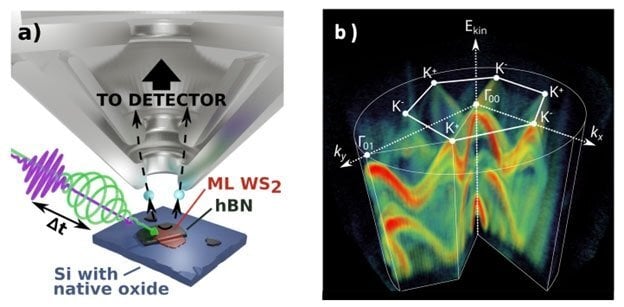
Scientists have developed a new approach to create separate images of individual quantum states in two-dimensional crystals of tungsten disulfide (WS2) using a technique called time-resolved momentum microscopy. By tracking the individual quantum states, researchers showed that the coupling mechanisms that lead to mixing of the states may not fully match current theories. This study provides crucial experimental support for some current theories of exciton coupling in TMDs, but also sheds light on important discrepancies.

"Frustration Machine" Unveils Strange Subatomic Material and Quantum Phase
science3 years ago

"Frustration Machine" Unveils Strange Subatomic Material and Quantum Phase

Scientists have discovered a new material called a bosonic correlated insulator, which is a whole new state of matter. The material is a lattice formed from a layer of tungsten diselenide and a layer of tungsten disulfide placed on top of each other but not fully aligned, creating a moiré pattern. The researchers used a light-based technique called pump-probe spectroscopy to create and probe the behaviors of the excitons in their system, leading to the discovery of the correlation that drove the bosons into a highly ordered state. The team thinks their approach could lead to the discovery of more bosonic materials further down the line, and an improved way for all scientists to study bosons in real scenarios rather than in synthetic systems.