
Bank of England hikes rates to 4%, but future hikes hinge on Iran war
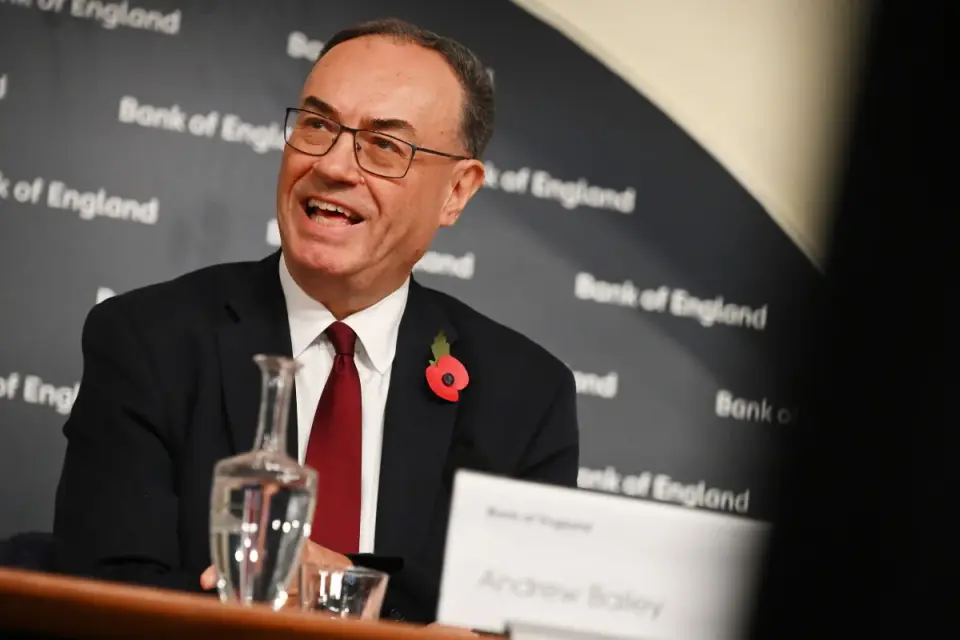
The Bank of England raised its base interest rate by 25 basis points to 4% on Thursday, marking its first increase in over three years. Governor Andrew Bailey stated that the decision was driven by inflation, which is forecast to peak at 5% next summer due to energy costs from the Iran war. However, Bailey emphasized that this hike is not necessarily the start of a long sequence of increases, noting that a sustained drop in energy prices following the U.S. midterm elections could limit the need for further rate hikes. The decision was unanimous among the nine-member Monetary Policy Committee, though one member advocated for a larger increase to 4.25%.
Key points
- The Bank of England raised its main interest rate from 3.75% to 4% on November 5, 2026, the first hike since August 2023.
- Inflation is expected to reach 5% by mid-2027, driven by high energy prices resulting from the Iran war and bottlenecks in the Strait of Hormuz.
- Global energy prices have fallen sharply since the U.S. midterm elections, with Brent crude dropping approximately $15 a barrel to $96, though it remains $30 higher than a year ago.
- Bank Governor Andrew Bailey stated that the future path of interest rates depends on the resolution of the Middle East conflict, warning that another hike is likely if the war continues.
- The decision was unanimous, but one Monetary Policy Committee member supported a larger increase to 4.25%, while others viewed the move as an 'insurance policy' against second-round inflation effects.
Background
The Bank of England had been lowering interest rates from a 15-year high of 5.25% until the U.S. and Israel attacked Iran. Inflation had risen to 3.5% in September 2026, well above the central bank's 2% target, prompting market expectations for a rate hike. The current conflict in Iran, now in its ninth month, has been the primary driver of resurgent inflation across global economies, leading other central banks, including the Federal Reserve and the European Central Bank, to raise rates recently.
How outlets are covering it
AP News and The New York Times agree that the rate hike was driven by inflation caused by the Iran war, with The New York Times noting that the Bank of England joined other global policymakers in raising rates. The Guardian provides additional detail on the economic outlook, citing Oxford Economics, which argues that a December hike is 'on the table' due to hawkish messaging from the Bank. Economists like Sanjay Raja of Deutsche Bank and Modupe Adegbembo of Jefferies view the hike as an 'insurance policy' against second-round effects, with Adegbembo predicting a possible hike in February if energy prices stabilize. Bailey himself emphasized that the hike should not be seen as the first in an inevitable sequence, but rather contingent on the resolution of the Middle East conflict.
Why it matters
The interest rate hike will increase borrowing costs for millions of mortgage holders and businesses, potentially slowing economic growth. However, it may also improve returns for savers. The future path of interest rates is closely tied to the resolution of the Iran war, as sustained energy price declines could limit the need for further hikes. The decision also highlights the interconnectedness of global economies, with the Bank of England's policy contingent on geopolitical events in the Middle East.
What to watch
The Bank of England will monitor energy prices and inflation data in the coming months to determine if further rate hikes are necessary. A December or February hike is possible if energy prices remain high or if second-round inflation effects emerge. The resolution of the Iran war will be a critical factor in determining the future path of interest rates, as a sustained drop in energy prices could limit the need for further hikes.
- BoE hikes rate for first time in 3 years; retreating oil prices may allow for more options ahead AP News
- Bank of England Raises Rates as Iran War Pushes Up Prices The New York Times
- Today’s UK interest rate rise unlikely to be the last unless Iran war ends, Bank of England warns – business live The Guardian
- After interest rate rise, the question now is how many more Sky News
- Bank of England Unanimously Hikes Rates, Sees 4.9% Inflation Bloomberg.com
Want the full story? Read the original reporting
Read on AP News