
Fed data reveals income compression but record debt distress
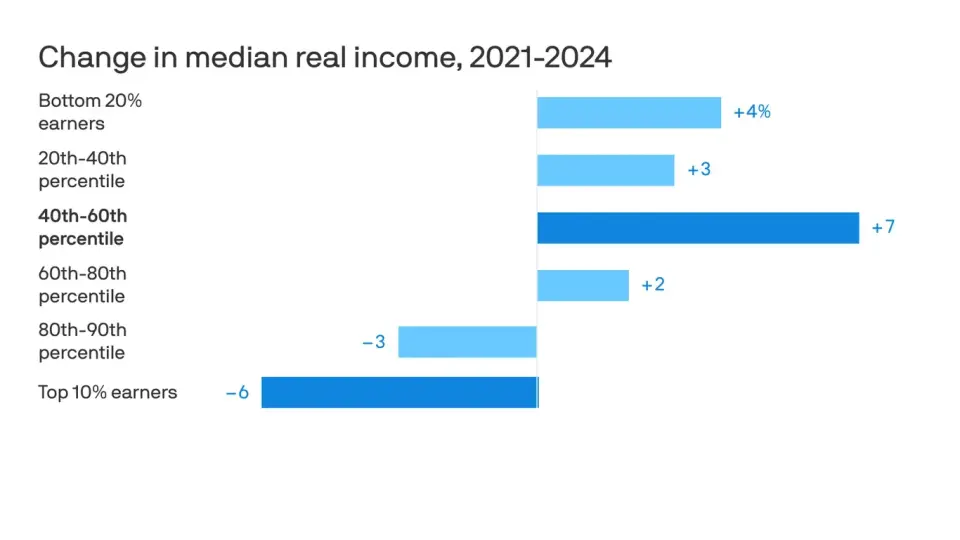
The Federal Reserve's 2025 Survey of Consumer Finances shows a sharp drop in income inequality as top earners' real incomes fell 14% while median family income rose 7% from 2021 to 2024. However, wealth inequality widened significantly, with the top 10% seeing net worth jump 31% while the bottom 40% saw slight declines. Simultaneously, debt distress hit a 15-year high, with nearly 20% of families behind on payments, a level not seen since the Great Recession.
Key points
- Median family income rose 7% in inflation-adjusted terms between 2021 and 2024, while average income fell 6% due to declines among the top 10%.
- Top 10% earners saw real income drop 14% to $652,000, driven by volatile capital gains and business income, whereas lower earners benefited from tight labor markets.
- Net worth for the top 10% increased 31% to $3.6 million, contrasting with a 2% rise for the median family and a 6% decline for the bottom 25% of income earners.
- The share of families behind on loan payments surged to nearly 20% from 12%, the highest since 2010, with debt-to-income ratios above 40% reaching 8.6%.
- Households headed by those 75 or older recorded the highest median net worth at $504,000, while those under 35 saw median net worth plunge 23% to $33,000.
Background
Recent Census data indicated record 2025 incomes masked persistent gaps for the lowest earners, with the bottom 20% capturing only 3% of total income. Additionally, first-time home buyers face a widening affordability gap as required incomes for starter homes now exceed $103,000, far outpacing the median buyer income of $72,100. These trends highlight ongoing cost-of-living pressures despite nominal income growth.
How outlets are covering it
Axios emphasizes the surprising compression in income inequality, attributing it to blue-collar wage gains and volatile high-earner income sources. CNBC focuses on the deterioration in debt repayment, highlighting that 20% of families are behind on payments, a figure comparable to the post-Great Recession era. CBS News highlights the wealth accumulation among seniors, noting that 18 million households headed by those 75 or older have the highest median net worth, driven by stock market gains, while younger households face wealth declines. All sources agree that while income gaps narrowed, wealth and debt burdens diverged sharply by age and income bracket.
Why it matters
The data reveals a bifurcated economy where income equality improved but wealth and debt burdens worsened for lower-income groups. The surge in delinquencies signals potential financial instability for households, while the wealth gains among seniors and top earners reflect the impact of asset price inflation. Policymakers must address the disconnect between income growth and debt sustainability to prevent broader economic fallout.
What to watch
The Federal Reserve will likely monitor the impact of high debt-to-income ratios on consumer spending and credit availability. Continued stock market performance will determine whether wealth gains for seniors and top earners persist. Future surveys will track whether the 20% delinquency rate stabilizes or worsens as interest rates and inflation evolve.
- The surprising post-pandemic drop in income inequality Axios
- Americans' debt problems are flashing a warning not seen since the Great Recession CNBC
- Fed says household income, wealth, debt stress increased from 2022 to 2025 Reuters
- These 18 million households now rank as the richest in the U.S., new Fed data shows CBS News
- Affluent and Older Americans Got Much Richer in Postpandemic Years WSJ
Want the full story? Read the original reporting
Read on Axios