
Brain Enzyme PLA2G2F Identified as Key Driver of Cognitive Resilience in Aging
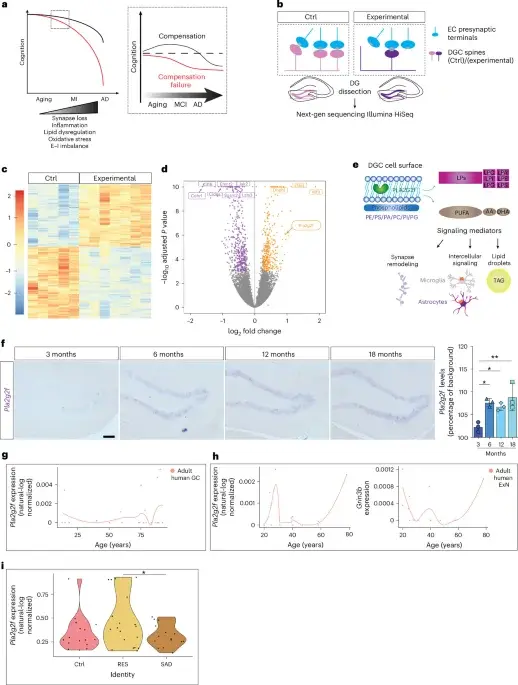
A new study in Nature Neuroscience identifies the secreted phospholipase PLA2G2F as a critical compensatory mechanism that protects memory during aging. The enzyme, produced by hippocampal neurons, reduces lipid accumulation and inflammation in glial cells, thereby preserving cognitive function even in the presence of Alzheimer's pathology.
Key points
- Researchers identified PLA2G2F as an aging-sensitive enzyme that increases in dentate granule cells as synapses are lost.
- Deletion of PLA2G2F in mice exacerbates synapse loss, inflammatory microglia, and memory deficits.
- Boosting PLA2G2F expression in aged mice reverses these pathologies and preserves hippocampal-dependent memory.
- The enzyme works by mobilizing lipid droplets and reducing cholesterol ester loads in microglia.
- Human data shows higher PLA2G2F expression in cognitively resilient individuals despite Alzheimer's histopathology.
Background
This finding aligns with recent research on cognitive reserve, such as the September 2026 study on language learning, which suggests that compensatory mechanisms can stave off decline. It also complements the October 2026 lifespan atlas of the prefrontal cortex, which mapped gene shifts from resilience to vulnerability, providing a broader framework for understanding non-linear brain aging.
How outlets are covering it
The primary source, Nature Neuroscience, emphasizes the mechanistic role of PLA2G2F in lipid homeostasis and its function as a 'broadcast signal' between neurons and glia. The secondary source, Bioengineer.org, highlights the therapeutic potential, noting that the authors have filed a patent for vectors to treat neurodegeneration. While both agree on the enzyme's protective role, the primary source focuses on the rigorous causal evidence from mouse models and human single-nucleus RNA sequencing, whereas the secondary source frames the discovery as a 'secret weapon' against memory decline, emphasizing the shift from fighting damage to strengthening the brain's own counteroffensive.
Why it matters
This research offers a new target for preventing cognitive decline by enhancing endogenous protective mechanisms rather than solely focusing on clearing amyloid plaques. It suggests that boosting this specific lipid-hydrolyzing enzyme in midlife could prophylactically alter the trajectory of cognitive decline, potentially reducing the risk of mild cognitive impairment and Alzheimer's disease.
What to watch
Researchers will need larger human cohorts to confirm the link between PLA2G2F expression and cognitive status. Additionally, further studies are required to resolve which specific cell types harbor lipid changes in vivo and to develop therapeutic vectors that can safely amplify this protective signal in humans.
- An aging-sensitive secreted phospholipase confers neuroprotection and cognitive resilience Nature
- Brain-protective molecule may help preserve memory during aging Medical Xpress
- A Hidden Brain Enzyme Emerges as the Secret Weapon Against Memory Decline in Aging Bioengineer.org
- Stem Cell Enzyme PLA2G7 Emerges as a Driver of Age-Related Memory Decline Bioengineer.org
- Suppressing neural stem cell PLA2G7 restores inhibitory circuit function and improves cognition in aging mice Nature
Want the full story? Read the original reporting
Read on Nature