
New Glucose-Powered Implant Targets Diabetes via Neuroimmune Axis
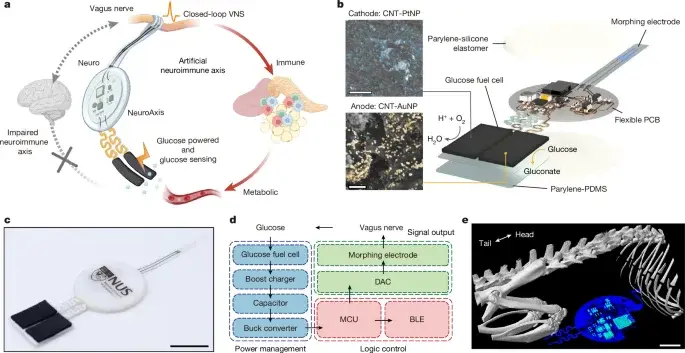
Researchers have developed a battery-free implant that uses endogenous glucose to power a closed-loop system for managing metabolic disorders. By mimicking the vagus nerve, the device reduces inflammation and improves insulin sensitivity in animal models.
Key points
- A new device called NeuroAxis, developed by researchers at the National University of Singapore, operates solely on endogenous glucose without batteries or wireless power.
- The implant emulates the vagal reflex to modulate the immune system, targeting the neuroimmune axis to address chronic inflammation associated with diabetes.
- In rat models of type 1 diabetes, the device promoted the recovery of insulin-producing beta cells, while in type 2 diabetes models, it reduced systemic inflammation and improved glucose tolerance.
- Therapeutic effects persisted even after treatment cessation, suggesting potential for long-term metabolic homeostasis restoration.
- The technology represents a shift from pharmacological interventions to autonomous, self-powered biological regulation.
Background
Recent coverage has highlighted the growing focus on lifestyle factors, such as evening exercise and post-meal walks, for managing glucose levels. Experts have also cautioned against obsessing over minor blood sugar spikes in healthy individuals, emphasizing that normal fluctuations are physiological. This new development contrasts with those lifestyle-based approaches by offering a technological, closed-loop solution for severe metabolic imbalances.
How outlets are covering it
The primary source, Nature, highlights the NeuroAxis device, which is powered by glucose and targets the neuroimmune axis to treat both type 1 and type 2 diabetes in rats. Secondary sources, including Medscape and The Stute, discuss a different device called ECHO, developed by ETH Zurich, which uses electrocatalysis to convert glucose into gluconate. While both aim to lower blood sugar, NeuroAxis focuses on immune modulation and beta-cell recovery, whereas ECHO focuses on direct glucose removal via catalysis. Experts noted in secondary sources caution that human trials are pending and that long-term safety and scalability remain unknown.
Why it matters
This research offers a potential alternative to traditional insulin therapy and medication for diabetes management. By leveraging the body's own glucose as power, the device could reduce the burden of daily injections and improve long-term metabolic health through immune regulation rather than just glucose reduction.
What to watch
Further research is needed to test the NeuroAxis device in human subjects. Researchers will need to validate the long-term safety, efficacy, and scalability of the closed-loop neuromodulation system in diverse patient populations.
- A glucose-powered artificial neuroimmune axis for metabolic control Nature
- An Electrocatalytic Implant Lowers Glucose in Mice Medscape
- Shock to the system: new implant uses electricity to lower blood sugar The Stute
- Implantable device controls blood sugar levels: Tested on mice, human trials yet to begin; doctors say it c... Bhaskar English
Want the full story? Read the original reporting
Read on Nature