
Nature and Shanghai Jiao Tong Launch Probes After Gene-Editing Trial Death
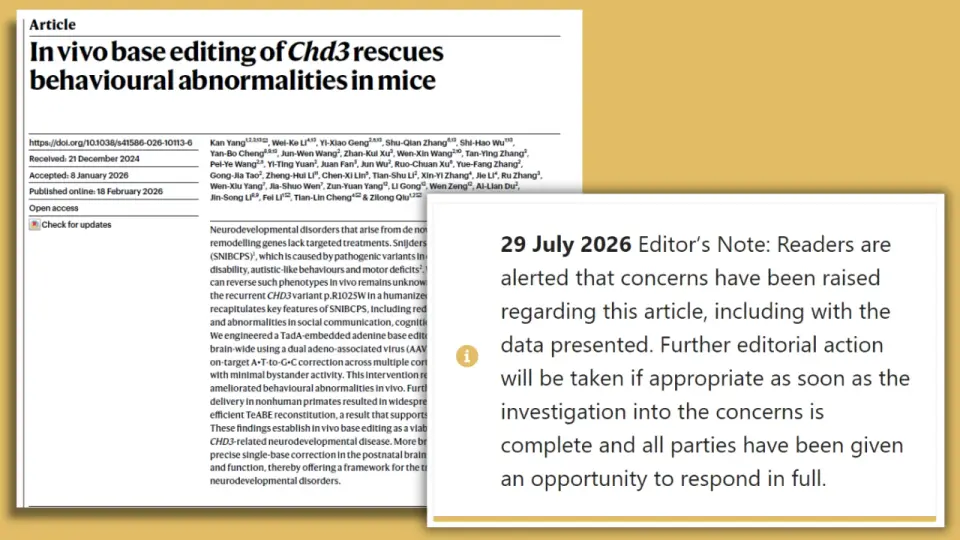
Nature and Shanghai Jiao Tong University have launched investigations into a 2025 gene-editing trial that resulted in the death of a six-year-old girl. The trial, led by neuroscientist Zilong Qiu, was partially funded by the patient's family for $860,000. A related paper published in Nature omitted details about the human trial and the patient's death, prompting an editor's note and institutional review.
Key points
- Nature placed an editor's note on a February 2026 paper by Zilong Qiu, stating concerns were raised regarding the data and that no human trial information was shared with the journal.
- Shanghai Jiao Tong University School of Medicine established a special task force to conduct a comprehensive investigation into the incident at its affiliated Xinhua Hospital.
- The patient, a six-year-old girl with Snijders Blok-Campeau syndrome, died in March 2025 from a severe immune reaction seven days after receiving the experimental base-editing therapy.
- The patient's parents funded the preclinical work for $860,000, a contribution and the subsequent death were not disclosed in the published paper, despite a preprint thanking the family.
- The hospital's ethics board concluded the death was definitely related to the treatment, but penalties were minor, including a $3,600 fine for the hospital and verbal counseling for a lead doctor.
- The trial occurred under China's investigator-initiated trial framework, which allows for less oversight than traditional approval pathways, raising concerns about regulatory gaps in the booming biotech sector.
Background
This incident follows the 2018 He Jiankui gene-edited babies scandal, which led to increased scrutiny of ethical standards in Chinese biomedical research. Recent regulatory updates in May 2026 aimed to centralize oversight of advanced therapies, but experts note the trial took place before these safeguards were fully implemented. The case highlights tensions between accelerating medical innovation and ensuring patient safety in China's rapidly expanding biotechnology sector.
How outlets are covering it
Retraction Watch and Science emphasized the failure to disclose the patient's death and family funding in the Nature paper, leading to the journal's investigation. CNN highlighted the broader regulatory context, noting that China's dual-track system for investigator-initiated trials may have allowed the trial to proceed with insufficient oversight. Le Monde focused on the ethical violations, noting the condition was non-lethal and the therapy involved significant financial investment by the family. Experts like Joy Zhang and Yanzhong Huang criticized the case as indicative of persistent gaps in transparency and accountability, contrasting it with the He Jiankui scandal by noting the involvement of established scientists at a prestigious institution.
Why it matters
The case underscores ongoing challenges in regulating experimental gene therapies, particularly in jurisdictions with less stringent oversight for investigator-initiated trials. It raises questions about the ethical responsibilities of researchers and institutions in disclosing adverse outcomes and funding sources, and may influence future regulatory frameworks in China and globally.
What to watch
Nature and Shanghai Jiao Tong University are expected to complete their investigations and take appropriate editorial and institutional actions. The case may lead to further tightening of regulations for investigator-initiated trials in China, though there are concerns that such measures could stifle scientific innovation. The outcome of the investigations will likely influence public trust in gene-editing therapies and the integrity of scientific publishing.
- Journal, university investigations launched into gene-editing death following Science-Retraction Watch reporting Retraction Watch
- Girl’s undisclosed death in gene-editing trial raises red flags in booming Chinese industry CNN
- In China, the hidden death of 'Mei', a 6-year-old girl, after gene therapy raises many questions Le Monde.fr
- Chinese scientist faces probe after girl dies ‘after experimental gene therapy’ South China Morning Post
- Scandal Exposes Limits of China’s Scientific Rise Foreign Policy
Want the full story? Read the original reporting
Read on Retraction Watch