
AI reveals predictable rules governing glioblastoma cell state switching
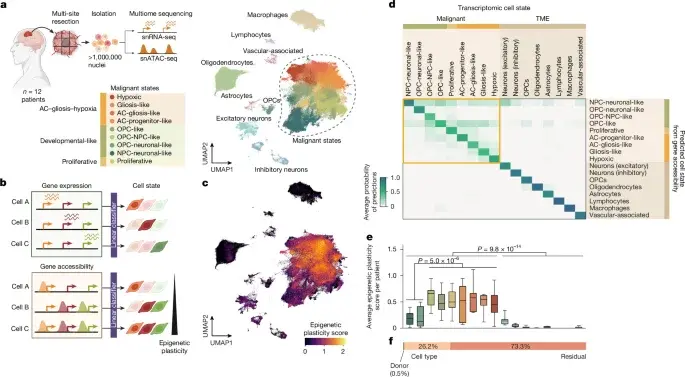
Researchers have identified a structured, predictable regulatory framework governing the cellular plasticity of glioblastoma, the deadliest adult brain tumor. By analyzing over one million cells from 12 patients, the team developed a deep-learning tool called scDORI to map how tumor cells switch between states. They discovered that low-plasticity states, such as neuronal-like identities, are actively maintained by repressors like MYT1L, which suppress alternative malignant fates. Enhancing this repressor reduces tumor growth and invasion in mice, suggesting new therapeutic strategies to lock cancer cells into less aggressive states.
Key points
- A deep-learning framework named scDORI was used to infer enhancer-driven gene-regulatory networks at single-cell resolution from over one million glioblastoma cells.
- Glioblastoma cell state transitions are not random but follow a hierarchical, predictable landscape governed by an asymmetric interplay of activators and repressors.
- The transcription factor MYT1L acts as a 'safeguard repressor' that stabilizes low-plasticity neuronal-like states by silencing alternative malignant fates.
- Overexpression of MYT1L in patient-derived cells restricted plasticity and suppressed tumor growth and invasion in mouse models, even under standard therapy.
- Loss of MYT1L reactivated plasticity and accelerated malignant features, indicating that low-plasticity identity requires continuous active repression.
Background
Glioblastoma has long been considered incurable due to its genomic stability under treatment and high cellular heterogeneity. Previous studies suggested that non-genetic mechanisms, such as epigenetic plasticity, drive therapy resistance, but the specific regulatory rules governing these state transitions remained unclear. This study builds on earlier single-cell transcriptomic findings that glioblastoma cells occupy a continuum of developmental-like states, now providing a mechanistic roadmap for these transitions.
How outlets are covering it
While all sources agree on the core finding that glioblastoma plasticity is governed by predictable rules rather than random switching, they emphasize different aspects. The primary source (Nature) focuses on the technical development of the scDORI deep-learning framework and the specific molecular mechanism of MYT1L as a safeguard repressor. News-Medical highlights the collaborative effort between EMBL, DKFZ, and the Wellcome Sanger Institute, and the use of spatial transcriptomics to map the tumor's architecture. Cancer Research UK emphasizes the clinical implications, noting that understanding these predictable paths could lead to therapies that target multiple aspects of the disease simultaneously. DKFZ press releases highlight the potential of MYT1L as a 'molecular brake' and note its relevance to autism spectrum disorders, though the cancer study focuses on its role in tumor plasticity.
Why it matters
This research reframes glioblastoma progression from a chaotic process to a structured, predictable one. By identifying specific repressors like MYT1L that maintain low-plasticity states, the study offers a new therapeutic target: instead of just killing cancer cells, treatments could aim to lock them into less aggressive, less adaptable states. This approach could potentially overcome therapy resistance and improve patient outcomes for one of the most challenging cancers to treat.
What to watch
Researchers are now applying the scDORI framework and the identified regulatory networks to other cancers and brain disorders. Further preclinical studies are needed to validate the therapeutic potential of targeting safeguard repressors like MYT1L. The full dataset, known as the GBM-Space atlas, has been made freely available for the global research community to build upon these findings and develop new treatment strategies.
- Decoding the regulatory programs governing glioblastoma plasticity Nature
- Deep learning method maps spatial architecture of brain cancer cells News-Medical
- Scientists uncover the hidden rules behind glioblastoma Cancer Research UK - Cancer News
- Molecular guardian inhibits aggressive brain tumor's ability to switch between identities Deutsches Krebsforschungszentrum
- Multiomic Human Glioblastoma Cell Atlas Could Act as Compass to Guide Future Treatment Approaches Genetic Engineering and Biotechnology News
Want the full story? Read the original reporting
Read on Nature