
Anesthesia's Neural Signature Persists Across Evolution and in Lab-Grown Brain Models
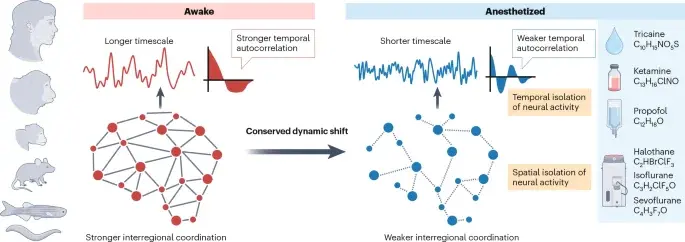
New research reveals that the neural dynamics of anesthesia are conserved across hundreds of millions of years of evolution and can be replicated in human stem cell-derived brain models. While a landmark study by Luppi and colleagues identifies a universal dynamic signature of unconsciousness, UCLA researchers demonstrate that minimal cortical circuits in lab-grown assembloids reproduce the slow brain waves of anesthesia without requiring deep brain structures like the thalamus.
Key points
- A study by Luppi and colleagues identifies a conserved dynamic signature of anesthesia that spans hundreds of millions of years of evolution, suggesting common neural changes during transitions between wakefulness and anesthesia across species.
- UCLA researchers demonstrated that human stem cell-derived brain assembloids can reproduce the electrical hallmarks of general anesthesia, including slow, sweeping brain waves, when exposed to the anesthetic propofol.
- The UCLA study found that a minimal circuit of human cortical neurons is sufficient to produce anesthesia-like electrical changes, challenging the long-held belief that deeper brain structures, such as the thalamus, are required for these effects.
- Researchers noted that while individual neurons become less active under anesthesia, the overall brain waves become larger due to synchronized activity across the network, a phenomenon described as counterintuitive but defining of the anesthetized state.
- These findings provide a controllable human system for studying how anesthesia reshapes brain electrical rhythms and may help investigate other disorders that alter brain dynamics, such as traumatic brain injury and epilepsy.
Background
This development builds on previous research into neural dynamics and consciousness, such as studies on cross-area consensus in visual processing and the reclassification of species based on genetic analysis. The current findings address longstanding questions about the mechanisms of unconsciousness, moving beyond animal models to human-derived systems and evolutionary comparisons.
How outlets are covering it
Nature highlights the evolutionary conservation of anesthesia dynamics, emphasizing a universal neural signature across species. In contrast, Mirage News focuses on the utility of human brain assembloids, noting that these lab-grown models can replicate anesthesia effects without the complexity of whole animal brains or deep brain structures. Yahoo's content was inaccessible due to technical errors, so no perspective could be extracted from that source.
Why it matters
Understanding the conserved neural dynamics of anesthesia across species and in human models could lead to better anesthetic drugs, improved patient safety, and insights into other brain disorders that involve altered consciousness. It also provides a new platform for studying how specific genes and cell types shape coordinated brain activity.
What to watch
Researchers plan to use brain assembloids to investigate how specific genes, cell types, and signaling pathways shape coordinated brain activity, potentially leading to new treatments for disorders like epilepsy and traumatic brain injury. Further studies may explore why patients differ in their sensitivity to anesthesia, including rare cases of unintentional awareness during surgery.
- Conserved neural dynamics of anesthesia and the oblivion of species nature.com
- Comprehensive profiling of brain dynamics during anesthesia across phylogeny nature.com
- Stem Cell Brain Models Shed Light on How Anesthesia Works Mirage News
- What Happens to Your Brain During Anesthesia? Scientists Are Still Searching for Answers Yahoo
Want the full story? Read the original reporting
Read on nature.com