
Cross-cell testing reveals BRCA1 variants with intermediate cancer risk
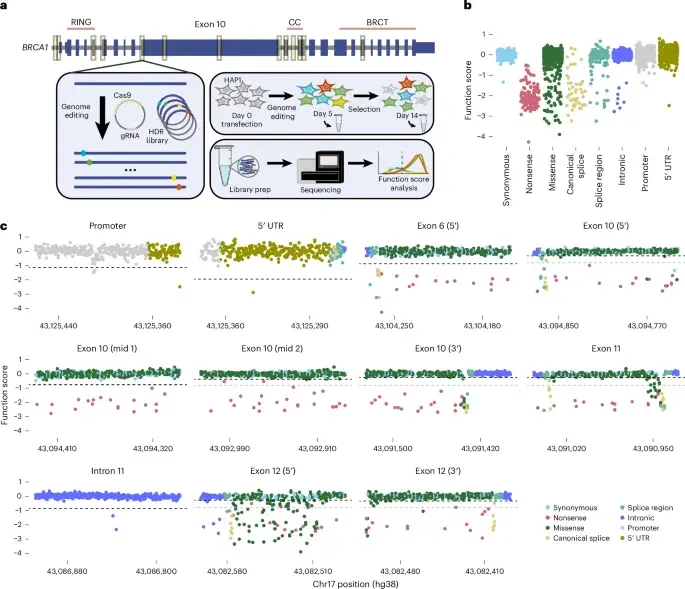
Researchers at the Francis Crick Institute used saturation genome editing to test over 4,000 BRCA1 variants in two different cell types. They found that nearly half of variants damaging in one cell line were neutral in human mammary cells, indicating these 'discordant' variants likely confer intermediate, rather than high, cancer risk. This approach helps resolve the clinical status of thousands of variants of uncertain significance.
Key points
- The study tested 4,113 BRCA1 variants in HAP1 cells and 2,157 in human mammary epithelial cells (HMECs).
- 538 variants were identified as impacting gene function, but nearly half of those damaging in HAP1 cells were neutral in HMECs.
- Variants that were damaging in both cell types were associated with a high breast cancer risk (odds ratio of 12.97).
- Variants damaging only in HAP1 cells were associated with an intermediate risk (odds ratio of 3.28).
- The discrepancy is explained by 'functional redundancy,' where other proteins like RNF168 compensate for BRCA1 defects in mammary cells.
Background
This research builds on the growing need to resolve 'variants of uncertain significance' (VUS) in BRCA1, where over half of reported single-nucleotide variants lack a definitive clinical interpretation. It follows recent advancements in cell-specific genomic prediction, such as DeepMind's AlphaGenome 2, which aims to predict variant effects across specific cell types rather than broad tissue averages. The study also complements broader efforts to map disease signals to cell-specific regulation, as seen in recent muscle genome mapping projects.
How outlets are covering it
The primary source, Nature, provides the detailed technical findings from the Francis Crick Institute, emphasizing the statistical discrimination of risk classes. Secondary sources from Bioengineer.org and Scienmag highlight the clinical implications, noting that this method could move genetic counseling beyond binary 'pathogenic/benign' labels to precise risk estimates. In contrast, a separate study reported by Oncodaily and Medical Xpress, led by the Institute of Cancer Research, focused on a different approach using massively parallel reporter assays to identify 709 regulatory variants in non-coding regions, specifically implicating the gene CCDC88C in ER-positive breast cancer. While both studies aim to clarify inherited breast cancer risk, the Crick Institute study focuses on BRCA1 coding variants across cell types, whereas the ICR study focuses on regulatory variants in a single cell line.
Why it matters
This research provides a new framework for interpreting genetic test results. By identifying variants that confer intermediate risk, clinicians can offer more tailored monitoring and preventive strategies, rather than leaving patients in uncertainty. It also highlights the importance of testing variants in disease-relevant cell types to avoid over- or under-estimating cancer risk.
What to watch
Researchers plan to develop frameworks that leverage functional data from multiple cell lines to inform both pathogenicity and disease risk. Future studies will likely focus on applying this cross-cell testing approach to other cancer susceptibility genes and integrating these functional scores with population data to refine clinical guidelines.
- Saturation genome editing of BRCA1 across cell types improves interpretation of variant pathogenicity Nature
- Testing BRCA1 variants reveals differences in breast cancer risk Medical Xpress
- Can Studying Genetic Variants Offer New Insights Into Inherited Breast Cancer Risk? – ICR Oncodaily
- Testing BRCA1 Variants Across Cell Types Clarifies Breast Cancer Risk Differences Bioengineer.org
- Scientists pinpoint hundreds of genetic variants that offer new insights into inherited breast cancer risk Medical Xpress
Want the full story? Read the original reporting
Read on Nature