
New Study Suggests Superionic Hydrogen Shapes Earth's Inner Core Structure
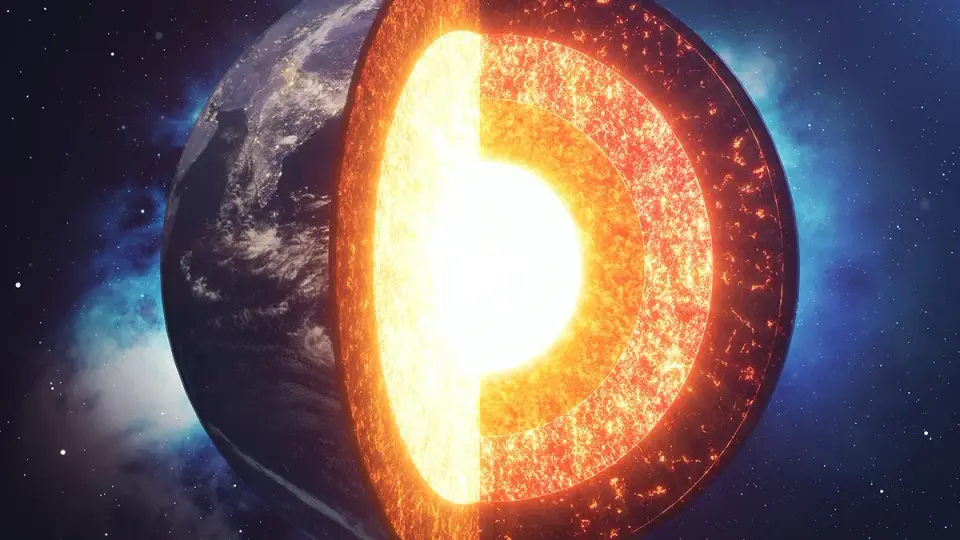
A new study published in the Proceedings of the National Academy of Sciences proposes that Earth's inner core contains abundant superionic hydrogen, a state where hydrogen flows like a liquid through crystalline iron. Researchers modeled two iron-hydrogen alloy structures, finding that the hexagonal close-packed (HCP) phase is thermodynamically more stable than the body-centered cubic (BCC) phase under core conditions. This distribution creates a radial concentration gradient, driving hydrogen exchange between the inner and outer cores. This process may contribute to chemical buoyancy, which helps power the geodynamo responsible for Earth's magnetic field. The findings suggest that temperature, rather than pressure, primarily controls the partitioning of hydrogen in the deep Earth.
Key points
- Researchers modeled superionic hydrogen, a state where hydrogen flows like a liquid while conducting electricity, within Earth's core.
- The study compared two iron-hydrogen alloy structures: hexagonal close-packed (HCP) and body-centered cubic (BCC).
- The HCP phase was found to be more thermodynamically stable than the BCC phase under typical inner core conditions.
- A radial concentration gradient exists, with hydrogen content dropping sharply toward the center of the inner core.
- This gradient drives a continuous redistribution of superionic hydrogen, facilitating exchange between the inner and outer cores.
- The movement of hydrogen may contribute to chemical buoyancy, an energy source believed to drive the geodynamo.
Background
Previous coverage has established that Earth's inner core is a solid iron-rich sphere growing by approximately one millimeter per year as the planet cools. Earlier studies also identified a hidden innermost core with different crystal orientations and noted that the inner core's rotation has slowed and drifted backward in a 70-year seismic rhythm. These findings highlight the dynamic and complex nature of Earth's deep interior, which remains inaccessible to direct sampling.
Why it matters
Understanding the distribution of light elements like hydrogen in Earth's core is crucial for explaining the planet's magnetic field and internal dynamics. If superionic hydrogen drives chemical buoyancy, it provides a new mechanism for sustaining the geodynamo, which protects life on Earth from solar radiation. This research also suggests that similar thermodynamic principles may apply to other light elements, influencing the overall composition and evolution of planetary cores.
What to watch
Future research will need to account for other light elements, such as oxygen and carbon, which are strongly liquid-preferring, to better understand density fluctuations and material differences in the inner core. Scientists will continue to refine models of core dynamics and test the implications of hydrogen redistribution on the geodynamo.
Want the full story? Read the original reporting
Read on ScienceAlert